
Body Recomposition Macros: How to Set Yours and Track Them
Set protein, carbs and fat for losing fat and building muscle at the same time, with worked examples, ratio answers and a simple way to track and adjust.
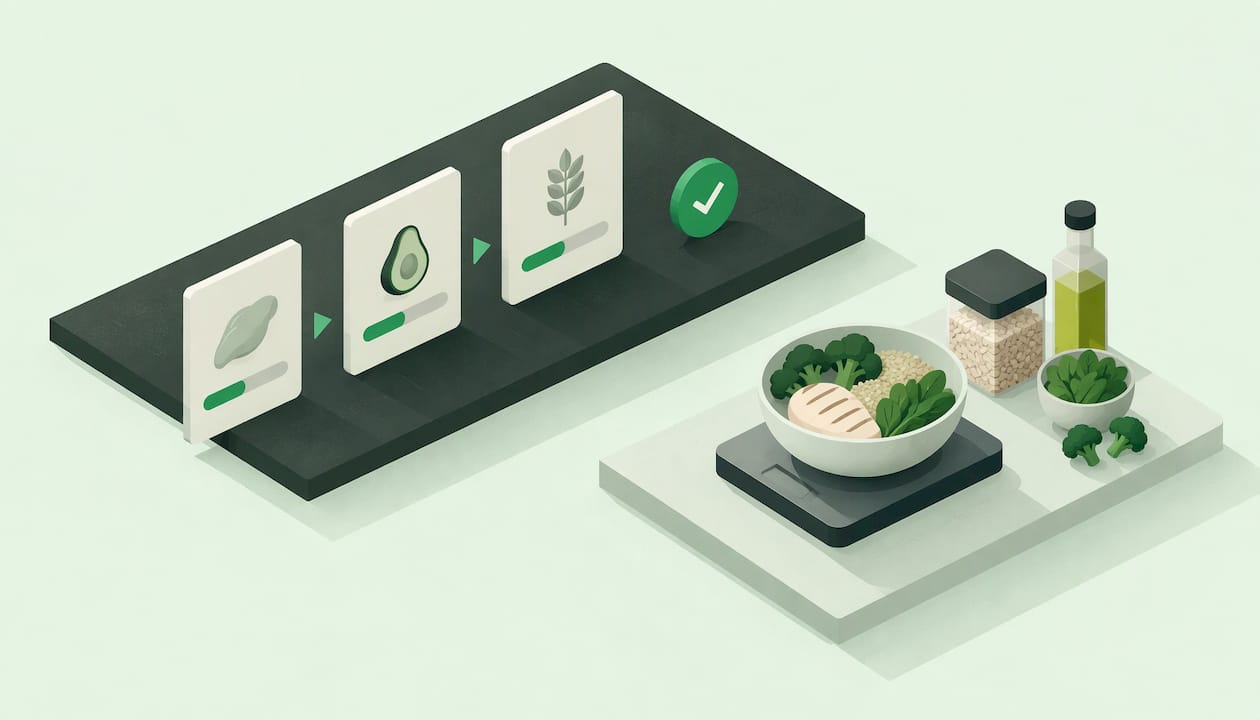
For body recomposition, set protein first, at roughly 1.6 to 2.4 grams per kilogram of body weight per day. Then keep calories near maintenance, or slightly below if fat loss is the bigger goal. Fill the rest with carbohydrate and fat, based on how you train and what you enjoy eating. The exact ratio matters less than hitting your protein, staying consistent and adjusting from real results.
This guide shows you how to turn that into numbers. It covers how to calculate your own macros, what the popular 35-35-30 and 40-40-20 splits mean, which foods make the targets easy, and how to track and adjust without turning it into a second job.
TL;DR
- Protein is the anchor. Research reviews commonly land between 1.6 and 2.4 g/kg/day, split across several meals.
- Calories decide the direction: a deficit favors fat loss, a surplus favors muscle gain. Recomposition sits near maintenance, so small, steady adjustments work better than big swings.
- Carbs and fat are flexible. Once calories and protein are matched, many different splits work similarly well.
- Weigh in regularly, use weekly averages, and watch strength, waist and recovery, because recomp changes often do not show on the scale.
- Accurate logging matters more than a perfect ratio. Tracking with visible assumptions makes it easier to trust your numbers.
Table of Contents
- What body recomposition actually asks of your diet
- Step 1: Set your protein
- Step 2: Choose your calories
- Step 3: Fill in fat and carbs
- What about 35-35-30 and 40-40-20?
- Fat loss and muscle gain: how the targets differ
- Foods that make the numbers easy
- Tracking: where most people lose accuracy
- Perspective
- Reading your progress without the scale lying to you
- Putting it together: a week in practice
- Track your macros with VeriTrack
- FAQ
- Sources
What body recomposition actually asks of your diet
Body recomposition means reducing body fat while maintaining or increasing lean mass at the same time. A 2024 editorial on the topic is not needed to see the tension: fat loss fundamentally needs a sustained calorie deficit, while diets aimed mainly at gaining lean mass are generally optimized by a sustained surplus, according to the ISSN position stand on diets and body composition.
So recomposition is a balancing act. You hold calories close to maintenance, or a modest deficit, and rely on three things to protect and build muscle:
- High enough protein, spread through the day
- Resistance training with progressive overload
- Enough carbohydrate and fat to train well and recover
That is why the macro conversation here is different from a pure cut or a pure bulk. Protein stays high in both. Calories move a little. Carbs and fat fill the space.
It also explains why the scale can sit still while your body changes. If you lose a little fat and gain a little muscle, your weight may barely move. We come back to how to read that later.
Step 1: Set your protein
Protein is the macro with the strongest evidence behind it for recomposition, so start there.
A 2025 Sports Medicine scoping review of 73 documents endorsed by 14 organizations reports commonly recommended protein intakes of 1.6 to 2.4 g/kg/day, distributed across 4 to 6 feeds. The ISSN protein position stand says 1.4 to 2.0 g/kg/day is sufficient for most exercising people building or maintaining muscle, and that higher intakes may be useful during energy restriction.
For lean, resistance-trained people eating in a deficit, the ISSN diets and body composition position stand notes that approximately 2.3 to 3.1 g/kg of fat-free mass may help maximize muscle retention.
Here is how that translates into a practical rule:
| Your situation | Protein starting point |
|---|---|
| Newer to lifting, near maintenance calories | 1.6 to 2.0 g/kg/day |
| Regular lifter, modest deficit | 2.0 to 2.4 g/kg/day |
| Lean and training hard in a deficit | Toward the higher end of the research range, ideally guided by a sports dietitian |
If you think in pounds, multiply your body weight in pounds by 0.7 to 1.1 for the same range. A 165 lb person lands at roughly 115 to 180 g.
How to spread it across the day
The ISSN suggests protein servings roughly every 3 to 4 hours, with a general recommendation of 0.25 g per kg of body weight per serving, or an absolute 20 to 40 g. A 2021 review on fat loss in resistance-trained people recommends spreading protein over 3 to 6 meals at about 0.40 to 0.55 g/kg per meal, with a protein feeding within 2 to 3 hours before and after resistance training.
In plain terms: three to five protein-rich meals or snacks, each with a real serving of protein, beats one huge dinner.
Step 2: Choose your calories
Calories set the direction. There is no single right number, so pick a sensible starting point and let your results correct it.
- Fat loss is the priority: start slightly below maintenance. The 2021 fat loss review recommends losing 0.5 to 1.0% of body weight per week during a loss phase, which for a 165 lb person is about 0.8 to 1.65 lb.
- Muscle is the priority: start at maintenance and add a small surplus only if progress stalls.
- True recomposition: hold maintenance, train hard, keep protein high and watch the trend.
Your maintenance estimate comes from a calculator that uses your body size and activity level. Treat it as a first guess. Two to three weeks of consistent logging and weigh-ins will tell you whether it is right.
If you do not want to estimate by hand, VeriTrack builds a daily nutrition target from your body and activity level, so you start with a number instead of a guess.
Step 3: Fill in fat and carbs
Once protein and calories are set, the remaining calories go to carbohydrate and fat.
Fat. The 2020 review of nutritional recommendations for physique athletes recommends fat at 10 to 25% of calories and cautions against very low fat intake for prolonged periods. The 2021 fat loss review suggests 20 to 30% of daily energy from fat, or at least 0.5 g/kg/day when that is not possible.
Carbohydrate. The same physique review suggests around 2 to 5 g/kg/day for physique athletes. The broader 2025 scoping review describes carbohydrate being periodized to training demand, across a much wider reviewed range of roughly 3 to 12 g/kg/day, which includes endurance-focused guidance. For most people lifting three to five times a week, the lower to middle part of that picture is the relevant one. Eat more on hard training days if you like, and less on rest days.
The calorie math in four steps
Protein and carbohydrate provide 4 kcal per gram. Fat provides 9. Fit&Well’s macro guide recommends calculating protein first, converting it to calories, then dividing what remains between carbs and fat.
Its example: a 75 kg athlete eating 2 g/kg of protein gets 150 g, or 600 kcal. With an 1,800 kcal target, splitting the remaining 1,200 kcal equally gives 150 g of carbohydrate and about 67 g of fat.
Here is a second example of our own, for a 75 kg person aiming at a maintenance-level recomp of 2,300 kcal (an illustration, not a prescription):
- Protein: 2.2 g/kg x 75 kg = 165 g, which is 660 kcal.
- Fat: 25% of 2,300 kcal = 575 kcal, which is about 64 g.
- Carbohydrate: 2,300 - 660 - 575 = 1,065 kcal, which is about 266 g.
- Resulting split: roughly 29% protein, 46% carbs, 25% fat.
The percentages are an outcome of the grams, not the starting point. That is the biggest shift in thinking for most people: set grams, then read the ratio afterward.
What about 35-35-30 and 40-40-20?
These are the splits people search for most, and they are both reasonable starting templates. Neither is a magic ratio.
The ISSN position stand concludes that low-carb and ketogenic diets have not shown a clinically meaningful fat-loss advantage over higher-carb diets when calories and protein are matched, so carbohydrate and fat proportions can be individualized. It also supports a wide range of dietary approaches as similarly effective for body composition.
That gives you a simple way to judge any ratio. Convert it to grams and check your protein.
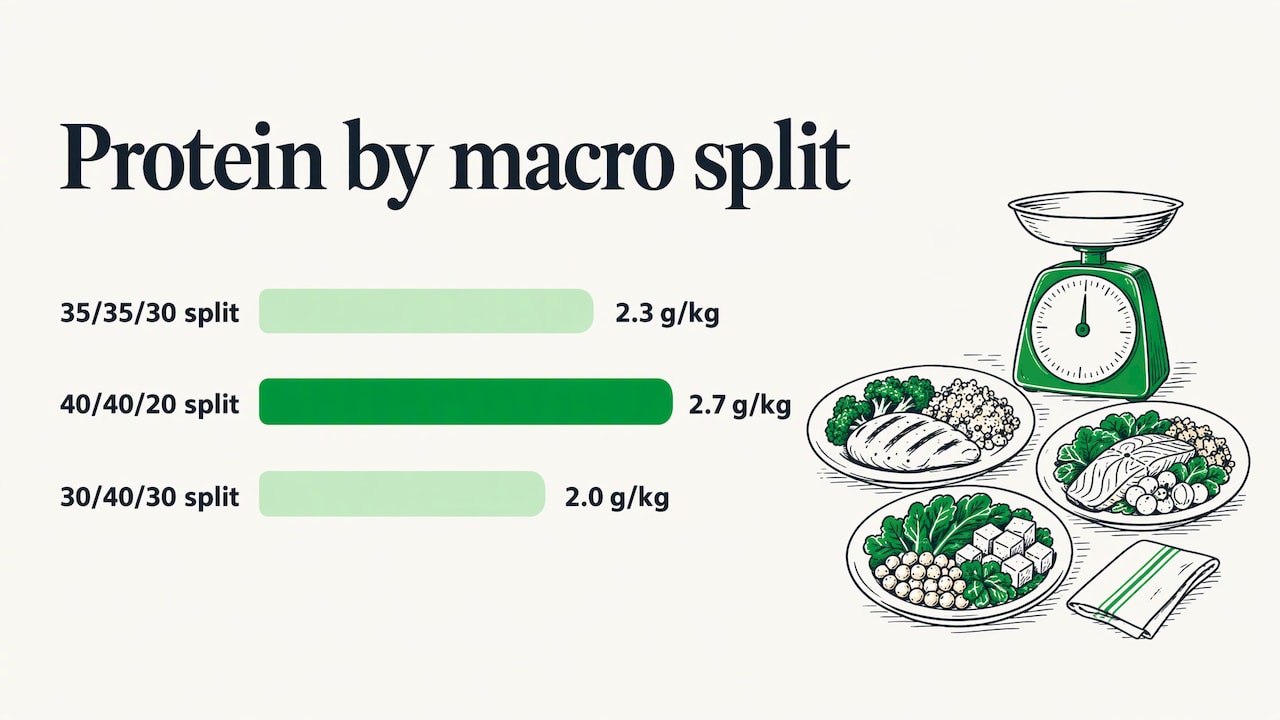
| Split (protein / carbs / fat) | At 2,000 kcal | Protein per kg at 75 kg |
|---|---|---|
| 35 / 35 / 30 | 175 g / 175 g / about 67 g | about 2.3 g/kg |
| 40 / 40 / 20 | 200 g / 200 g / about 44 g | about 2.7 g/kg |
| 30 / 40 / 30 | 150 g / 200 g / about 67 g | 2.0 g/kg |
All of that is arithmetic from the 4-4-9 rule above.
35-35-30 lands inside the commonly cited protein range for a 75 kg person at 2,000 kcal, leaves room for a fat intake in the commonly recommended zone, and keeps carbs high enough for training. It suits many people who lift and want a bit of a deficit.
40-40-20 pushes protein to the upper edge of the research range and keeps fat lower. Some people like it because protein is filling. Watch your fat grams so they do not fall too low for long stretches, since the physique athlete review cautions against prolonged very low fat intake.
The pattern to notice: as calories change, the same percentage gives a different number of grams. A fixed percentage of a small calorie budget may give less protein than you need. Anchoring to grams per kilogram avoids that problem.
Fat loss and muscle gain: how the targets differ
People often ask whether macros for losing fat and gaining muscle at once differ from macros for building muscle alone. The answer is mostly in calories, with small shifts in everything else.
| Fat loss with muscle retention | Recomposition | Muscle gain focus | |
|---|---|---|---|
| Calories | Modest deficit | Near maintenance | Maintenance to small surplus |
| Protein | Upper part of the range | Mid to upper part | 1.6 to 2.2 g/kg is typical |
| Carbs | Enough to fuel training | Periodized to training | More room on training days |
| Fat | 20 to 30% of calories, at least 0.5 g/kg | Similar | Similar |
Protein per serving and per day barely changes across the three. What changes is how much energy sits around it.
If your goal is mostly muscle and you would rather avoid a classic bulk, a practical approach is to start at maintenance for a few weeks, then add a small surplus of about 100 to 200 calories per day only if strength stalls. That keeps weight gain slow and makes it easy to see what is working.
Foods that make the numbers easy
Hitting protein is far easier when your plate is built around it. The 2021 fat loss review and the ISSN stand point to the same kinds of foods:
- Protein: chicken, lean beef or turkey, eggs, Greek yogurt, cottage cheese, fish, tofu or tempeh
- Carbohydrate: rice, oats, potatoes, pasta, fruit, whole-grain bread
- Fat: olive oil, avocado, nuts, seeds
Simple meal patterns that work:
- High-protein oats with berries
- Chicken-and-rice bowls with vegetables
- Greek yogurt bowls with fruit and nuts
- Tofu stir-fry with rice
- Lean protein with potatoes and a side of greens
The ISSN notes that active people can get protein from whole foods, and that protein supplements can be a practical way to hit quantity and quality for relatively few calories. It also recommends prioritizing protein sources that contain all the essential amino acids. If you eat plant-based, combining sources such as tofu, tempeh and legumes across the day helps.
For ideas that fit a macro target, browse our food and recipes section.
Tracking: where most people lose accuracy
The plan is only as good as the data behind it. Most recomp plans stall for one reason: the logged numbers do not match what was eaten.
A splash of oil, a handful of nuts and a second helping all disappear from memory. Over a week, those small gaps can erase a deficit or hide a surplus. And portion size, not the food choice itself, is usually where the error comes from.
A few habits close the gap:
- Log as you eat, not at the end of the day.
- Weigh or measure the foods that are dense in calories, such as oils, nut butters, rice and pasta.
- Use a trusted database. USDA FoodData Central is the standard reference for U.S. foods.
- Do not aim for perfect. Consistent and roughly right beats perfect for three days and abandoned on day four. We wrote about this in why calorie tracking works even when you do not do it perfectly.
Perspective
We built VeriTrack around one belief: you can only adjust what you can see. Most macro plans fail quietly, not because the targets are wrong, but because the logged numbers drift away from the plate.
When you photograph a meal, our app estimates the portion and shows you the assumptions behind it, such as the food it recognized, the amount it estimated and the USDA data it used. On supported iPhones, LiDAR adds depth measurement to help with portion size. If something looks off, you correct it, and the entry reflects your correction.
For recomposition, that matters. Your protein target is specific, and your calorie target is tight. Knowing which parts of a log are solid and which are estimates helps you decide when to adjust and when to stay the course.
We also think tracking should feel light. Photo, typed or voice entry gets a meal logged in seconds, and gentle reminders keep you consistent without nagging.
Aliaksei
Reading your progress without the scale lying to you
Because recomposition can happen without big movements in body weight, one measurement is never enough. Use several, and look at trends rather than single days.
Weigh in often, then average. Daily weigh-ins are noisy. Compare weekly averages. A practical guide on recomposition macros suggests pairing them with waist measurements, training performance, recovery and sleep.
Track strength. If your main lifts are climbing while your waist is flat or shrinking, you are probably recomposing, even if the scale has not moved.
Give changes time. Hold a new target for at least two weeks, often three to four, before judging it.
When to adjust
Use a simple decision rule:
- Weight and waist flat, strength flat, for 2 to 4 weeks: you are likely near maintenance with no extra stimulus. Lower calories by about 100 to 150 per day if fat loss is the goal, or add 100 to 200 if gaining is.
- Weight dropping faster than about 1 lb per week and training suffers: add 100 to 200 calories, mostly from carbohydrate.
- Strength rising, waist shrinking: change nothing.
- Big body weight change (about 10 lb or more): recalculate maintenance and rebuild your targets.
These are small, deliberate moves. Changing three things at once makes it impossible to know what worked.
Putting it together: a week in practice
Here is a sample day for the 75 kg example (about 2,300 kcal, 165 g protein), to show how the grams spread across meals.
| Meal | What | Protein (approx.) |
|---|---|---|
| Breakfast | Greek yogurt bowl with oats and berries | 35 g |
| Lunch | Chicken, rice and vegetables | 45 g |
| Snack | Cottage cheese with fruit | 25 g |
| Dinner | Tofu or salmon with potatoes and greens | 40 g |
| Evening | Whey or soy shake, or a high-protein snack | 20 g |
That is five protein feedings, each within the 20 to 40 g per-serving guidance, adding up near 165 g. On training days, move a bit more carbohydrate around the workout. On rest days, trim carbs slightly or keep them steady. Both work.
Track your macros with VeriTrack
If you want a simple way to log meals and see where your protein, carbs and fat land, VeriTrack is a calorie and macro tracker for iPhone. You can photograph a meal, type it or say it. VeriTrack Premium unlocks unlimited analyses, while the free tier includes a limited number of AI meal analyses per month.

You also get a daily target based on your body and activity level, a meal diary, progress tracking and read-only Apple Health integration. Because the app labels its assumptions, you can check and correct each entry. It is a practical fit for recomposition, where small errors add up. Start at veritrack.app.
FAQ
What is a good macro ratio for body recomposition?
There is no single best ratio. A common starting point is around 30 to 35% protein, 35 to 45% carbohydrate and 20 to 30% fat. Better still, set protein at 1.6 to 2.4 g/kg/day and let carbs and fat fill the rest, since research supports flexibility once calories and protein are matched.
Is 35-35-30 a good macro split?
Yes, for many people. At 2,000 kcal it gives about 175 g of protein, which fits the research range for someone near 75 kg, and enough fat and carbs to train and recover. Check the grams against your body weight rather than relying on the percentages alone.
Is 40-40-20 good for cutting?
It can work, as it gives a high protein intake and keeps carbs available for training. At 2,000 kcal it means about 200 g of protein and 44 g of fat. Make sure your fat grams stay in a sensible range, since reviews caution against very low fat intake for long periods.
How many calories should I eat to lose fat and build muscle?
Start near maintenance, or a modest deficit if fat loss matters more. Hold the number for two to four weeks while tracking weekly weight averages, strength and waist. Then adjust by about 100 to 150 calories at a time. A sports dietitian or physician can help if you have a medical condition or train at a high level.
Do I need to track macros forever?
No. Many people track closely for a few weeks to learn what their targets look like on a plate, then check in periodically. The aim is to build awareness and consistency, not to log every bite for life.
Sources
- Dietary Recommendations for Body Mass and Composition (Sports Medicine, 2025)
- Nutritional Recommendations for Physique Athletes (PMC, 2020)
- ISSN position stand: diets and body composition (2017)
- ISSN position stand: protein and exercise (2017)
- Achieving an Optimal Fat Loss Phase in Resistance-Trained Athletes (2021)
- How to calculate macros for weight loss (Fit&Well)