
Portion Control for Weight Loss: A Practical Guide
Learn how portion control supports weight loss, with hand and plate cues, measuring tips, and how food tracking helps you eat less without guessing.
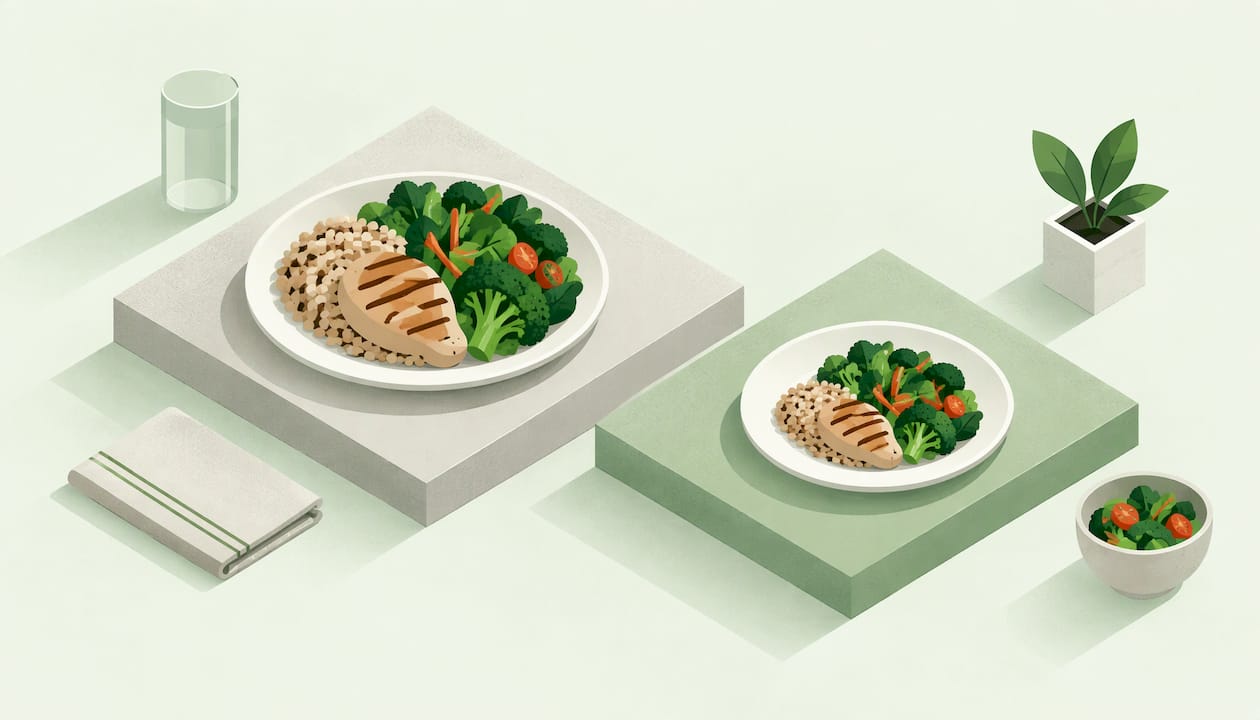
Portion control means choosing how much of a food you eat at one time, and it supports weight loss because smaller amounts mean fewer calories. You don’t need a perfect diet or a kitchen scale for life. You need a few reliable ways to judge amounts, a short stretch of measuring to calibrate your eye, and a simple way to keep track.
This guide covers what portions are, what the research says, the visual and hand cues that work, how accurate your eye really is, and how tracking helps you avoid overeating.
TL;DR
- A portion is what you choose to eat; a serving is the amount listed on a food label. They are often not the same.
- People tend to eat more when they are served more, so shrinking what lands on your plate is one of the easiest ways to cut calories.
- Hand cues, the plate method and smaller dishes work anywhere. Weighing food for a few weeks makes your estimates much better.
- Tracking what you eat, even imperfectly, helps you see where portions creep up and adjust.
Table of Contents
- What portion control actually means
- Why portion size changes how much you eat
- Can you lose weight with portion control alone?
- Visual cues you can use anywhere
- The plate method and a few simple habits
- Weigh and measure for a while, not forever
- How accurate is your eye, really?
- Tracking helps you reduce calorie intake and avoid overeating
- Our perspective on portions and tracking
- Make portion tracking easier with VeriTrack
- A simple one-week portion plan
- FAQ
- Sources
What portion control actually means
The words “portion” and “serving” get mixed up constantly, and the difference matters. The NIDDK defines a portion as the amount of food you choose to eat at one time, and a serving as the amount listed on a product’s Nutrition Facts label. A bag of chips may list a serving of about a handful, while the portion you eat may be the whole bag.
The label is a reference point, not a prescription. The same NIDDK page notes that a label’s serving size may be more or less than what you should eat, because your daily calorie needs depend on your age, weight, height, metabolism, sex and activity level.
So portion control is not about eating tiny meals or feeling deprived. It is about knowing roughly how much you are eating, and deciding on purpose whether that amount fits your goal.
Why portion size changes how much you eat
Most of us believe we eat until we are full. In practice, the amount in front of us shapes the amount we finish.
Mayo Clinic states that research has shown people almost always eat more food when offered larger portions. That is why it matters for both losing weight and keeping it off.
A 2022 systematic review and meta-analysis in the British Journal of Nutrition pooled studies of smaller versus larger served portions. It found a moderate-to-large reduction in daily energy intake with smaller portions, about 235 kcal, and less weight gain (0.58 kg) for people served smaller portions.
Visual cues matter too. A 2012 Cornell University study, cited by the Obesity Action Coalition, found that people ate 50 percent more when given no visual cues about what a portion should be. Give yourself a reference, and you eat closer to what you planned.
There is good news in this. You don’t need to rely on willpower at every bite. You can shape the environment: the plate size, the serving dish, the amount you put down before you start.
Can you lose weight with portion control alone?
Portion control works by lowering your total calories while keeping your meals balanced. The Obesity Action Coalition describes it as a practice that reduces the total number of calories consumed while still offering balanced nutrition for energy, and says it takes consistent effort before it feels normal.
So yes, for many people, eating smaller portions of the foods they already enjoy is enough to create the calorie gap that leads to weight loss. Other habits help it along: moving more, sleeping well and choosing filling foods. But portion size is the lever you can pull today, at the very next meal.
Keep expectations realistic. NHS guidance suggests aiming for 1 to 2 pounds (0.5 to 1 kg) per week, or 5 to 10 percent of body weight over 3 to 6 months. Slow, steady loss is the kind you can maintain.
If you have a medical condition, take medication that affects appetite or blood sugar, or are pregnant, talk with your doctor or a registered dietitian before you change how much you eat.
Visual cues you can use anywhere
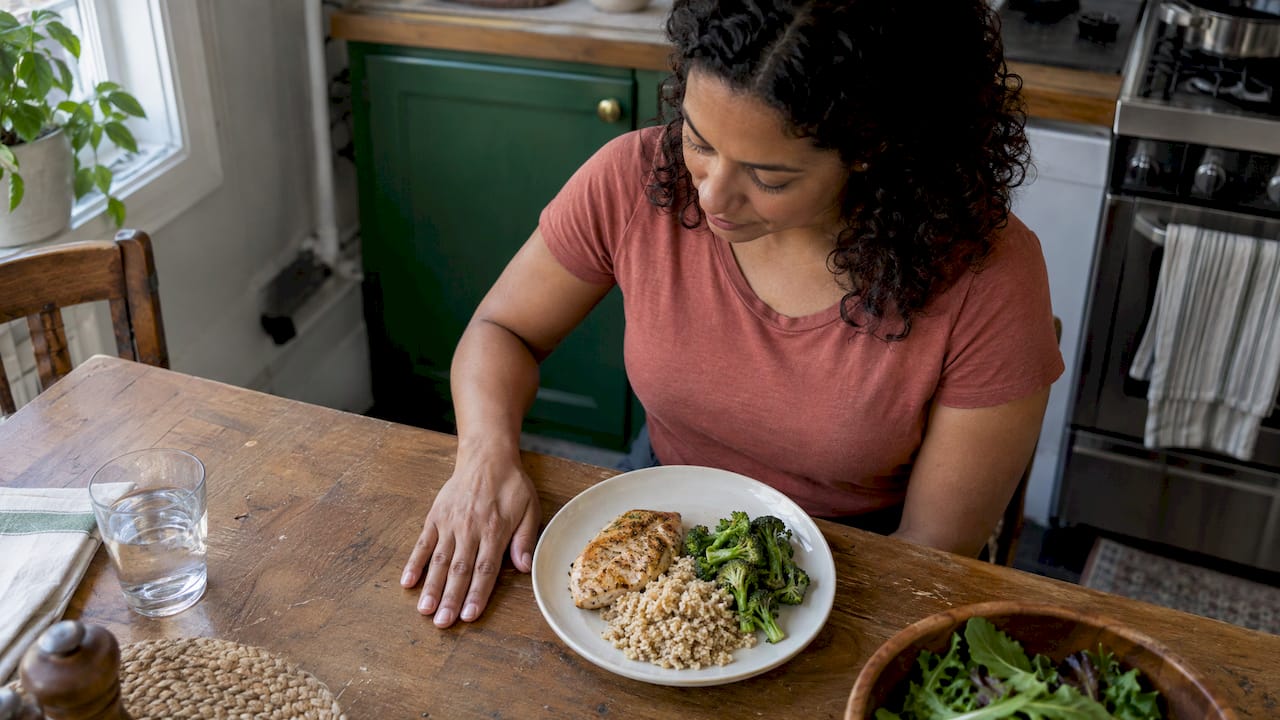
You won’t always have a scale or measuring cups. Everyday objects and your own hand are surprisingly useful stand-ins.
Everyday object cues
Mayo Clinic gives these visual comparisons, with example foods and calories:
| Food group | Looks like | Example |
|---|---|---|
| Fruit | A tennis ball | A small apple, about 60 calories |
| Vegetables | A baseball | Half a cup of cooked carrots, about 25 calories |
| Carbohydrates | A deck of cards | Half a cup of cooked whole-grain pasta, about 70 calories |
| Protein | No bigger than a deck of cards | 2 to 2.5 ounces of cooked skinless chicken, about 110 calories |
| Fat | A pair of dice | 2 teaspoons of mayonnaise, about 45 calories |
Harvard Health adds that a serving of pasta is only 1/2 cup, and a serving of poultry or meat is 4 ounces, about the size of a deck of playing cards. Many restaurant plates hold several times that.
Your hand as a ruler
Your hand goes everywhere with you and scales roughly with your body. Harvard Health lists these hand-based cues for eating away from home:
- 1 thumb tip is about 1 teaspoon of peanut butter, butter or sugar
- 1 finger is about 1 ounce of cheese
- 1 fist is about 1 cup of cereal, pasta or vegetables
- 1 handful is about 1 ounce of nuts or pretzels
- 1 palm is about 3 ounces of meat, fish or poultry
A quick example: a palm of chicken, a fist of rice and two fists of roasted vegetables is a balanced dinner you can build without any equipment.
The plate method and a few simple habits
If counting anything feels like too much, start with the plate. The NHS suggests that you fill half your plate with vegetables or salad, one quarter with protein and one quarter with starchy carbohydrates. It builds portion control into the meal layout.
A few habits make it easier:
- Use smaller dishes. The NIDDK recommends smaller dishes, bowls and glasses so you eat and drink less.
- Slow down. The same page says your brain needs time to register fullness, which may take at least 15 minutes.
- Wait before seconds. The British Heart Foundation, as cited by Medical News Today, suggests waiting 20 minutes before going back for a second portion.
- Plate it, don’t eat from the package. Serve one portion, put the rest away, and sit down to eat it.
- Split restaurant meals. Ask for a box at the start and pack half before you begin.
None of these require you to give up foods you love. They just stop a splash of oil, a handful of nuts and a second helping from disappearing from memory.
Weigh and measure for a while, not forever
Estimating gets much better after a short period of measuring. The NHS recommends weighing portions before cooking to see whether your usual serving matches the label. Its example: a 75 g portion of rice is 260 calories, while a 150 g portion is 520 calories. Same food, same pot, double the energy.
Try this for two weeks:
- Pick the five or six foods you eat most often, such as rice, pasta, cereal, oil, cheese and peanut butter.
- Measure them with cups, spoons or a scale at each meal.
- Look at what the amount looks like on your plate or in your bowl.
- Note where your usual serving is bigger than you expected.
This is not a life sentence. The NIDDK says you don’t need to measure and count everything you eat or drink for the rest of your life, only long enough to learn typical serving and portion sizes. Think of it as training your eye.
How accurate is your eye, really?
As accurate as your practice. Studies of portion estimation show a wide spread.
In a study by Gibson and colleagues in the British Journal of Nutrition, 80 percent of geometrically shaped foods estimated with the finger width method fell within 25 percent of the true weight, versus only 29 percent when people used household measures such as cups and spoons. The authors point out that fingers are always with you and are more socially acceptable than pulling out a ruler.
Another study, of dietetics students, found a mean absolute error of about 28 percent using household utensils and about 45 percent using food exchanges, with the largest errors for fruit juice and salads. Even trained people misjudge amounts, especially for liquids and loose, bulky foods.
What that means for you:
- Expect some error and don’t let it discourage you.
- Be most careful with the foods that are easy to underestimate: oils, dressings, juices, salads, nuts and anything poured.
- A consistent habit beats a perfect measurement. If you misjudge the same way every day, you can still spot trends and adjust.
Tracking helps you reduce calorie intake and avoid overeating
Portion cues work at the moment you eat. Tracking works across the whole week: it shows you the pattern, not just the plate.
In a randomized trial of mobile-based dietary tracking, participants who used an app to track food lost significantly more weight at six months (6.8 kg) than the group using a wearable bite counter (3.0 kg). Seeing what you eat, in a form you can review, appears to help.
Tracking supports portion control in practical ways:
- It makes the extras visible: the second helping, the handful of nuts, the oil in the pan.
- It shows how much a typical portion of your favorite foods adds up to, so you can resize it.
- It gives you a daily target to aim for, which turns a vague intention into a clear number.
- It builds the habit of pausing before you eat.
Perfection isn’t the goal. If you want to read more about why logging works even when your entries are imperfect, see why calorie tracking works.
Our perspective on portions and tracking
Most people don’t overeat because they don’t care. They overeat because portions are hard to judge, and most trackers hide how they got their numbers behind a single confident figure.
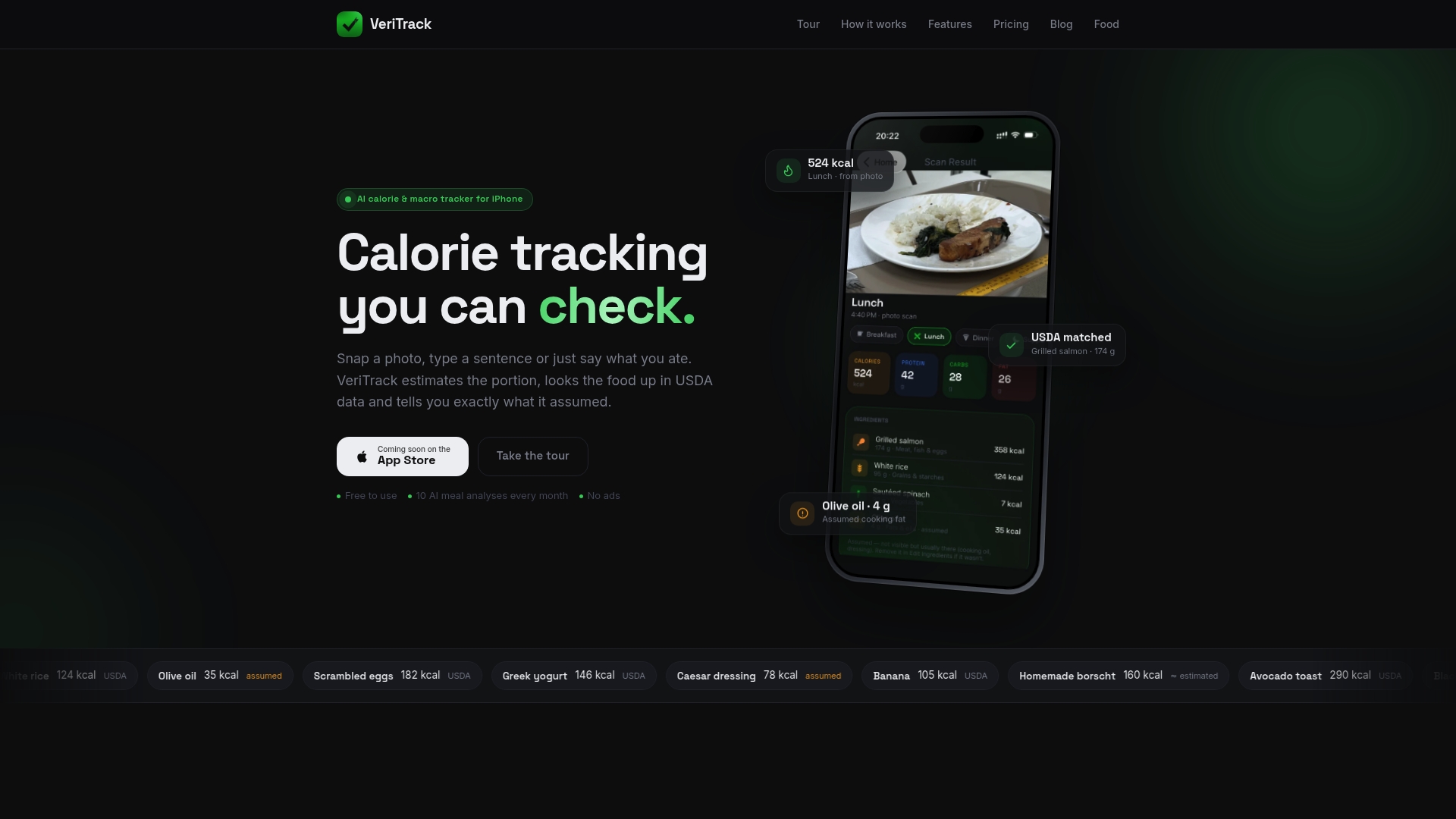
That is the problem we built VeriTrack to solve. You can photograph a meal, type it or say it out loud, and we estimate the portion using USDA data. On supported iPhones, LiDAR adds depth measurement so the estimate reflects how much food is actually on the plate.
Just as important, we show the assumptions behind each estimate. If we guessed a cooking oil amount or a portion size, you can see it, and you can correct it. A number you can check is a number you can trust, and a number you trust is one you’ll keep using.
We would rather you log quickly and honestly than measure perfectly and quit. Consistency is what moves the needle, and a tracker that makes consistency easy and transparent is the one worth keeping.
Aliaksei
Make portion tracking easier with VeriTrack
If you want to put all of this into practice without carrying a scale everywhere, VeriTrack is an iPhone app for calorie and macro tracking. Snap a photo of your meal, type a description or use your voice. It estimates portions using USDA data, shows its assumptions, and lets you correct them.
You also get a daily target based on your body and activity level, a daily meal diary, progress tracking, read-only Apple Health integration and gentle reminders. The free tier includes a limited number of AI meal analyses per month, and VeriTrack Premium offers unlimited analyses and the full feature set. Try VeriTrack on your iPhone and see how your usual portions measure up. If you want ideas for what to eat, browse our food and recipes pages.
A simple one-week portion plan
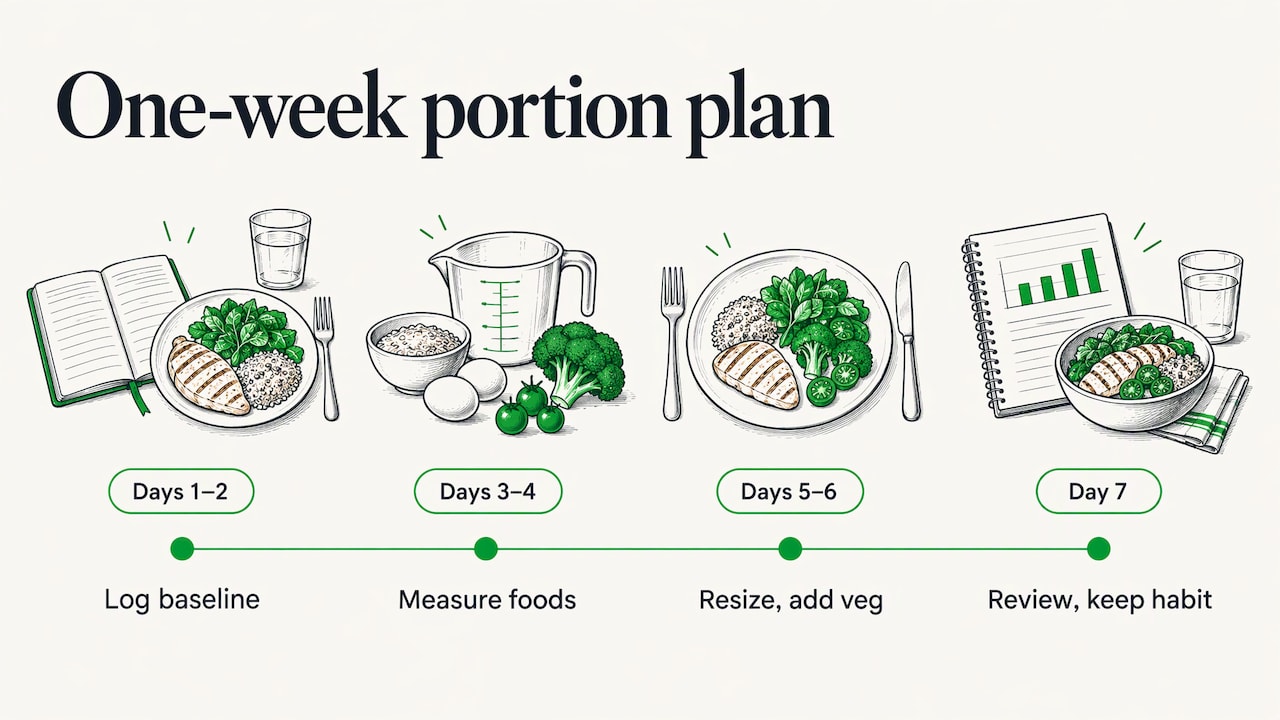
You can start tomorrow. Here is a low-pressure week.
Days 1 to 2: look. Eat as usual, but log everything. Don’t change a thing. You are collecting a baseline.
Days 3 to 4: measure. Weigh or measure your most common foods once each. Compare to what you thought you ate.
Days 5 to 6: resize. Pick two or three foods where your portion ran large, and trim them a little. Add vegetables to fill the gap. Use the plate method for dinner.
Day 7: review. Look at your average. Did you hit your daily target? Which meal was hardest? Choose one habit to keep.
Small changes stack up. A 235 kcal daily difference, the average reduction seen in the research on smaller portions, is not a crash diet. It is one slightly smaller serving at a couple of meals.
FAQ
Can I lose weight just by portion control?
For many people, yes. Eating smaller portions lowers total calories, and research has linked smaller served portions to lower daily energy intake. Results depend on what you eat, how active you are and how consistent you stay. If you have a health condition, check with your doctor or a registered dietitian first.
How big should my portions be?
It depends on your age, weight, height, sex, metabolism and activity level, which is why the serving size on a label is only a reference. Cues such as the plate method, a palm of protein or a fist of vegetables give you a starting point. A daily calorie target based on your body and activity helps you fine-tune.
Do I have to weigh my food forever?
No. The NIDDK says you only need to measure for as long as it takes to learn what typical portions look like. After a few weeks of weighing your most common foods, your eye improves, and you can switch to hand cues and quick logging.
How do I avoid overeating at restaurants?
Decide on your portion before the food arrives. Ask for a box and pack half right away, share a dish, or build your plate using hand cues: a palm of protein, a fist of starch and the rest vegetables. Eat slowly, and wait before ordering more.
How does food tracking help with portion control?
Tracking shows you how much you actually eat across a day and a week, including the easy-to-forget extras. A trial of app-based tracking found significantly greater weight loss at six months than a wearable bite counter. It also gives you a target to plan portions around.
Sources
- Food Portions: Choosing Just Enough for You, NIDDK
- Portion control for weight loss, Mayo Clinic
- Downsizing food: a systematic review and meta-analysis, British Journal of Nutrition
- Navigating Portion Control, Obesity Action Coalition
- How to lose weight in a healthy way, NHS
- 10 behaviors for healthy weight loss, Harvard Health
- Tips for healthy eating away from home, Harvard Health
- Portion control for weight loss: 12 tips and more, Medical News Today
- Calories and weight loss, NHS Better Health
- Accuracy of hands v. household measures as portion size estimation aids
- Food Portion Size Estimation Skill Among Post Graduate Dietetics Students
- The Dietary Intervention to Enhance Tracking with Mobile Devices trial