
Energy Balance: What It Means and How to Use It
Energy balance is calories in versus calories out. Learn how positive, negative and neutral balance affect weight, and how to estimate both sides in daily life.

Energy balance is the relationship between the energy you take in from food and drinks and the energy your body uses. When the two match over time, your weight stays steady. When intake is higher, you gain. When it is lower, you lose. The idea is simple, and the useful part is knowing how to estimate both sides without needing perfect numbers. That is where a tracker that shows its assumptions, like VeriTrack, makes the daily work lighter.
This guide explains what energy balance means, how the three states differ, what sits on each side of the equation, why small gaps matter, and how to put it into practice.
TL;DR
- Energy balance means energy in (food and drinks) compared with energy out (everything your body burns). Equal over time means stable weight.
- Positive balance usually leads to weight gain. Negative balance usually leads to weight loss.
- Total energy expenditure has three parts: basal metabolic rate, the thermic effect of food and physical activity.
- Small daily gaps add up. A 100 kcal difference per day is enough to matter over years.
- Estimates will never be exact. Consistent logging with visible assumptions is more useful than chasing perfection.
Table of Contents
- What energy balance means
- Positive, negative and neutral energy balance
- The intake side: where food energy comes from
- The output side: where your energy goes
- Why small gaps matter
- Why your body adapts as you lose weight
- How to use energy balance in daily life
- How accurate can you really be?
- Try it with VeriTrack
- Our perspective on energy balance
- FAQ
- Sources
What energy balance means
The Food and Agriculture Organization describes energy balance as the state in which dietary energy intake equals total energy expenditure. It adds the energy cost of growth in childhood and pregnancy, or of producing milk during lactation. Held over a long period, this is a steady state.
The National Academies put it in practical terms. Energy balance is the difference between the energy you consume and the energy your body needs for breathing, circulation, metabolism and physical activity. Eating more than you use, without extra activity, can lead to weight gain. Eating less without reducing activity can lead to weight loss.
You may also see this called calories in versus calories out. It is the same idea in everyday words. (If you landed here looking for the earth’s energy balance or an engineering energy balance, those are different topics. This page is about human nutrition.)
Positive, negative and neutral energy balance
There are three states, and you move between them constantly. A single big dinner does not change your body. What matters is the pattern across weeks and months.
| State | What is happening | Typical result over time |
|---|---|---|
| Neutral (balance) | Intake equals expenditure | Weight stays stable |
| Positive | Intake is greater than expenditure | Body mass increases |
| Negative | Expenditure is greater than intake | Body mass decreases |
A negative energy balance is not a bad thing by default. It is simply what happens when you eat less than you use, and it is the mechanism behind intentional weight loss. A positive balance is likewise normal during growth, pregnancy or when someone is building muscle with a plan.
An introductory nutrition text states it as a subtraction: energy intake minus energy expenditure. If the result is zero, weight should hold steady. Above zero usually means gain. Below zero usually means loss.
The intake side: where food energy comes from
Energy intake is the energy that food and drinks provide to your body. Nutrition labels and food databases work out that number with standard conversion factors for each macronutrient. Carbohydrate and protein provide about 4 kcal per gram, fat 9 kcal and alcohol 7 kcal. This is known as the Atwater system. The gold-standard lab method is bomb calorimetry, which burns a food sample and measures the heat released.
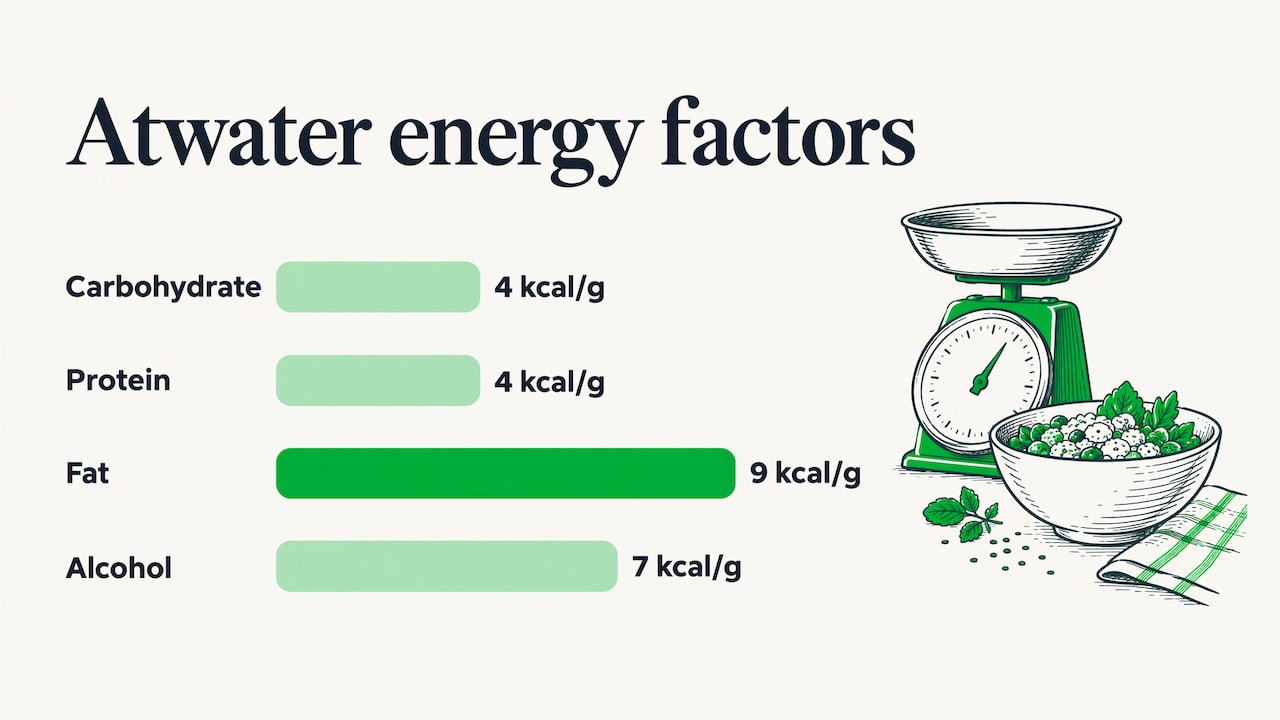
The Atwater factors themselves come from USDA data. Canada’s food regulator, for example, says energy values on labels should be calculated with the Atwater method using factors from USDA Agriculture Handbook No. 8. That is why USDA-based nutrition lookup is a sensible foundation for any calorie log.
One more detail: the calories on a label are not exactly what your body absorbs. Dietary energy is formally called metabolizable energy, and roughly 90% of gross food energy is available to the body, with the rest lost in stool and urine. Standard factors already account for this on average.
A quick example
Take a lunch of grilled chicken, rice and olive oil. Say it contains 40 g of protein, 60 g of carbohydrate and 15 g of fat. Using the factors above:
- Protein: 40 g x 4 = 160 kcal
- Carbohydrate: 60 g x 4 = 240 kcal
- Fat: 15 g x 9 = 135 kcal
That is about 535 kcal. The hard part is rarely the arithmetic. It is knowing the grams. A splash of oil, a handful of nuts and a second helping can all disappear from memory, and that is where most of the gap between your log and your real intake comes from.
The output side: where your energy goes
Total energy expenditure has three main components: basal metabolic rate, the thermic effect of food and physical activity.
- Basal metabolic rate (BMR): the energy your body uses at rest to keep you alive, including breathing, circulation and temperature control. For most people it is the largest share.
- Thermic effect of food: the energy used to digest, absorb and process what you eat.
- Physical activity: everything from workouts to walking to the store to fidgeting.
Expenditure differs from person to person. It is influenced by body mass, particularly fat-free mass, as well as the thermic effect of food and physical activity. Two people of the same weight can burn different amounts of energy, which is why a daily target based on your body and activity level is more useful than a generic number like 2,000 kcal.
Why small gaps matter
The energy equation is simple: calories consumed equal calories expended plus or minus calories stored as body fat or glycogen. A review in a medical journal notes that this is always true, even though applying it is complex because many factors affect expenditure, intake and absorption.
The same review notes that about 7,000 kcal is contained in each kilogram of adipose tissue, and that a small excess such as 100 kcal per day can accumulate into significant weight gain over years. Researchers James Hill, Holly Wyatt and John Peters make a similar point: small changes of around 100 kcal per day could arrest weight gain in most people.
That is encouraging. You do not need dramatic changes. A modest, consistent adjustment, such as a smaller portion of one meal or a daily walk, is within reach.
The 3,500-calorie rule is a guide, not a law
You may have heard that a 3,500-calorie deficit equals one pound of weight loss. Researchers describe this as a useful clinical approximation that does not strictly hold, because intake, expenditure and weight affect each other over time. Use it to set expectations, then let your own trend over several weeks tell you what is actually happening.
Why your body adapts as you lose weight
If you cut intake and your weight drops, the expenditure side does not stay fixed. During active weight loss, basal metabolic rate falls and physical activity becomes more efficient, so you burn fewer calories in proportion to the weight you have lost. This can lead to a plateau.
A plateau is not a failure. It is the equation updating. The practical response is to review your target as your weight changes, keep your protein and activity steady, and keep logging so you can see what is going on. Thoughtful inclusive progress tracking in fitness looks beyond a single number on the scale for the same reason: one measure never tells the whole story.
How to use energy balance in daily life
Here is a routine that works without demanding perfection.
- Set a daily target. Base it on your body and activity level, and on whether you want to lose, maintain or gain. VeriTrack calculates a daily nutritional target from your body and activity level, so you do not have to work it out by hand.
- Log as you eat. Memory is the weak point. Entering a meal right away, by photo, typed description or voice, takes seconds. VeriTrack accepts all three, so you can choose whatever is fastest in the moment.
- Estimate portions, not just foods. A food name alone is not enough. A medium bowl of rice can vary by hundreds of calories. On supported iPhones, VeriTrack uses LiDAR depth measurement to help estimate portion size, and it draws its nutrition values from USDA data.
- Check the assumptions. Every estimate rests on guesses about oil, sauces, size and preparation. VeriTrack shows its assumptions, and you can correct any that look off, so your log reflects your actual plate.
- Watch the trend, not the day. Look at weekly averages. One high day is noise. A pattern is information. For more on this mindset, see our piece on why calorie tracking works even when you don’t do it perfectly.
- Adjust slowly. If your weight is not moving as expected after two to three weeks, change one thing by a small amount, such as a portion size or a daily walk, and see how the trend responds.
If portions are your main challenge, our practical guide to portion control for weight loss goes deeper. If you are new to logging on a phone, the guide to tracking calories on iPhone walks through the basics. And if you are training for muscle, body recomposition macros explains how to set and track yours.
How accurate can you really be?
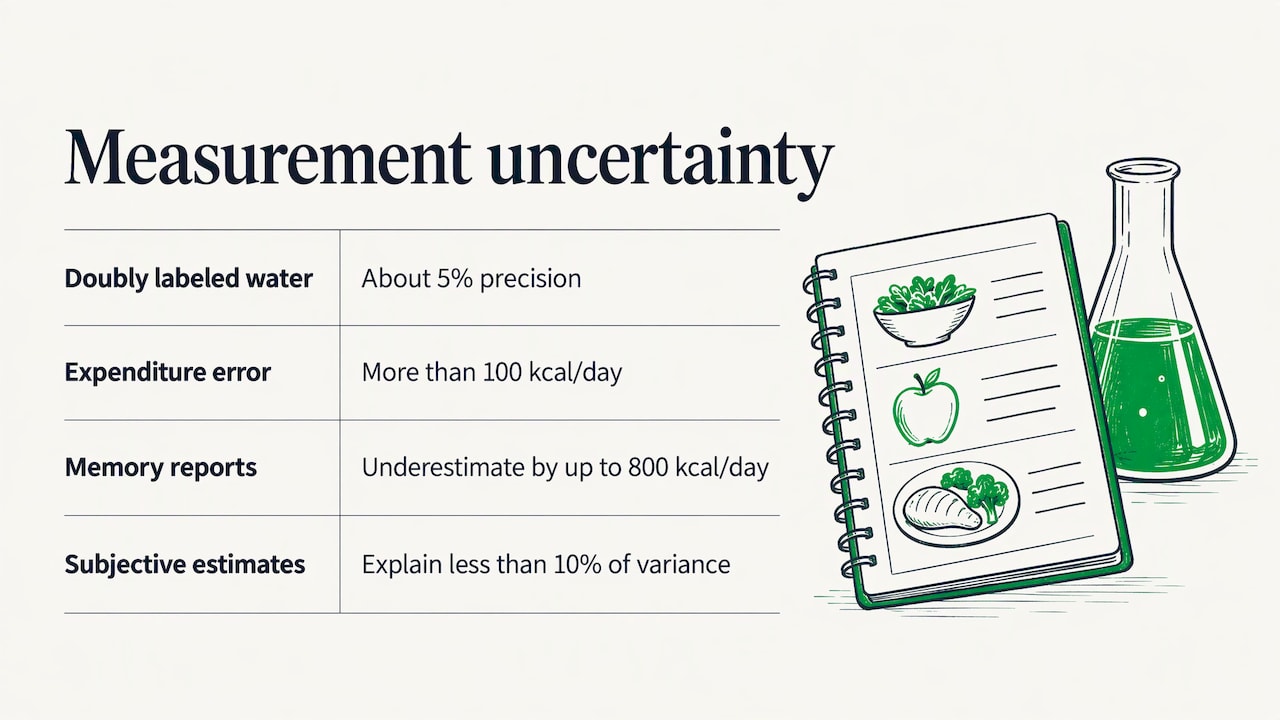
Nobody measures both sides of the equation perfectly, not even researchers. Scientists note that estimates of energy intake and expenditure are currently imprecise, and that even the doubly labeled water technique used in studies has a precision of about 5%, or more than 100 kcal per day in expenditure.
The biggest source of error for most people is recall. Work on national survey data found that reports based on memory can underestimate intake by as much as 800 kcal per day, and that subjective estimates explained less than 10% of the variance in true intake.
What this means for you: logging in the moment, measuring portions where you can, and seeing the assumptions behind each number all narrow the gap. You are aiming for a log that is close enough to guide good decisions, and consistent enough to show a trend.
Try it with VeriTrack
VeriTrack is an iPhone app for calorie and macro tracking. You photograph a meal, type it or say it out loud, and the app estimates portions using USDA data, with LiDAR depth measurement on supported iPhones. It shows the assumptions behind each estimate so you can correct them. It also gives you a daily target based on your body and activity level, a daily meal diary, progress tracking, read-only Apple Health integration and gentle reminders. The free tier includes a limited number of AI meal analyses per month, and Premium unlocks unlimited analyses and the full feature set.
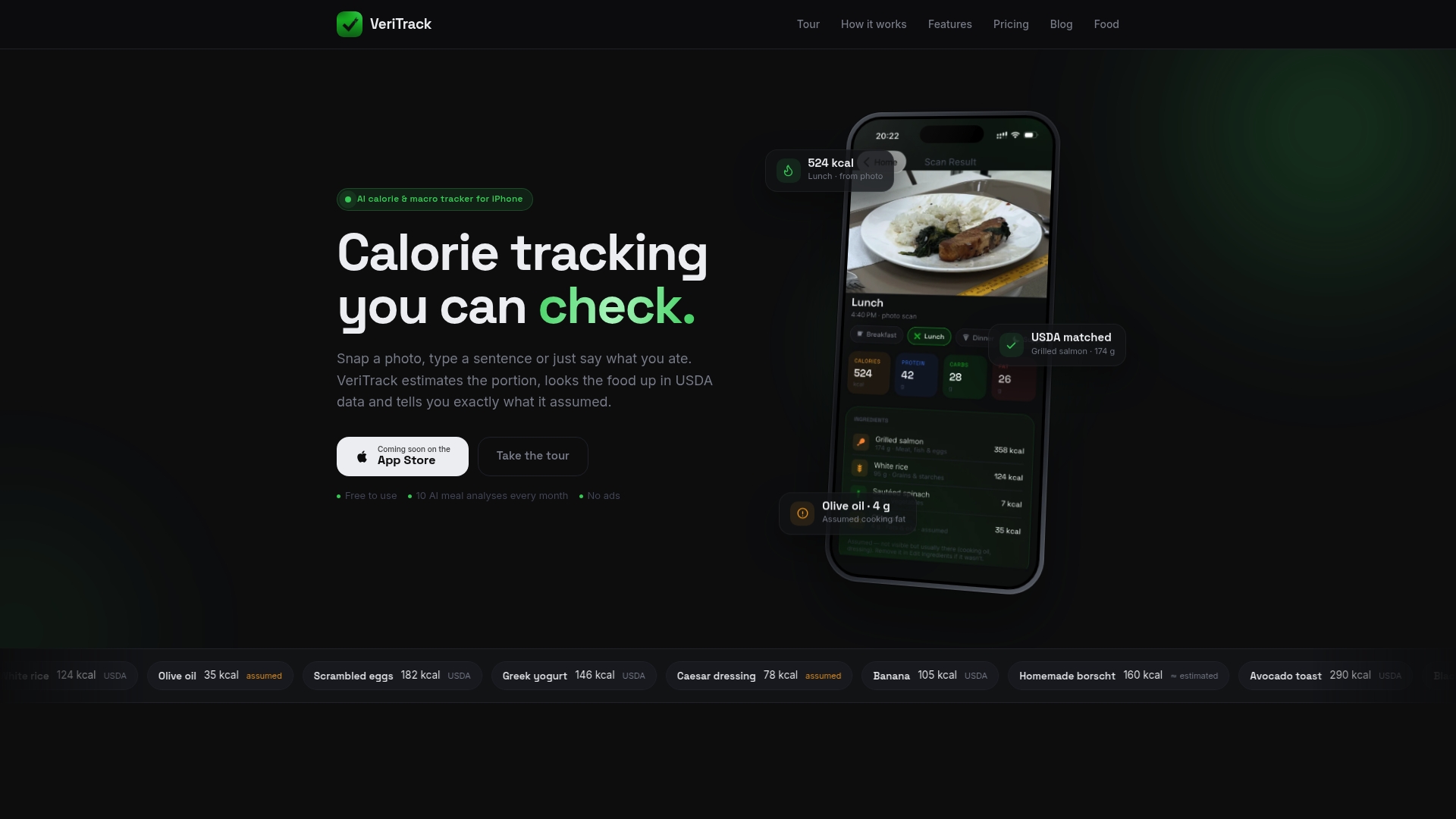
If you want to see your own energy balance rather than guess at it, you can start with VeriTrack on your iPhone. You can also browse food and recipe pages to see how everyday foods break down.
Our perspective on energy balance
Energy balance is one of the few ideas in nutrition that nobody seriously disputes. The hard part has never been understanding it. The hard part is living with it: guessing portions, forgetting the oil, and feeling like a failure when the numbers are off.
That is why we built VeriTrack around transparency. A number with no explanation is easy to doubt and easy to ignore. When you can see that an estimate assumes a tablespoon of oil or a certain bowl size, you can fix it in a few seconds and trust the result more.
We also think consistency beats precision. You do not need a perfect log. You need an honest one that you keep up. Photo, text and voice entry exist so that logging fits into a busy day, and LiDAR portion estimation on supported iPhones is there to take some of the guesswork out of the part people find hardest.
Used this way, energy balance stops being a theory and becomes a daily habit that is encouraging rather than judgmental.
Aliaksei
FAQ
What does a negative energy balance mean?
It means your body is using more energy than you take in. Over time this usually results in weight loss. It is the basis of intentional weight loss, and a modest deficit is easier to sustain than a large one.
Is energy balance just calories in versus calories out?
Yes, in principle. Intake is the energy from food and drinks, and output is the energy you spend. In practice, the equation is always true but complex to apply, because absorption, activity and metabolism all vary between people and change over time.
What is energy intake?
Energy intake is the amount of energy that food and drinks provide your body. It is estimated from the macronutrients they contain, using about 4 kcal per gram for protein and carbohydrate, 9 for fat and 7 for alcohol.
Why did my weight stop dropping even though I’m eating less?
As you lose weight, your body needs less energy. Research shows that basal metabolic rate falls and activity becomes more efficient during weight loss, which can cause a plateau. Recheck your daily target at your new weight and keep logging so you can adjust in small steps.
Sources
- Human energy requirements, FAO
- Dietary Reference Intakes for Energy, National Academies
- Energy Balance and Obesity
- Introduction to Nutrition and Wellness: Energy Balance
- Calories and kilojoules: how do we know the energy content of food
- Elements within the Nutrition Facts table, Canadian Food Inspection Agency
- Dietary Energy
- Making progress on the global crisis of obesity and weight management
- The Importance of Energy Balance
- Calories in, calories out and macronutrient intake
- Energy balance and its components
- Energy Balance Measurement: When Something is Not Better Than Nothing