
How to Estimate Meal Calories: A Practical Method
Learn how to estimate meal calories from labels, ingredients, portions and photos, where errors creep in, and how to keep your daily log honest and easy.
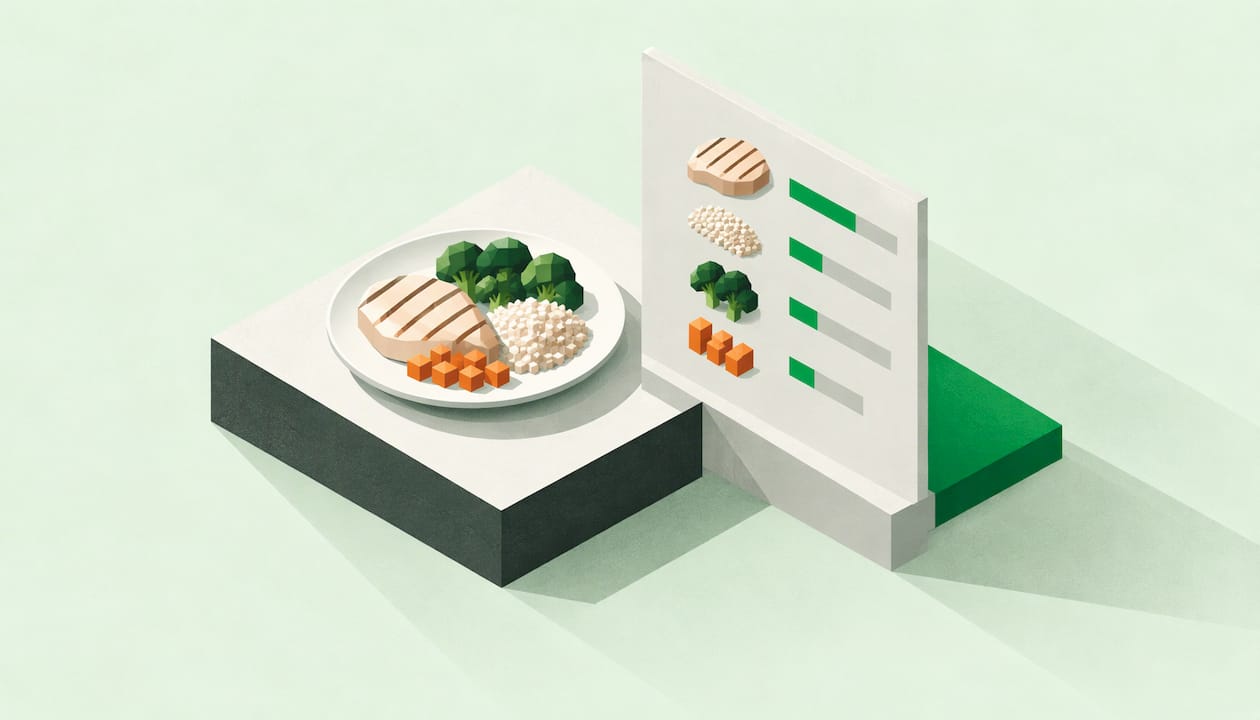
You can estimate the calories in a meal in three steps. Identify what is on the plate, work out how much of each food there is, then multiply by the calories in that amount. Weighing gives the best numbers. Labels, portion cues and photos get you close when you can’t weigh. Close, logged consistently, is enough to learn from.
This guide walks through each method, shows the math with real examples, and explains where estimates go wrong so you can correct for it. No perfection required.
TL;DR
- Every meal estimate is food amount × calories per amount. The amount is where most errors happen, not the calorie value.
- Labels refer to one serving. If you eat two servings, double everything.
- Weighing portions is the most accurate method. Photos, hand-size cues and AI estimates are useful when you can’t weigh.
- Cooking oil, sauces and drinks are the most commonly forgotten calories. Log them on purpose.
- People tend to underestimate intake, so a steady habit beats a perfect number. Look for trends over days and weeks.
Table of Contents
- The math behind every calorie number
- Start with the label, and fix the serving size
- Weigh it when you can
- Estimating when you can’t weigh
- Homemade meals: oil, sauces and servings
- How accurate should you expect to be?
- Our perspective
- Estimate faster with photo, voice or text on iPhone
- A simple routine for daily estimates
- FAQ
- Sources
The math behind every calorie number
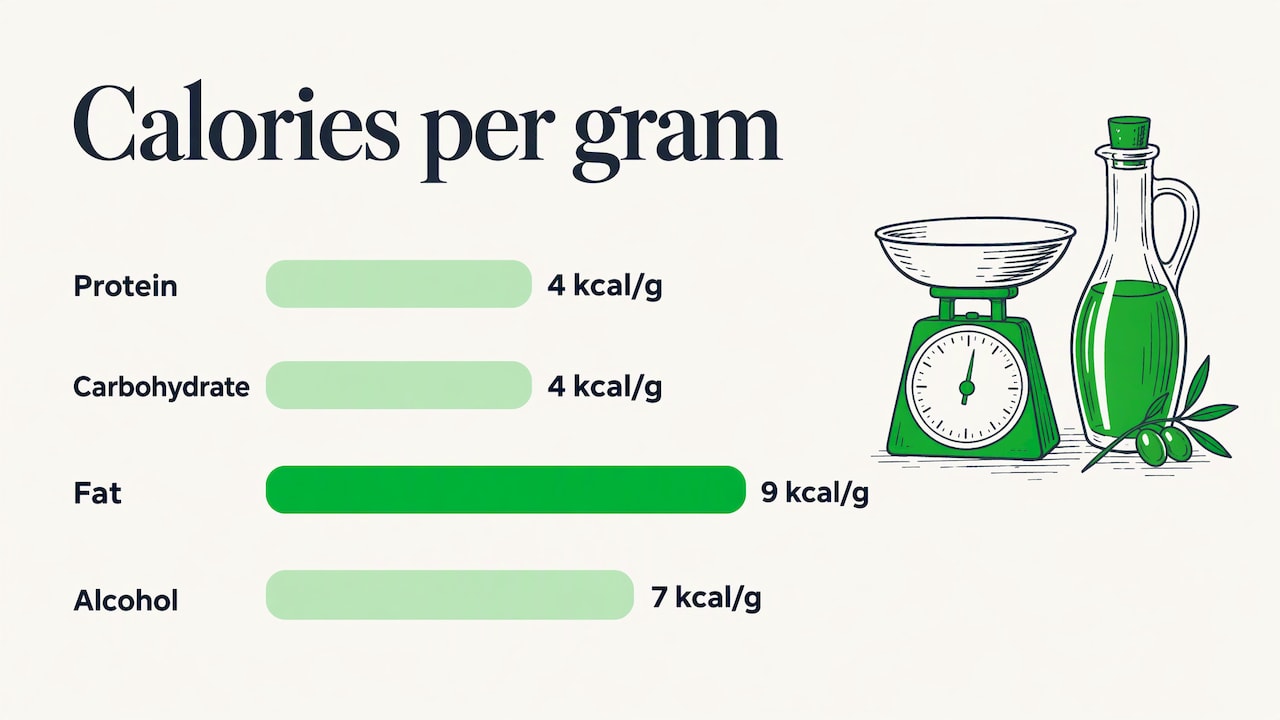
A meal’s calories are the sum of the calories from its protein, carbohydrate, fat and any alcohol. Protein and carbohydrate each provide four calories per gram, fat provides nine and alcohol seven, according to the Tufts Health & Nutrition Letter. To calculate a portion, multiply the grams of each nutrient by its factor and add the results.
Here is a worked example. Say a serving of food contains 30 g of protein, 40 g of carbohydrate and 15 g of fat:
| Nutrient | Grams | Calories per gram | Calories |
|---|---|---|---|
| Protein | 30 | 4 | 120 |
| Carbohydrate | 40 | 4 | 160 |
| Fat | 15 | 9 | 135 |
| Total | 415 |
You rarely need to do this by hand. Food databases and labels have already done it. But knowing the math explains a useful fact: fat is dense. A gram of fat carries more than twice the calories of a gram of protein or carbohydrate, which is why a small pour of oil moves a total more than a larger scoop of rice.
U.S. labeling rules use these same general factors. Under 21 CFR 101.9, calories can be calculated from 4 calories per gram of protein, 4 per gram of carbohydrate and 9 per gram of fat. The rule also requires label calories to be rounded: to the nearest 5 up to 50 calories, and to the nearest 10 above that. So even a packaged food’s number is a rounded figure, not a lab-exact one.
The USDA FoodData Central FAQ explains that its energy values are calculated from fat and protein analytical values when those are available. The database most nutrition tools draw on is itself built from the same logic.
Start with the label, and fix the serving size
If your meal comes from a package, the label is your best starting point. The catch is the serving size.
The FDA explains that all nutrient amounts on the label refer to the serving size. Its example: one serving of lasagna is 1 cup and 280 calories, so eating the whole 4-serving package means 1,120 calories.
The label’s serving may also differ from your portion. The NHS gives an example of a rice packet where a 75 g portion is 260 calories. If you actually eat 150 g, you are having 520 calories.
A quick label routine:
- Find the serving size and servings per container.
- Decide how many servings you are actually eating.
- Multiply the calories by that number.
- Check whether the label describes the food dry or cooked, since rice, pasta and oats change weight when cooked.
Watch the zero-calorie claims
Small serving sizes can round calories down to zero. The CSPI notes that cooking sprays list 0 calories because the serving is defined as a quarter of a gram. A four-second spray to coat a pan delivers an estimated 4 grams of oil and 35 calories. It is a small number, but it adds up if you cook with spray every day.
Weigh it when you can
Weighing is the gold standard. A nutrition textbook from Cal State University says the most accurate information comes from weighing and measuring all foods and beverages, while noting that this is unrealistic for most people. Both points are fair.
The NHS advice is to weigh portions before cooking, because the label portion may be smaller than what you eat. Raw weights also match what most databases list for raw ingredients.
You don’t have to weigh forever. A practical approach:
- Weigh for one or two weeks the foods you eat most often: rice, pasta, oats, chicken, nut butter, cheese.
- Note what those portions look like in your own bowls, plates and spoons.
- Estimate by eye once your eye is calibrated, and re-check now and then.
This matters because most of us are poor judges of portions. The same textbook points out that many people don’t know what 3 oz of chicken looks like compared with 6 oz. When filling out a record, they tend to pick the default serving regardless of what they ate.
Estimating when you can’t weigh
Restaurants, work lunches and dinners at a friend’s house don’t come with a scale. You still have good options.
Use portion references you always have
A closed fist is roughly a cup, a palm is roughly a serving of meat, a thumb tip is roughly a teaspoon. These are rough guides, not precise measures, and hands vary. Use them to catch big gaps, like a plate of pasta that is clearly two cups, not one.
Work on the few foods that swing the total most:
- Starches (rice, pasta, potatoes, bread)
- Fats (oil, butter, dressing, cheese, nuts)
- Proteins with variable fat (ground meat, salmon, chicken thighs versus breast)
- Drinks with calories (juice, lattes, soda, alcohol)
Use photos as a portion aid
Photos work for estimation, and the research on this goes back decades. In a food photography study, Nelson and colleagues found that photographs showing a range of portion sizes are a useful aid. Excluding butter and margarine, meal nutrient estimates were on average within ±7%, though energy and fat were overestimated by participants over 65.
A 2022 study of Japanese adults, published in the Journal of Nutritional Science, found that estimates of serving size from digital photographs had a mean relative difference of 8.8%. About half of participants (51.6%) were within ±25% of the true serving size. The authors also saw wider variation with larger servings, so big portions are where extra care pays off.
Know how AI photo estimates behave
AI tools can estimate calories from a picture, and they are improving. A 2025 evaluation of three large language models found that two of them had a mean absolute percentage error around 36% for energy estimated from food images, while the third had substantially higher errors. The same study saw a tendency to underestimate that grew with portion size.
What does that mean for you? A photo alone can’t see everything. Depth is hard to judge from a flat image, and hidden ingredients stay hidden. The most useful AI tools deal with this in two ways: they measure portions more directly, and they show their assumptions so you can fix them. More on that below.
Homemade meals: oil, sauces and servings
Home cooking is where calories hide. A splash of oil, a handful of cheese and a second helping all disappear from memory. The good news is that recipes can be calculated in a clear order.
The FAO’s method for recipe calculation uses the weights of raw ingredients to calculate total nutrients, then weighs the cooked dish and divides to get per-100 g values. Those can then be expressed per serving.
A home version:
- List every ingredient with its raw weight, including oil, butter and sauces.
- Add up the calories for all ingredients.
- Weigh the finished dish (the pot on the scale, minus the pot).
- Weigh your portion and divide: your portion’s weight ÷ total weight × total calories.
Example: a pot of chili totals 2,400 calories and weighs 2,000 g cooked. You serve yourself 400 g. That’s 400 ÷ 2,000 = 0.2 of the pot, so 480 calories.
Count the oil
Oil is the easiest thing to underestimate. Archived USDA data lists olive oil at 884 kcal per 100 g, with one tablespoon at 119 kcal and one teaspoon at 40 kcal. Pouring “a glug” can easily be two tablespoons, around 240 kcal.
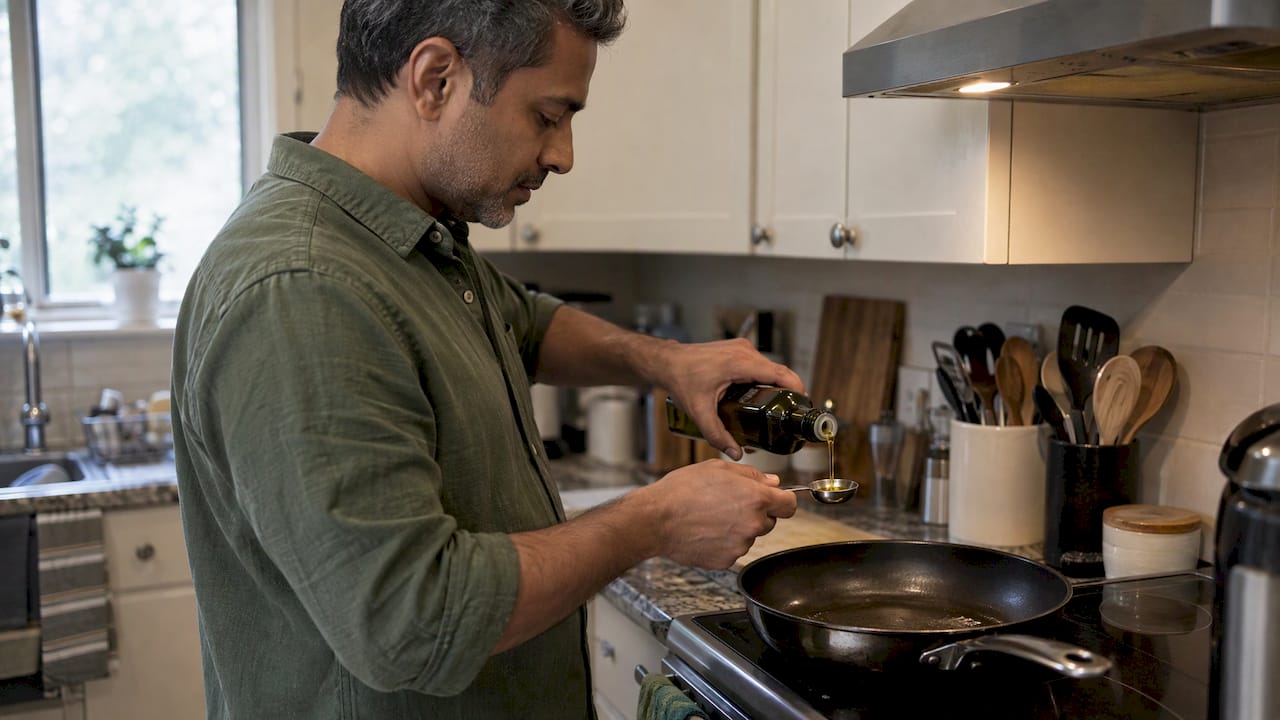
For frying, not all of the oil ends up in the food. The EuroFIR recipe calculation method says that when fat is used as a cooking medium, only the amount absorbed should be counted. If you can’t measure absorption, a sensible habit is to log what you poured in and note that it is an upper estimate. EuroFIR also reminds us that calculated recipes should always be treated as approximations.
How accurate should you expect to be?
Nobody gets this exactly right, researchers included. Studies comparing self-reports with biological markers show that underreporting is common. A study published in 2018 found that, compared with an energy biomarker, intake was underestimated by 18 to 21% on 4-day food records. Underreporting was more common among people with obesity. An earlier large U.S. study found that underreporting was substantially more common than overreporting on every dietary tool tested.
The Cal State textbook puts it simply: most people underestimate calories by 10 to 20% when keeping food records.
That is not a reason to give up. It is a reason to build in a few habits:
- Log right after eating, not at the end of the day.
- Log the extras: oil, sauces, bites while cooking, drinks.
- When unsure between two portion sizes, pick the larger one.
- Judge your results by the trend of your weight and energy over two to three weeks, not by one meal’s number.
We cover why imperfect tracking still produces results in why calorie tracking works even when you don’t do it perfectly, and the portion side of the story in our portion control guide.
Our perspective
We built VeriTrack around one observation: the calorie number on your screen is only as good as the guesses behind it, and most apps hide those guesses.
When you log a meal, something has to decide how big the chicken was, how much oil went in the pan, and which database entry matches your dinner. A typical tracker makes those calls silently and gives you one confident number. If it is off, you never find out why.
We think the better approach is to show the work. VeriTrack uses USDA data for nutrition lookup and, on supported iPhones, LiDAR for depth, which helps with portion size. It labels its assumptions, such as the portion size, the cooking method and the ingredients it thinks it sees, so you can spot the one that is wrong and correct it in seconds.
This is how we think estimation should work. Not magic accuracy, but visible reasoning that you can check. A number you can inspect is a number you can trust, and a log you trust is a log you keep.
Consistency beats perfection. We would rather help you log every day with honest estimates than ask you to weigh every gram for a week and quit.
Aliaksei
Estimate faster with photo, voice or text on iPhone
If you want the steps above without the manual work, VeriTrack is an iPhone app that lets you photograph a meal, type a description or say it out loud. It estimates portions, looks up nutrition from USDA data and shows the assumptions it made. You can correct any of them.
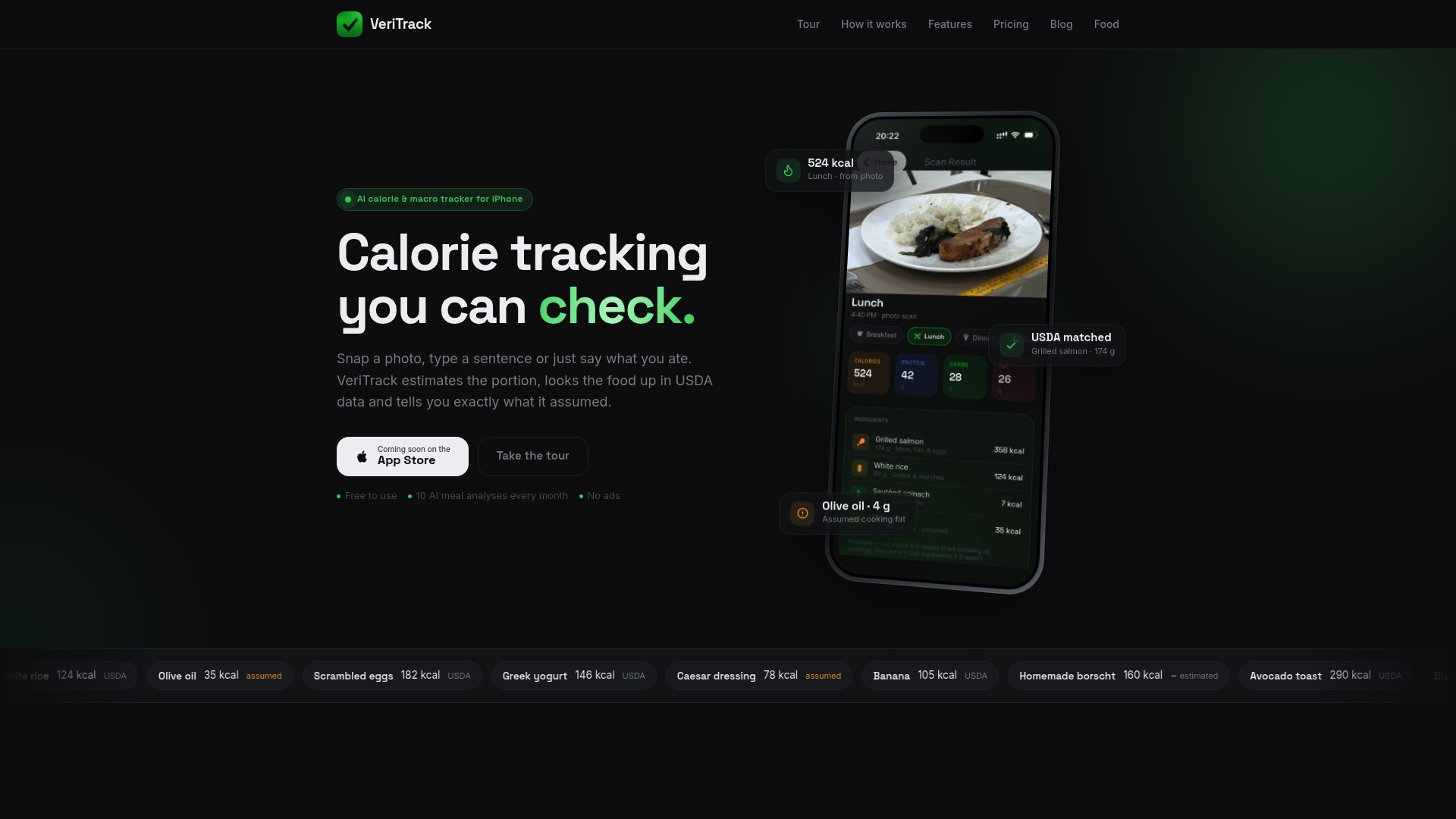
On supported iPhones, LiDAR adds depth measurement to portion sizing. The app sets a daily target from your body and activity level, reads Apple Health data (read-only), keeps a daily meal diary and sends gentle reminders. The free tier includes a limited number of AI meal analyses each month, and VeriTrack Premium unlocks unlimited analyses and the full feature set. You can see how VeriTrack works or read our guide to tracking calories on iPhone.
A simple routine for daily estimates
You don’t need a different method for every meal. Match the method to the situation:
| Situation | Best method | What to watch |
|---|---|---|
| Packaged food | Label × servings eaten | Serving size, dry versus cooked |
| Home cooking, repeat meals | Weigh once, save the meal | Oil, sauces, cheese |
| New homemade recipe | Recipe calculation | Cooked weight, your share of the pot |
| Restaurant or takeout | Photo, portion cues, search by description | Hidden fats, drinks, shared sides |
| In a rush | Photo, voice or text entry | Check the labeled assumptions |
A few habits make this stick:
- Save your regular meals. Breakfast and lunch are often the same five or six items. Calculate them well once.
- Prepare a short list of calorie-dense items you track carefully every time: oils, nut butters, cheese, dressings.
- Check recipes and ingredients in our food and recipes pages for reference nutrition data.
- Review weekly, not meal by meal. One estimate off by 100 calories will not decide your week.
One note on children: the adult math above is not a feeding plan for babies. Readers also ask about starting solids at 6 months, where readiness signs matter more than counting calories.
FAQ
How do I calculate calories in a meal without a food scale?
Start with labels and the serving size, then use portion references such as a fist for a cup of rice or pasta. Pay attention to oil, dressing and drinks, since they swing the total most. A photo-based tracker can also help, as long as it shows the portion assumptions so you can correct them.
How accurate is a calorie estimate from a photo?
It depends on the method and the food. Studies of people estimating portions from photographs found average differences under about 9% in some settings, but with wide variation for larger servings. AI estimates have shown larger errors in research, especially for big portions. Tools that measure depth and show their assumptions give you a better chance to spot and fix mistakes.
Why do my calorie estimates always come out low?
Most people underestimate. Studies comparing self-reports with biological markers found underreporting of roughly 15 to 20% or more on common tools. The usual culprits are cooking oil, sauces, snacks while cooking and drinks. Logging right after you eat and rounding uncertain portions up both help.
How do I count calories in a homemade recipe?
Add up the calories of every raw ingredient, including oil and butter. Weigh the finished dish, weigh your portion, then multiply: your portion’s share of the total weight times the total calories. Treat the result as an approximation, because cooking changes water and fat content.
Do I need to weigh everything forever?
No. Weigh your most common foods for a week or two to train your eye, save those meals, and then estimate by eye with occasional spot checks. The goal is a habit you can keep.
Sources
- Calories and weight loss, NHS
- How to Understand and Use the Nutrition Facts Label, FDA
- How is the number of calories determined in a portion of food, Tufts Health & Nutrition Letter
- 21 CFR 101.9, Nutrition labeling of food
- FAQs, USDA FoodData Central
- Estimating Energy Intake, Nutrition and Physical Fitness (Cal State)
- How to use Nutrition Facts: 8 confusing examples, CSPI
- Food photography II, British Journal of Nutrition
- Accuracy of estimates of serving size using digitally displayed food photographs, Journal of Nutritional Science
- Performance Evaluation of 3 Large Language Models for nutritional estimation, PMC
- Food Composition Data, FAO
- USDA National Nutrient Database, olive oil (archived)
- EuroFIR method for recipe calculation of nutrition values
- Comparison of self-reported dietary intakes from the ASA24, 4-day food records and FFQs, PubMed
- Using intake biomarkers to evaluate the extent of dietary misreporting, Johns Hopkins