
Maintenance Calories Explained: What They Are and How to Find Yours
Maintenance calories are the daily intake that keeps your weight steady. Learn what they mean, how to estimate yours, and how to check the number against real life.

Maintenance calories are the average number of calories you eat per day that keeps your weight steady over time. Eat that amount and your weight stays about the same. Eat more and it tends to creep up. Eat less and it tends to drift down.
The number is the same as your total daily energy expenditure, or TDEE. You can estimate it with a formula in about five minutes. Then you can fine-tune it with a couple of weeks of real data. This guide shows you both steps, with worked examples.
TL;DR
- Maintenance calories are the daily intake at which your weight stays broadly stable. They are numerically the same as TDEE.
- A formula gives you a starting estimate: Mifflin-St Jeor for resting needs, multiplied by an activity factor.
- Your real maintenance is a range, not a single number. Tracking intake and weight for two weeks shows where you land.
- There is no universally right figure. 1,400 and 3,000 calories can each be maintenance for different people.
- Consistent logging beats perfect logging, so pick a method you will actually keep using.
Table of Contents
- What maintenance calories mean
- Where your calories go
- How to estimate your maintenance calories
- What shifts your number
- Why your result is a range, not a single number
- How to check your estimate against real life
- Is 1,400 or 3,000 calories enough for maintenance?
- Our perspective
- Find your maintenance with VeriTrack
- What to do once you know your number
- FAQ
- Sources
What maintenance calories mean
Your body uses energy all day, even when you sit still. Maintenance calories are the amount of food energy that matches what you burn. Maintenance calories are numerically equivalent to TDEE, and at that level the energy from food roughly equals the energy spent through metabolism, physical activity and digestion.
Official bodies use similar language. Australia’s Eat for Health describes the Estimated Energy Requirement for Maintenance as the energy intake predicted to maintain energy balance in healthy people at their current body size and activity level.
Two details in that definition matter:
- Current weight and activity. If your weight or routine changes, your maintenance changes too.
- Average intake. You do not need to hit the number every day. Your weight responds to the pattern over weeks, not to one big dinner.
That second point is worth holding on to. Maintenance is a target to live around, not a pass-or-fail test.
Where your calories go
Your TDEE is not one thing. The Health Council of the Netherlands explains that total energy expenditure has three parts:
- Resting energy expenditure. What your body burns to keep you alive: breathing, circulation, temperature control. This is your BMR, or basal metabolic rate. Cleveland Clinic says it accounts for about 60% to 70% of the energy your body uses.
- Physical activity. Workouts, walking, chores, fidgeting, a job on your feet. This is the part that varies most between people. The same Dutch report notes that the activity energy of a very active person can be twice that of a very inactive person.
- The thermal effect of food. The energy it takes to digest and process what you eat.
This is why two people of the same weight can have very different maintenance numbers. The difference is often in the activity column.
How to estimate your maintenance calories
The most common method has two steps. First estimate your BMR, then multiply it by an activity factor.
Step 1: Estimate your BMR
The Mifflin-St Jeor equation is widely used. As Healthline lays it out:
- Women: 10 × weight in kg + 6.25 × height in cm − 5 × age in years − 161
- Men: 10 × weight in kg + 6.25 × height in cm − 5 × age in years + 5
To convert, divide pounds by 2.2 to get kilograms, and multiply inches by 2.54 to get centimeters.
Step 2: Multiply by an activity factor
The same multipliers appear on NASM’s calorie calculator page:
| Activity level | Multiplier | What it looks like |
|---|---|---|
| Sedentary | BMR × 1.2 | Desk job, little planned exercise |
| Lightly active | BMR × 1.375 | Light exercise a few days a week |
| Moderately active | BMR × 1.55 | Moderate exercise most days |
| Very active | BMR × 1.725 | Hard exercise daily |
| Super active | BMR × 1.9 | Very hard training or a physical job |
Be honest about your category. Most people overrate their activity, so if you are between two levels, start with the lower one and adjust later.
A worked example
Take a 30-year-old woman who weighs 150 lb (about 68 kg) and is 5 ft 5 in (about 165 cm).
- BMR: 10 × 68 + 6.25 × 165 − 5 × 30 − 161 = about 1,400 kcal
- Lightly active (× 1.375): about 1,925 kcal
- Moderately active (× 1.55): about 2,170 kcal
Now a 30-year-old man who weighs 180 lb (about 82 kg) and is 5 ft 10 in (about 178 cm).
- BMR: 10 × 82 + 6.25 × 178 − 5 × 30 + 5 = about 1,787 kcal
- Lightly active (× 1.375): about 2,457 kcal
- Moderately active (× 1.55): about 2,770 kcal
These are our own calculations with the formula above, rounded. They are starting points, not verdicts.
What shifts your number
A formula only knows your age, sex, height, weight and activity. Real life adds more. Cleveland Clinic lists sex, height, weight, age, activity level, hormones, medications, sleep and stress as factors that can affect how much you need.
Some practical examples:
- Weight changes. A larger body burns more. As weight drops, maintenance usually drops a little, so recalculate after meaningful changes.
- Activity shifts. A new job, a training block, or a month of injury all move the number.
- Life stages and conditions. Mayo Clinic warns that its calorie calculator may overestimate or underestimate the needs of people who are pregnant or breast-feeding, competitive athletes, or those with a metabolic disease such as diabetes. If that is you, ask your doctor or a registered dietitian to set your target.
Why your result is a range, not a single number
Even good formulas are predictions. The Health Council of the Netherlands notes that individual estimates can differ considerably from a person’s real requirement because of margins of error in predicted resting energy and the estimated activity level. The most accurate lab method, doubly labelled water, is very expensive, which is why equations are used almost everywhere.
A practical way to think about it: your maintenance is a band. One nutrition education provider describes it as a range of roughly 200 to 300 calories, not a fixed figure. If your estimate is 2,200, anywhere from about 2,000 to 2,400 may keep your weight flat on a given stretch of weeks.
How to check your estimate against real life
The same Dutch report points out that when your weight is stable, your intake is itself an estimate of your energy requirement. That gives you a simple test.
- Eat near your estimate for two weeks. Log everything you can, including oils, drinks and snacks.
- Weigh yourself on a consistent schedule. Same time of day, same conditions, ideally most mornings. Daily weights bounce around with water, so look at the weekly average.
- Compare week one with week two. If the average is flat, your estimate is close to your maintenance.
- Adjust. If weight crept up, lower your target by about 100 to 150 kcal. If it dropped, raise it by about the same. Then run another one to two weeks.
The CDC also recommends writing down foods and beverages each day to learn how many calories you consume regularly. That record is what makes the test work. If you want a closer look at how tracking intake and body weight over time turns into a realistic maintenance estimate, that is the principle behind the whole method.
The quality of the test depends on the quality of the log. Most of the error hides in portions: a splash of oil, a handful of nuts and a second helping all disappear from memory. If you are not sure where to start, our guide to how to track calories on iPhone walks through the basics.
Is 1,400 or 3,000 calories enough for maintenance?
It depends on the person. Neither number is right or wrong on its own.
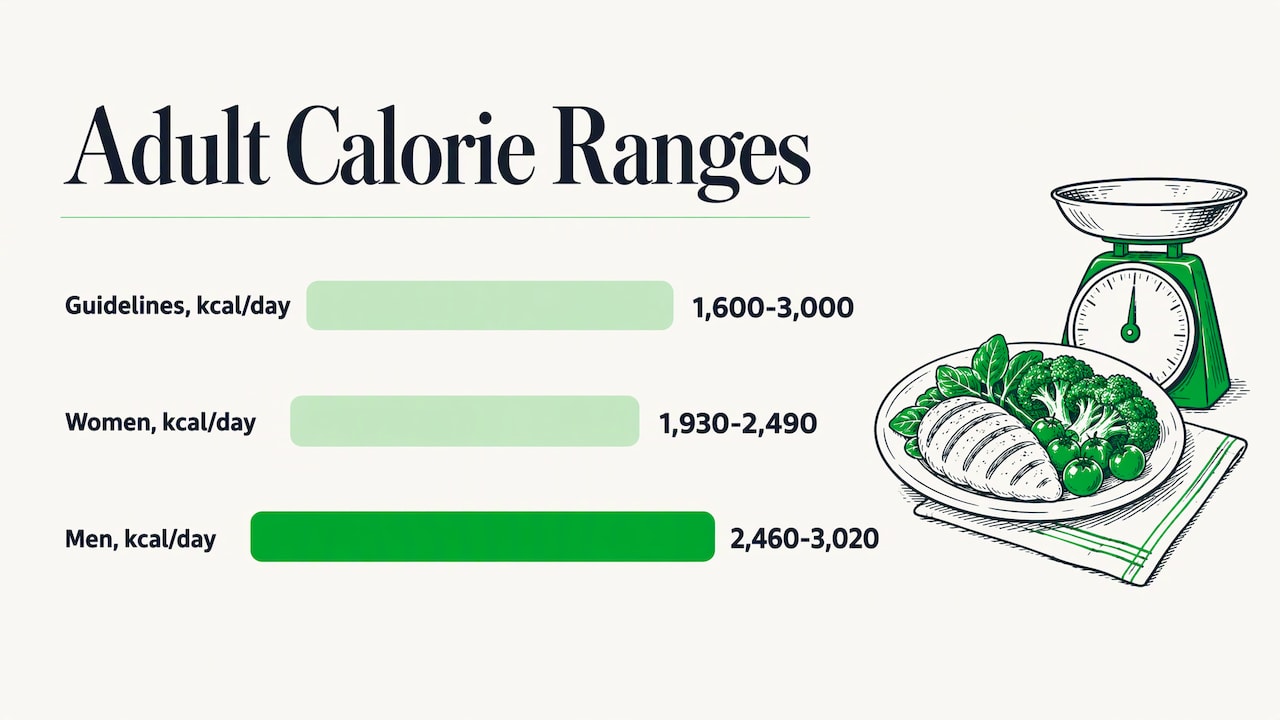
U.S. dietary guidelines, as Cleveland Clinic reports, put adult intakes anywhere between 1,600 and 3,000 calories a day. FitnessVolt’s Mifflin-St Jeor figures for moderately active 30-year-olds run from about 1,930 to 2,490 kcal for women of 120 to 200 lb, and from 2,460 to 3,020 kcal for men of 140 to 220 lb.
So:
- 3,000 calories can be a perfectly ordinary maintenance level for a larger, active man or someone training hard.
- 1,400 calories sits below the maintenance range for most adults. For a smaller, very sedentary person it could be close, but it is a number to confirm with a doctor or dietitian rather than assume.
The point is to compare a number to your own body and routine, not to a stranger’s.
Our perspective
We built VeriTrack because maintenance is only as good as the log behind it. A formula gives you a starting line. The real answer comes from weeks of honest data, and honest data depends on portions, which are the hardest thing to judge by eye.
That is why we show our work. VeriTrack lets you photograph a meal, type it or say it out loud. It estimates portions using USDA data, and on supported iPhones it uses LiDAR depth measurement for sizing. Then it displays the assumptions behind each estimate, so you can see what it guessed and correct it.
We think that matters for maintenance more than for almost anything else. When your weight trend is flat but your intake looks off, you want to know which entries were solid and which were guesses. Visible assumptions turn a confusing average into something you can act on.
You do not need perfection. You need a log you can trust enough to adjust from, and a routine easy enough to keep.
Aliaksei
Find your maintenance with VeriTrack
If you want to run the two-week test without the busywork, VeriTrack is built for it. It sets a daily target based on your body and activity level, keeps a daily meal diary, tracks your progress and sends gentle reminders. It can read your data from Apple Health (read-only). The free tier includes a limited number of AI meal analyses per month, and Premium unlocks unlimited analyses and the full feature set.

Get VeriTrack for iPhone and start logging your first week. You can also browse food and recipe pages to check nutrition for everyday meals.
What to do once you know your number
Maintenance is a reference point. You can use it in three ways:
- Stay at maintenance. Hold your weight while you build habits, recover from a diet or focus on training.
- Set a gentle deficit. NASM’s calculator suggests subtracting 500 to 1,000 calories from TDEE for weight loss. Start at the smaller end if you are new to this, and ask your doctor before going lower. Our guide to portion control for weight loss can help you get there without feeling deprived.
- Eat at maintenance while changing your body. If you lift weights and want to improve body composition, see our post on body recomposition macros.
Whichever you choose, remember that tracking works even when it is not flawless. We explain why in why calorie tracking works, even when you do not do it perfectly.
FAQ
What are maintenance calories?
They are the average daily calories that keep your weight stable. They equal your total daily energy expenditure, which covers resting metabolism, physical activity and digestion. Your weight follows the pattern over weeks, not a single day.
How do I figure out my daily calories to maintain weight?
Estimate your BMR with the Mifflin-St Jeor equation, then multiply by an activity factor from 1.2 to 1.9. Eat near that number for two weeks while logging food and tracking your weekly average weight. Adjust by 100 to 150 kcal if your weight trends up or down.
Is 3,000 maintenance calories a lot?
Not necessarily. U.S. dietary guidelines extend up to 3,000 calories a day for adults, and larger or very active people can need that much. It would be high for a small, sedentary person, so compare it with your own estimate.
Is 1,400 calories enough for maintenance?
For most adults it falls below their maintenance range. Individual needs vary with size, age and activity, so if you are eating this little, talk to a doctor or registered dietitian before settling on a long-term target.
Do maintenance calories change over time?
Yes. Weight loss or gain, new training habits, a different job, age and some medications can all move your number. Recheck it after any big change, using the same two-week method.
Sources
- Maintenance Calories: What They Are, How to Calculate (FitnessVolt)
- Dietary energy (Eat For Health, Australia)
- Dietary reference values for energy (Health Council of the Netherlands, 2022)
- How Many Calories Should I Eat a Day? (Cleveland Clinic)
- Tips to Maintain Your Weight (Healthline)
- Calorie Calculator (NASM)
- Calorie calculator (Mayo Clinic)
- Tips for Maintaining Healthy Weight (CDC)
- Understanding Maintenance Calories (Clean Health)
- Inclusive Progress Tracking in Fitness