
Food Scale Accuracy: How Close Is Close Enough?
How accurate are food scales? Learn what the display really tells you, how to test yours at home, and why portion error matters more than a gram or two.
A good digital food scale is accurate enough for tracking calories and macros. Most consumer scales land within a gram or two of the true weight, and that is far tighter than the other errors in a food log: guessed portions, forgotten extras and mismatched database entries. The number to worry about is rarely the scale’s. It is the total error in the whole logging chain, and that is where we focus our work at VeriTrack.
This guide explains what “accurate” means for a kitchen scale, how to check yours in five minutes, what throws a reading off, and how to log meals well on the days a scale is not in reach.
TL;DR
- Consumer kitchen scales are generally within a gram or two of calibrated weights, and a few grams of error is adequate for most cooking.
- A display that shows 0.1 g or 1 g is about readability, not truth. Finer digits do not prove a more accurate scale.
- You can test your scale with US nickels (5 g each) or any known weights, at the center and the edges, three times each.
- Setup matters: a flat surface, fresh batteries, grams selected and no wind or drafts.
- Portion estimation error is much larger than scale error, so the biggest gains come from consistent, transparent logging.
Table of Contents
- What “accurate” really means on a food scale
- How accurate is accurate enough for tracking?
- How to test your food scale in five minutes
- What throws a food scale off
- Where the real error in your food log comes from
- A worked example: one dinner, two ways
- Choosing a scale: what to look for
- Connecting weights to your tracking routine
- What to do when you cannot weigh the food
- Our perspective
- Log meals with the assumptions in view
- FAQ
- Sources
What “accurate” really means on a food scale
Two words get mixed up. Accuracy is how close a reading is to the object’s true weight. Precision is how consistent the readings are when you weigh the same object again and again. Dietary-assessment testing guidance uses exactly this split. A scale can be precise and still wrong: it reads 52 g every time for a 50 g weight.
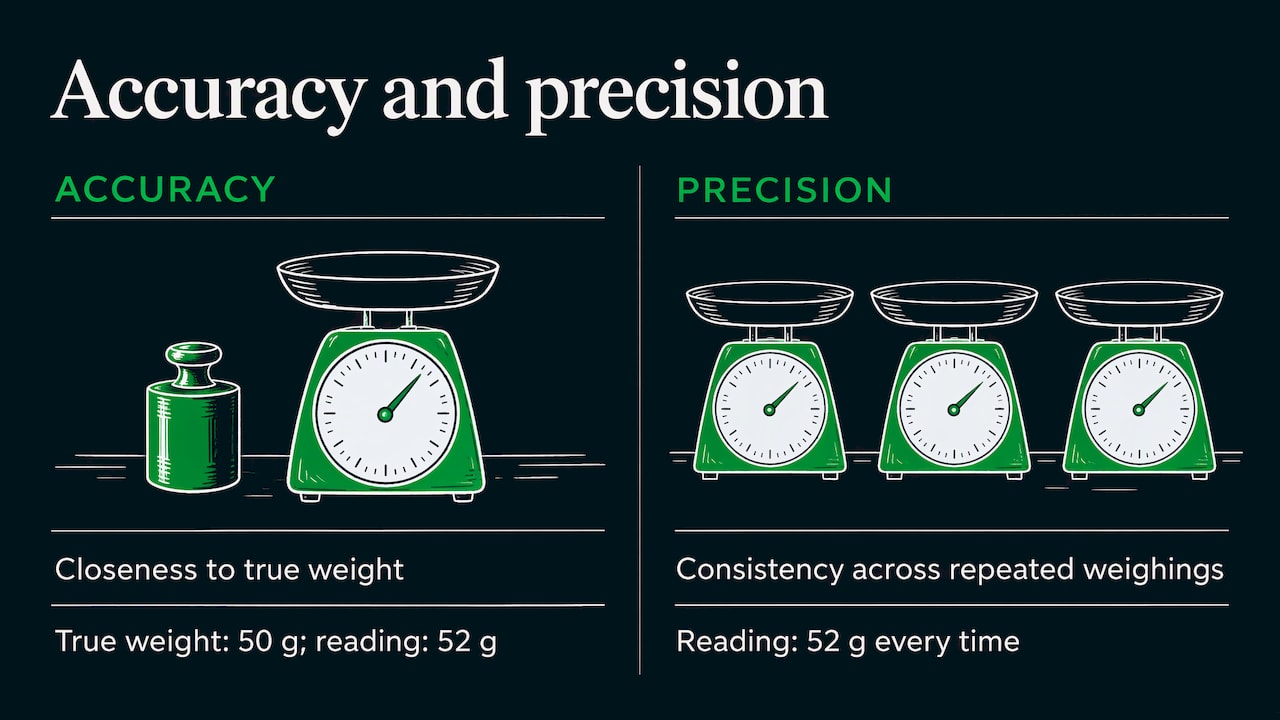
For tracking you want both. Repeatable readings let you compare day to day. Accurate readings let your totals match the food on the plate.
Are scales 100% accurate?
No, and they are not meant to be. Every scale has a tolerance, a small allowed gap between the true weight and the reading. The US National Institute of Standards and Technology (NIST) explains in its weighing and scales FAQ that a scale’s displayed step (the smallest change the screen can show) and its verification division (the step tied to accuracy and legal tolerances) are different things. For a home cook, the practical meaning is simple: a scale that is off by a gram or two is behaving normally.
Why a 1 g display does not mean 1 g accuracy
It is easy to assume that a screen showing 0.1 g can detect a 0.1 g change. It cannot be assumed. America’s Test Kitchen’s 2026 scale review notes that a 1 g display increment does not mean the scale reliably detects a 1 g change, and it reports that ±3 g is common and acceptable for many kitchen uses.
NIST makes the same point from the metrology side: extra displayed digits describe readability, not proof of accuracy.
How accurate is accurate enough for tracking?
The tolerances used for testing dietary scales scale up with the load. The Intake testing protocol suggests these acceptable ranges:
| Test weight | Suggested tolerance |
|---|---|
| 10 to 30 g | ±1 g |
| 50 to 100 g | ±1 g |
| 200 to 300 g | ±5 g |
| 500 to 800 g | ±10 g |
| 2,000 to 3,000 g | ±50 g |
| 5,000 to 6,000 g | ±100 g |
The same guidance recommends 1 g display increments and 1% precision across the load range for survey scales, while noting that no established standard for acceptable accuracy exists for them. In plain terms, a scale that is within a gram on small portions and within a few grams on a plate-sized load is doing its job.
There is a different kind of scale for a different job. Precision scales can show increments as small as 0.01 g, but they typically hold only 100 to 1,000 g and have small platforms, so they complement a general kitchen scale rather than replace it. For meals, a regular scale with a decent platform is the right tool.
How to test your food scale in five minutes
You do not need a lab. You need something with a known weight and a little patience.
- Set up properly. Put the scale on a flat, firm, vibration-free surface, away from direct sunlight, vents and wind. The testing guidance calls for a flat surface, protection from wind, charged batteries and grams selected rather than ounces.
- Pick your reference weights. A US nickel should weigh 5 g, so four nickels should read 20 g. Food Network’s reviewers used four nickels for their accuracy check. For heavier tests, a sealed packaged item with a printed net weight works as a rough guide, though packaging tolerances mean it is less exact than coins.
- Weigh at several points. Serious Eats tests calibrated weights at the center and the corners, repeats measurements, and checks 10 g, 100 g and 500 g loads. Checking one object in the middle can miss real problems, because accuracy can vary with load position, load size and repetition.
- Repeat three times. The CHOICE test method uses three runs for each test and checks small-increment accuracy, accuracy at 1 kg, accuracy at maximum capacity and tare performance (the zeroing function you use with a bowl).
- Handle weights cleanly. Testers there handle small calibrated weights with tweezers and soft gloves so finger oils do not skew the result. With nickels, this is overkill, but clean, dry coins are a good habit.
- Compare to the table above. Four nickels reading 19 g or 21 g is fine. A reading that wanders from 20 g to 24 g between runs is a sign to change the batteries, move the scale or replace it.
A quick note on a common forum question: when one nickel reads 4 g and two read 10 g, the scale is not linear, which means it is unreliable. Consistent errors can sometimes be fixed with the maker’s calibration instructions. If the scale cannot be calibrated, note the discrepancy or replace it.
What throws a food scale off
Most bad readings come from setup, not from a faulty scale.
- Wind and drafts. Even an open window or a kitchen fan can make the number drift.
- Low batteries. Dying batteries can cause erratic displays. Allrecipes’ guide lists low batteries, weight limits and environmental factors among the causes of error.
- The wrong unit. If the scale switched to ounces, a “150” is not what you think it is.
- Uneven or soft surfaces. A folded towel or a tilted counter changes the reading.
- Temperature. Load-cell resistance is influenced by temperature, including the room and the object being weighed, according to a manufacturer’s help-center explanation. A scale that has been in a cold garage and a hot pan placed on it are both worth thinking about.
- Rough handling. The testing guidance recommends re-checking a scale after it is dropped, gets wet or shows an unstable display.
One more habit: press the tare button gently. A 2023 hands-on review of one coffee scale reported that pressing the touch buttons too hard disrupted the displayed weight. Treat that as a reason to be gentle and to wait for the number to settle, not as a rule for every model.
Where the real error in your food log comes from
Here is the key point. A scale error of 1 to 3 g on a 150 g portion is about 1 to 2%. Portion-reporting error is, according to the same dietary-assessment guidance, expected to exceed 1%, and small differences in food weight are not meaningful when estimating energy and nutrient intake.
Now compare that with what happens when people estimate by eye or by cup.
- In a 2017 study of dietetics students and interns, participants identified foods correctly 79.5% of the time, but only 38% of their serving-size estimates were within 10% of the actual weight. Knowing what you are eating is the easy part. Sizing it is hard.
- In a 2016 study of 67 participants, finger-width portion estimates for geometric foods and liquids fell within ±25% of true weight 80% of the time, versus 29% for household measures. The researchers also found that accuracy depends on the method and the shape of the food, with irregular foods being harder to size.
- Volume measures are noisy too. America’s Test Kitchen found that cups of flour measured with the dip-and-sweep method could differ in weight by as much as 20%.
So the logic runs like this. A decent scale takes a 20% to 60% guess down to a few percent. After that point, chasing a more precise scale gives you almost nothing. What matters next is whether you log the food at all, whether you pick the right entry, and whether you can see what your numbers assume.
If you want to go deeper on the habit side, our guide on why calorie tracking works even when it isn’t perfect is a good companion to this one.
A worked example: one dinner, two ways
Say you cook salmon, rice and vegetables.
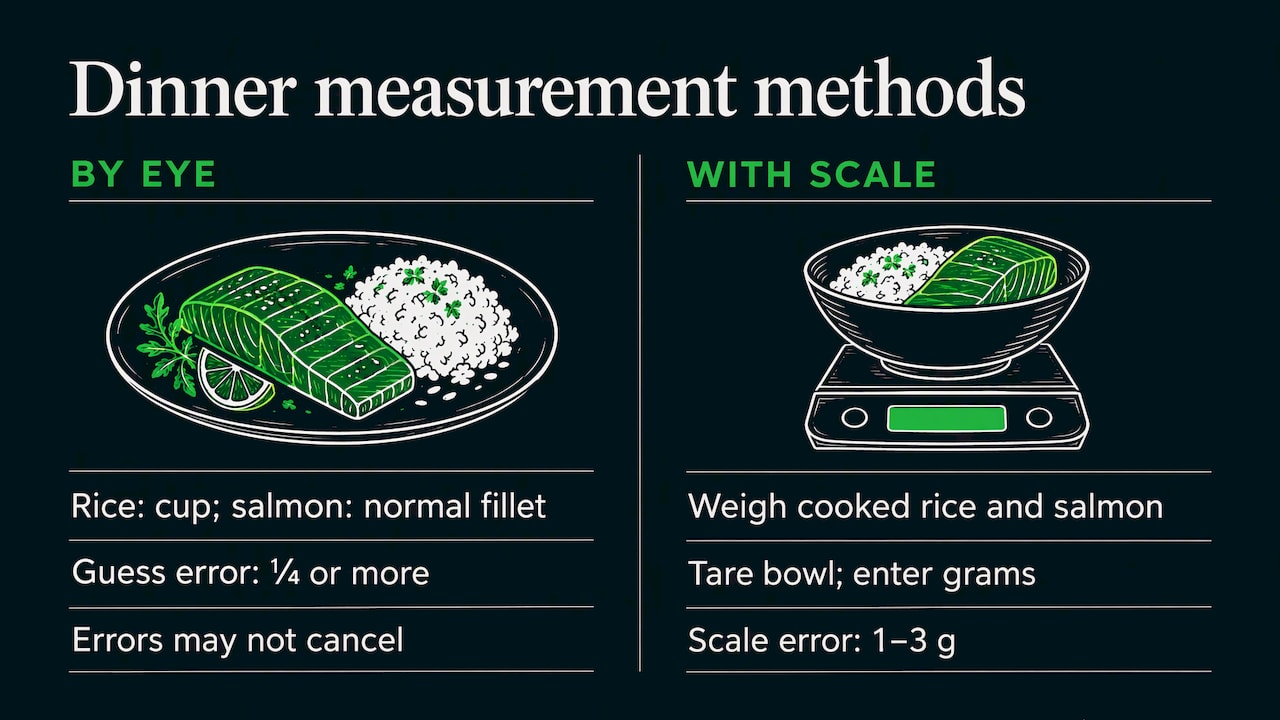
By eye. You call the rice “a cup” and the salmon “a normal fillet.” Based on the studies above, each guess could be off by a quarter or more, and the errors do not necessarily cancel out.
With a scale. You weigh the cooked rice and the salmon, tare the bowl, and enter grams. Your scale may be 1 to 3 g off, which is a rounding error next to the guess.
The habit is what pays off, not the extra decimal. Log what you weigh, keep the same method, and the trend in your numbers becomes reliable. That trend is what drives results, as we explain in our guide to energy balance.
Choosing a scale: what to look for
You do not need the fanciest model. Look for:
- A tare function that zeroes quickly, so you can weigh ingredients in the same bowl one after another.
- A grams setting that is easy to lock in.
- A platform big enough for a dinner plate or a mixing bowl, so you are not balancing food on a tiny surface.
- Capacity that fits your cooking. Several kilograms covers meal prep. A 100 g capacity precision scale will not.
- 1 g increments are enough for meals. Finer increments are handy for spices or supplements, not for dinner.
- Fresh, replaceable batteries or a charging cable you will actually use.
For reviews, the rankings listed in search results compare accuracy across dozens of models, and the test methods above show you how reviewers decided. A scale that does well on center and corner loads, repeats well and handles a range of weights is a safe pick.
Connecting weights to your tracking routine
A weight on the counter is only useful once it becomes a log entry with the right nutrition data attached. Connected scales and wearable workflows try to shorten that path. For a look at how wearable-based macro logging works in practice, see this overview of macro tracking on a watch.
Still, even the best scale does not solve the problem for meals you cannot weigh: restaurant plates, a colleague’s lunch, a bowl at a friend’s table. That is where the rest of your tracking method has to carry the load.
What to do when you cannot weigh the food
This is most of real life. A few ways to keep the error small:
- Write down the assumptions. “One cup cooked rice” and “two tablespoons of oil” are assumptions. When they are visible, you can fix them later. When they are hidden, they quietly become the truth.
- Be consistent. Using the same method each time makes your trend more trustworthy than a perfect weigh-in every third day.
- Log fast. The best log is the one you actually finish. Our walkthrough on how to estimate meal calories shows a practical method, and our guide to portion control for weight loss covers sizing food without a scale.
- Keep a diary. A short daily record beats memory every time. We cover how in keeping a food diary.
Our perspective
We think the scale question is a good one, and the honest answer is reassuring: a decent scale is accurate enough, and you can stop worrying about it once you have checked it.
The harder problem is everything around the weight. A number on a scale becomes a calorie number only after someone picks a food entry, decides what was in the sauce and guesses the oil. Each choice is an assumption, and in most apps those assumptions are invisible.
That is why VeriTrack shows its assumptions instead of hiding them. When you photograph a meal, type it or say it out loud, we estimate the portion using USDA data, and on supported iPhones we add LiDAR depth measurement to size what is on the plate. Then we show you what the estimate rests on, so you can correct a portion or an ingredient in seconds.
We built it for the days when a scale is not at hand and for the days you do not want to bother. You do not need a perfect log. You need a log you can read, check and trust enough to act on.
Aliaksei
Log meals with the assumptions in view
If you weigh your food at home, keep doing it: it is a good habit. For everything else, VeriTrack is built for fast, transparent logging on iPhone. Photograph the meal, type a description or use your voice, and the app estimates portions with USDA nutrition data. On supported iPhones it uses LiDAR for depth, and it lists the assumptions behind each estimate so you can correct them.
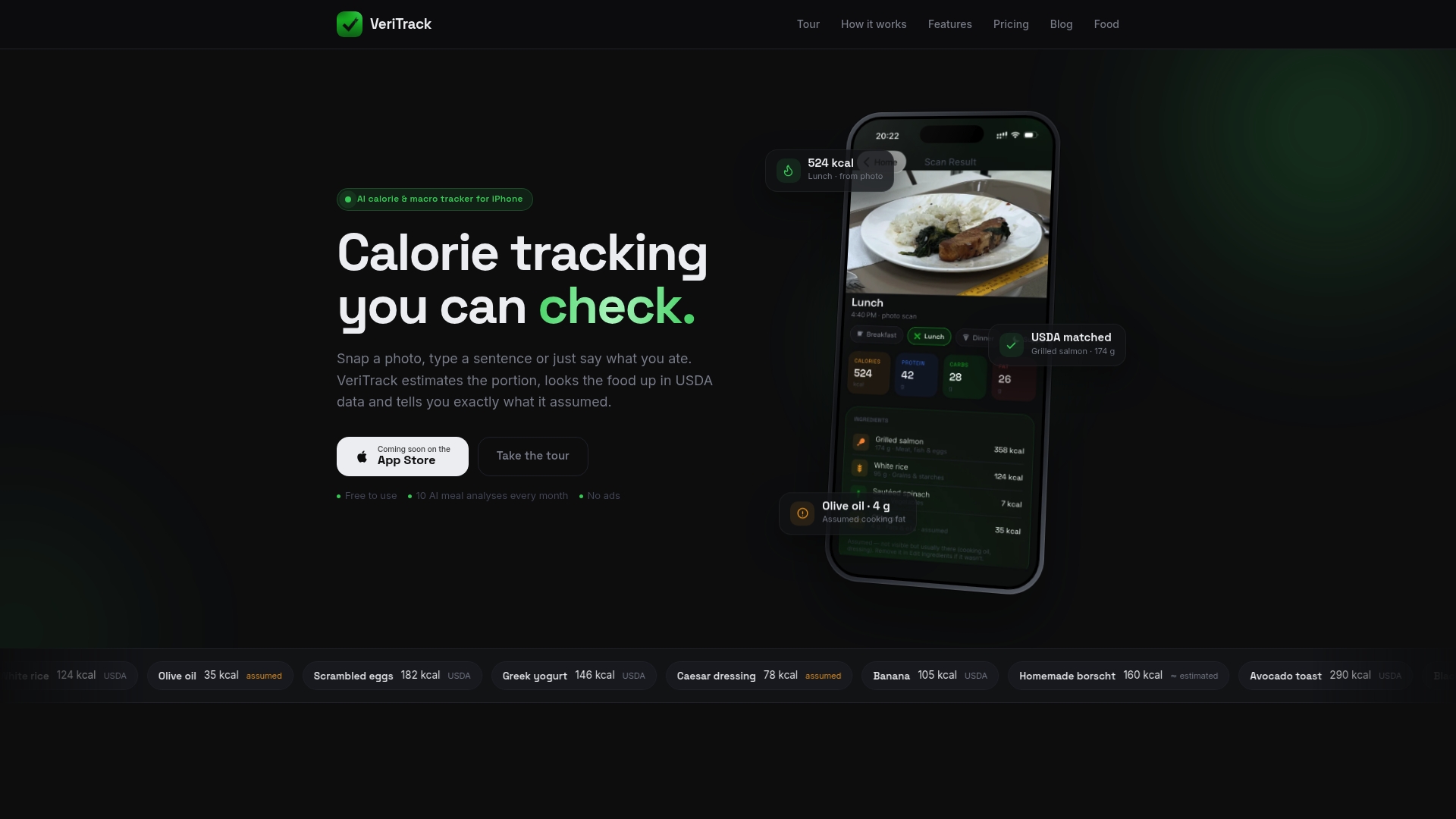
The free tier gives you a limited number of AI meal analyses each month, and VeriTrack Premium unlocks unlimited analyses and the full feature set. You can also set a daily target based on your body and activity level, and read your Apple Health data for context. Start on veritrack.app, or read our practical guide to tracking calories on iPhone first.
FAQ
How accurate are food scales?
Most consumer food scales are within a gram or two of calibrated weights, and a few grams of error is adequate for most cooking. That is much tighter than eyeballing portions, where studies show errors of 25% or more are common. Test yours with coins to be sure.
How do I know if my food scale is accurate?
Place it on a flat surface with fresh batteries and grams selected. Weigh four US nickels, which should total 20 g, at the center and near the edges, three times each. If readings stay within about a gram, your scale is fine for tracking. Repeat after a drop, a spill or an unstable display.
Does a scale that reads to 0.1 g measure more accurately than one that reads to 1 g?
Not necessarily. Display resolution describes how finely the screen shows numbers, while accuracy depends on the scale’s build and tolerances, as NIST explains. For meals, a 1 g scale with a good platform and a reliable tare is plenty.
Is a food scale worth it if I am off by a few grams?
Yes. A few grams on a normal portion is a tiny error next to the 20% or more you can get from cups or guessing. The goal is a consistent, repeatable method, not perfect numbers.
What should I do when I cannot use a scale?
Estimate the portion, write down what you assumed, and log it anyway. VeriTrack lets you snap a photo, type or speak the meal, and shows the assumptions so you can adjust them. A logged estimate beats a skipped meal.
Sources
- The Best Digital Scales of 2026, America’s Test Kitchen
- The Best Precision Kitchen Scales, America’s Test Kitchen
- Ensuring Weight and Temperature Accuracy, America’s Test Kitchen
- Weighing and Scales FAQs, NIST
- Routines and Procedures to Test the Accuracy and Precision of Digital Scales, Intake
- How we test kitchen scales, CHOICE
- 5 Best Kitchen Scales 2026 Reviewed, Food Network
- The 4 Best Kitchen Scales of 2026, Serious Eats
- The Best Food Scales, Allrecipes
- Temperature Effects, Acaia Help Center
- OXO BREW Precision Scale review, First Coffee Then
- Accuracy of hands v. household measures as portion size estimation aids, Journal of Nutritional Science
- Image-Based Dietary Assessment Ability of Dietetics Students and Interns, Nutrients
- Wear OS Macro Tracking, Fortivus Blog