
Calorie Tracking Accuracy: How Close Can You Really Get?
How accurate is calorie tracking? See where errors come from, what the research shows, and how to log portions, recipes and restaurant meals more precisely.
Calorie tracking is not exact, and it does not need to be. The best you can do is make your errors small, consistent and visible. Most of the gap between what you log and what you eat comes from portion sizes, not from the database. That is why we built VeriTrack to measure portions with LiDAR on supported iPhones and to show every assumption behind each estimate, so you can see and correct what is uncertain.
TL;DR
- Self-reported intake is usually too low. Across 59 studies, food records underestimated energy intake by 11–41% compared with a lab reference method.
- Apps are close to USDA data on total calories. The larger problem is portion size, which accounts for about half of app errors.
- Labels are not exact either: the FDA allows calorie counts to be off by up to 20%.
- Weigh or measure, log oils and drinks, and fix the entries you eat often. Consistency beats perfection.
- VeriTrack uses photos, LiDAR depth and USDA data, and labels its assumptions so you can correct them.
Table of Contents
- How accurate is calorie tracking, really?
- Where the errors come from
- What does this mean for you?
- How to log food accurately, step by step
- Photo-based tracking: what it solves
- Do you need to be perfect?
- Try it with VeriTrack
- Our perspective
- FAQ
- Sources
How accurate is calorie tracking, really?
The honest answer is “close enough to guide you, not close enough to treat as a lab measurement.”
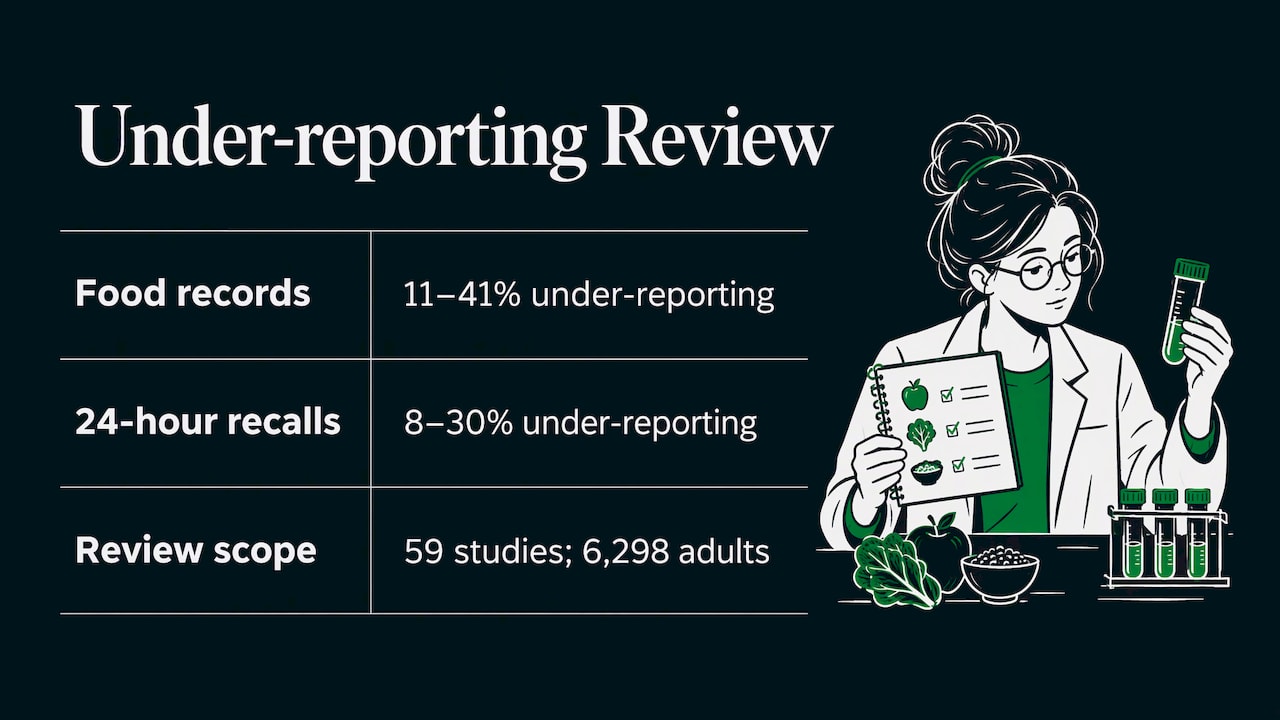
In a 2019 review of 59 studies covering 6,298 adults, researchers compared what people reported eating with doubly labeled water, a lab method that measures energy actually used. Food records fell short by 11–41%. Twenty-four-hour recalls did best, at 8–30% under-reporting.
A separate study of 197 people found that participants were inaccurate on every estimation measure, and their confidence did not match their actual accuracy. Experience with food journaling made only a marginal difference.
This is not a character flaw. It is how memory and eyeballing work. A splash of oil, a handful of nuts and a second helping all fade from memory. The good news is that the errors follow patterns, and patterns can be fixed.
Where the errors come from
There are four main sources. Knowing which one you are dealing with tells you where to spend your effort.
1. Portion size
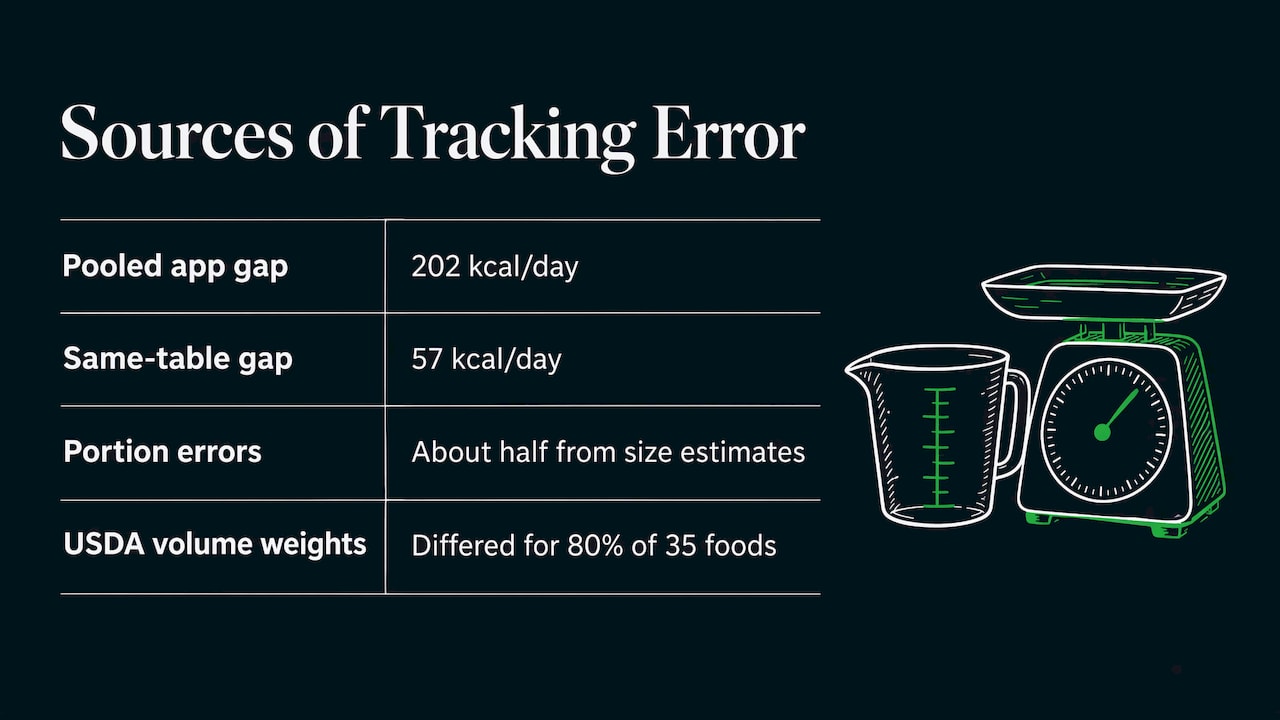
A 2021 meta-analysis of 11 app validation studies found apps underestimated intake by a pooled 202 kcal a day. When the app and the reference used the same food-composition table, the gap shrank to 57 kcal a day. The authors attribute about half of the errors to wrong portion-size estimates. The food data was mostly fine. The amounts were not.
The weight of the same food can also vary by how it is measured. One study found USDA volume-based weights differed significantly from measured weights for 80% of 35 foods. A “cup” of something is not a reliable unit.
2. Database quality
In a comparison of six apps against the USDA database, total calories differed by just 1.4%, but protein was overestimated by 10.4% and fat underestimated by 6.5%. Totals can look right while macros drift.
Crowd-sourced entries add another risk. A Polish validity study noted that user-uploaded entries can carry typos. One app listed buckwheat at 84 kcal per 100 g instead of 336. Other research found that missing food-preparation detail and incomplete nutrient data in app databases pushed nutrient means below research software.
3. Labels
The FDA allows calorie counts on labels to vary by as much as 20%, so a food listed at 100 calories could contain 120, according to Cleveland Clinic. The same source notes that labels show averages, that crop measurements can be outdated, and that cooking changes the energy you absorb. Added cooking oil is commonly undercounted.
Restaurant food runs high. One analysis found actual calories exceeded labeled values by an average of 18% for restaurant meals.
4. Forgotten items
Drinks, sauces, oils and bites while cooking are the usual gaps. In a 1992 study, people who struggled to lose weight underreported their food intake by an average of 47% while overreporting activity. Our guide to hidden calories covers where they tend to hide.
What does this mean for you?
A worked example. Say you eat a bowl of rice you log as 1 cup cooked. If the real portion is closer to 1.5 cups, you have missed roughly half the rice. Add a tablespoon of oil you did not log, around 120 kcal, and one dinner is off by 250 kcal or more. Repeat that daily and it can erase a planned deficit.
The fix is not to log less often. It is to correct the biggest and most common errors first: starches, oils, dressings, nuts and drinks.
How to log food accurately, step by step
Step 1: Measure portions, especially the dense foods
The NHS advises weighing portions before cooking. Its example: 75 g of rice is 260 kcal, while 150 g is 520 kcal. Eyeballing a double portion is easy to do.
A scale is the gold standard at home, and small scale errors matter less than you may think. See how close is close enough for food scales. When a scale is not practical, such as at a restaurant, a depth-aware photo is the next best thing. In VeriTrack, LiDAR on supported iPhones measures the depth of the food on the plate to estimate the portion, and the app uses USDA data for the nutrition lookup.
Step 2: Log it when you eat it
The 24-hour recall performed best in the research above, and memory fades fast. A photo, a typed line or a voice note takes seconds in VeriTrack, which is what busy days need. Logging right away avoids the “what did I have for lunch?” problem at 9 p.m.
Step 3: Count the extras
The NHS also says to include alcohol, fizzy drinks, juices, cooking oils, spreads, toppings and sauces such as mayo and ketchup. Add the oil you cooked with. Add the splash of cream in coffee. For more, see our guide to estimating meal calories.
Step 4: Check the entry, not just the total
Before you save, glance at the macros and the serving unit. A food entry of 84 kcal per 100 g for grain is a red flag. VeriTrack shows the assumptions behind each estimate, such as the food it matched, the portion it inferred and the preparation it assumed, so you can correct anything that looks off. Your correction is part of the log.
Step 5: Build recipes once
Home-cooked meals are the hardest to log because ingredients change. Calculate the recipe’s total, divide by servings and reuse it. Our guide to recipe macro tracking walks through it.
Step 6: Keep foods you eat often correct
A 2024 study across 16 manual logging apps found energy was overestimated for Western diets and underestimated for Asian diets. The authors suggest verifying commonly logged foods and clarifying portion sizes. Fixing your top 10 foods once pays off every week.
Photo-based tracking: what it solves
Photo tools are not magic. A 2024 pilot study of one portion-size app found its food weight estimates matched digital photography (1,105 vs 1,086 g a day), but energy estimates differed by 15.6%. The lesson is that portion and food identification are separate problems, and both need to be visible to you.
That is the idea behind showing assumptions. If a photo estimate says “cooked white rice, 180 g, cooked in no oil,” you can see at once what to change. A single number gives you nothing to fix. If you want to explore how portion estimation works in general, a private calorie calculator you can test is a useful place to see how inputs change an estimate.
Do you need to be perfect?
No. Steady, slightly imperfect logging still shows trends, and trends are what you act on. If your weekly average weight is not moving as your logs predict, adjust your portions or targets rather than abandoning the log. We explain more in why calorie tracking works even when it is not perfect. If you are tracking for weight loss, portion control is where most of the accuracy gains are.
Calories burned are a different matter. Wearable and app burn estimates are far less reliable than food data, so treat them as a rough guide. VeriTrack sets a daily target from your body and activity level and reads Apple Health data in read-only mode.
Try it with VeriTrack
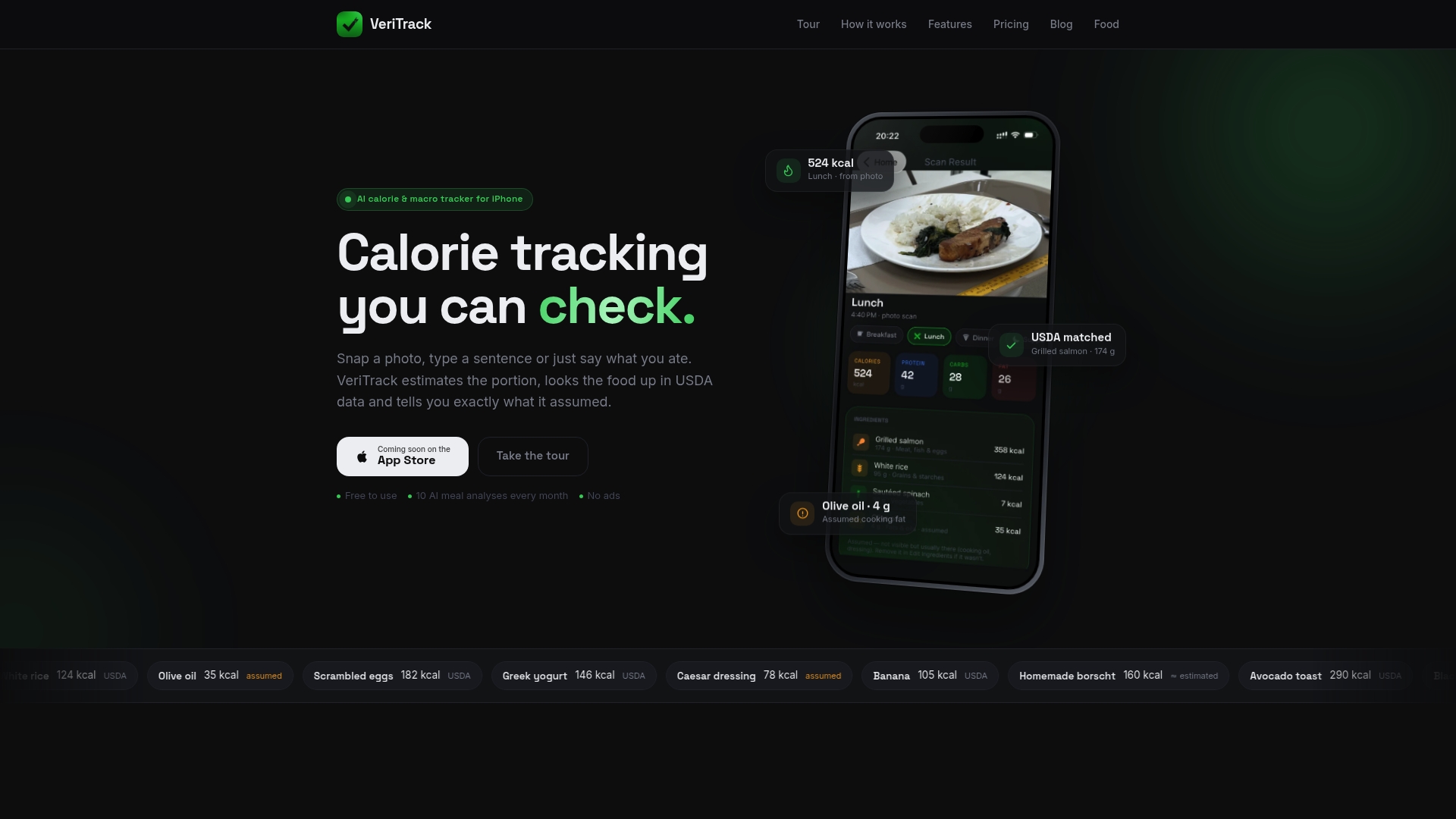
VeriTrack is an iPhone app for calorie and macro tracking. You can photograph a meal, type it or say it, and it estimates the portion with LiDAR on supported iPhones, looks up nutrition from USDA data and shows its assumptions so you can correct them. The free tier includes a limited number of AI meal analyses each month, and VeriTrack Premium unlocks unlimited analyses. Get VeriTrack and log your next meal in seconds.
If you cook a lot, browse food and recipes too.
Our perspective
Most accuracy advice tells you to be more careful. We think that is the wrong lever. People are already trying. The trouble is that a single calorie number hides everything that went into it.
The research agrees: much of the error sits in portions and preparation, not in the totals. So we designed VeriTrack to show its work. When it estimates a meal, it labels the assumptions, uses LiDAR depth for portions on supported iPhones, and lets you change what is wrong.
You do not need a perfect log. You need one you can trust and fix in a few seconds, every day.
Aliaksei
FAQ
How accurate are calorie tracking apps?
On total calories, many apps land close to USDA data, with one review finding a 1.4% difference. Individual macros and user-added entries are less reliable, and a pooled analysis found apps still underestimate intake by about 202 kcal a day. Portion errors drive much of that.
How do I track calories accurately?
Measure dense foods, log at the time you eat, count oils, sauces and drinks, and check each entry’s serving and macros. Keep your most common foods corrected.
Are nutrition labels accurate?
They are approximate. The FDA allows up to a 20% variation, so a label is a good estimate rather than an exact value.
Do I need a food scale?
A scale is the most direct way to fix portion errors at home. When you eat out or are in a hurry, a photo with depth measurement gives you a practical estimate you can still adjust.
Sources
- Validity of Dietary Assessment Methods When Compared to Doubly Labeled Water (Frontiers in Endocrinology, 2019)
- Quantifying Actual and Perceived Inaccuracy When Estimating the Sugar, Energy Content (PubMed, 2019)
- Systematic Review and Meta-Analysis of Validation Studies of Dietary Record Apps (PMC, 2021)
- Comparison of Nutrient Estimates Based on Food Volume versus Weight (PMC, 2018)
- A Focused Review of Smartphone Diet-Tracking Apps (PMC, 2019)
- Low Comparability of Nutrition-Related Mobile Apps (Nutrients, 2021)
- Assessment of the accuracy of nutrient calculations of five popular apps (PMC, 2018)
- Is Counting Calories Worth It? (Cleveland Clinic, 2025)
- Comparison of Accuracy in the Evaluation of Nutritional Content (PMC, 2025)
- Discrepancy between Self-Reported and Actual Caloric Intake (NEJM, 1992)
- Calories and weight loss (NHS Better Health)
- Evaluating the Quality and Comparative Validity of Manual Food Logging Apps (Nutrients, 2024)
- Evaluating the Validity of the PortionSize app (ScienceDirect, 2024)