
Hidden Calories: Where They Hide and How to Count Them
Hidden calories are the oils, drinks, sauces and portions that never reach your log. See where they hide, with numbers, and how to count them without stress.
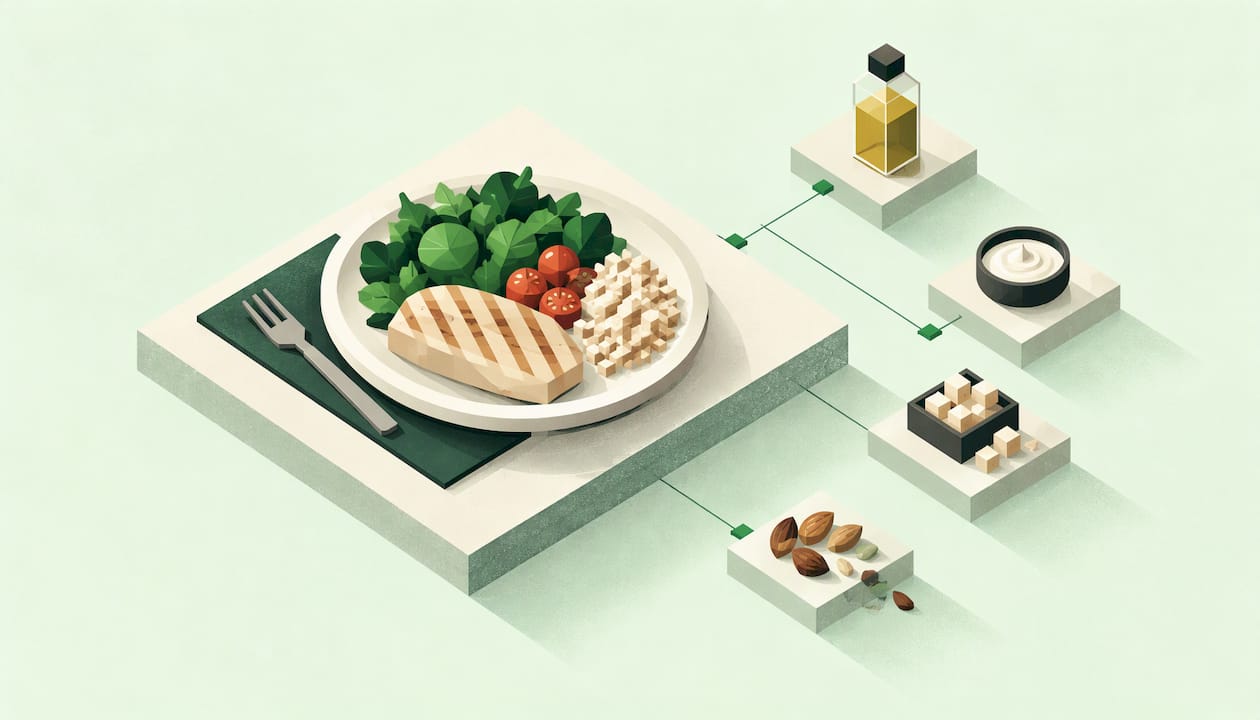
Hidden calories are the calories you eat but never write down: the cooking oil, the splash of creamer, the sauce, the second helping, and the gap between a label’s serving and your actual portion. They are rarely a sign you are doing something wrong. They are what happens when memory and guesswork meet calorie-dense food. The fix is to know the usual hiding places, measure them for a short while, and use a tracker that shows its assumptions so you can correct them. VeriTrack is built around that idea: photo, text or voice logging, USDA-based nutrition data, and estimates that spell out what they assume.
TL;DR
- Most hidden calories come from drinks, cooking fats, sauces, toppings and portions larger than the label’s serving, not from “bad” foods.
- Small items add up: the CDC’s examples show a single swap of high-calorie drinks saving 641 kcal a day.
- A label’s serving is not your portion. Check the servings per package before you multiply.
- Weigh and measure for a couple of weeks to calibrate your eye, then rely on estimates you can see and adjust.
- Consistency beats perfection: a log that includes the oil and the sauce is more useful than a perfect log of half the meal.
Table of Contents
- What hidden calories actually are
- The usual hiding places
- Portions: the biggest hidden source
- How to count them without going crazy
- A worked example: one ordinary day
- Where VeriTrack fits
- Try it on your next meal
- A short checklist for the next week
- FAQ
- Sources
What hidden calories actually are
The phrase sounds like food companies are sneaking something in. Usually nothing is concealed. The calories are simply easy to overlook, for three reasons.
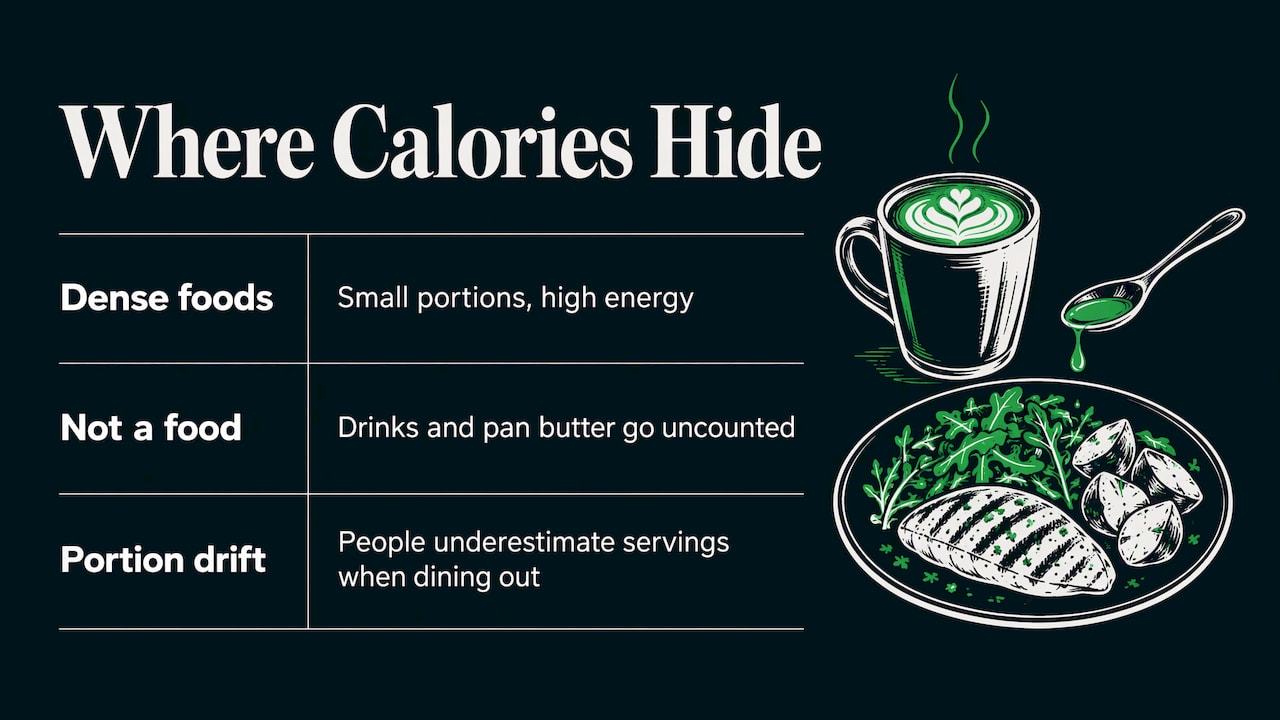
First, some foods are dense. A tablespoon of oil or a handful of nuts is small, quick to eat and packed with energy, so it leaves almost no memory of having been eaten.
Second, some calories are never “a food” in your mind. A latte, a juice, a glass of wine or the butter used to grease a pan does not feel like part of the meal.
Third, portions drift. The label describes one serving. You eat what is on your plate, and Mayo Clinic notes that people commonly underestimate how much they eat, particularly when dining out.
A kcal, short for kilocalorie, is the unit usually called a “calorie” on labels. If your daily target is, say, 2,000 kcal, an extra 300 kcal that you never log is 15% of the day. That is enough to blur the picture when you are trying to lose weight or hold steady.
None of this calls for guilt. It calls for knowing where to look.
The usual hiding places
The NHS lists alcohol, fizzy drinks, juices, cooking oil and spreads, toppings or accompaniments such as cheese or yogurt, and sauces such as mayonnaise and ketchup as typical sources of calories people forget to count. Other health organizations name the same patterns. Here they are grouped by where they appear in your day.
Drinks
Liquid calories are the easiest to miss because they do not feel like eating.
- Soda and energy drinks. Health.com reports that an 18-ounce Coca-Cola contains 215 kcal and more than 50 g of added sugar, and a 16-ounce Rockstar energy drink contains 260 kcal and 63 g of added sugar.
- Juice. Mayo Clinic’s example: 8 oz of orange juice is 112 kcal, while a 4 oz serving is 56 kcal. The glass you pour is rarely 4 oz.
- Coffee drinks. UF Health explains that coffee itself is low in calories, but high-fat milk, sweet flavorings and whipped cream can raise the total substantially.
- Smoothies. Cleveland Clinic dietitian Julia Zumpano lists smoothies and custom coffee drinks among the items where calories pile up fast.
- Alcohol. The NHS names it as a common source people leave out of their count.
The CDC’s illustrated example shows that replacing high-calorie drinks with low- or no-calorie ones can save 641 kcal per day. That is a large number from a change that involves no food at all, which is why drinks are the first place to look.
Cooking fats and spreads
Oil disappears into a pan and into a recipe. You see the finished dish, not the tablespoon that went into it. The NHS lists cooking oil and spreads among the usual culprits, and Cleveland Clinic names cooking oils, nut butter and cream cheese.
The CDC offers a sense of scale: using cooking spray instead of a pat of butter saves 34 kcal. One pat is small. Daily habits repeat it.
Sauces, dressings and toppings
A salad can be a light meal or not, depending on the dressing. The CDC’s examples say that cutting ranch dressing from 2 tablespoons to 0.5 tablespoon saves 109 kcal, and that a side salad with low-fat vinaigrette instead of medium fries saves 270 kcal. Health.com adds that dips and dressings can contain more than 100 kcal per 2 tablespoons, and two tablespoons of honey come to 127 kcal.
Cheese, sour cream and yogurt toppings belong here too. They go on at the end, almost without thinking.
Snacks that sound healthy
Cleveland Clinic’s list includes packaged snacks, granola, trail mix and nut butter. The point is not that they are poor choices. Zumpano’s advice is moderation, not avoidance: these foods can fit a balanced diet when the serving size is visible. A handful of trail mix is easy to double without noticing.
Illinois Extension also flags large breads, cheese, fried or heavily enriched potatoes and sweetened dry cereals as concentrated-calorie foods.
Soups and restaurant meals
Soup looks light, but cream changes it. UF Health gives roughly 400 kcal for 1 cup (250 ml) of many creamy soups, compared with about 100 kcal for 1 cup of broth-based minestrone.
Restaurants are the biggest unknown. A JAMA Internal Medicine study of 3,507 meal variations from 19 Canadian chain restaurants found the average breakfast, lunch and dinner contained 1,128 kcal. Beverages, appetizers and condiments were not included, so what customers actually eat could be higher. The study is Canadian and from 2013, but the pattern, big plates plus extras, will look familiar.
Portions: the biggest hidden source
Most hidden calories are not a secret ingredient. They are a multiplication you did not do.
The National Institute of Diabetes and Digestive and Kidney Diseases (NIDDK) draws a useful line. A portion is the amount you choose to eat; a serving size is the amount specified on a product label. The two are often different.
The arithmetic is simple once you see it:
- NIDDK’s example: two servings of a food labeled at 280 kcal per serving equal 560 kcal.
- The CDC’s example: a 20-ounce soda labeled 100 kcal per 8-ounce serving, with 2.5 servings per bottle, holds 250 kcal.
- Mayo Clinic’s example: 1.5 cups of cooked whole-grain noodles hold 355 kcal, versus 237 kcal for 1 cup.
The NHS adds that packaged calories are usually shown per 100 g, 100 ml or per portion, and that the manufacturer’s portion might differ from what you eat. So before you log anything from a package, check two things: the unit the number refers to, and how many of those units you actually ate.
This is also where tracking tools earn their place. A tool that lets you enter what you actually ate, rather than a label’s default, closes most of this gap. Parents managing feeding and meal routines around a new baby can find that same serving-versus-portion thinking in these baby milestone tracker benefits for first-time parents.
Can a food really have zero calories?
A “zero calorie” label is not always zero. Under U.S. regulation 21 CFR 101.60, a food can be called calorie-free when it has fewer than 5 calories per reference amount and labeled serving. That rule applies to U.S. labeling, not everywhere. One spray of oil or one packet of sweetener rounds down. Ten sprays do not. If something is calorie-free by label and you use a lot of it, count the use.
How to count them without going crazy
The worry behind “how do I track calories without going crazy” is a fair one. You do not need to weigh every grain of rice for life. A calmer routine has four parts.
1. Calibrate your eye for a short time
The NHS suggests that when you begin, you weigh portions before cooking to learn whether your usual amount matches the package portion. It describes weighing as a learning tool, not something to do forever. After a couple of weeks, your eye is much better. Our guide to estimating meal calories walks through a practical method.
2. Log the extras first
The NHS recommends keeping a daily record of everything you eat and drink, including oils, spreads, toppings, sauces, alcohol, fizzy drinks and juices. Make the extras the first thing you log, while you still remember them, rather than the afterthought you skip. If you are new to this, keeping a food diary covers how to start and make it stick.
3. Plate it, do not eat from the package
NIDDK’s practical advice: serve one labeled portion onto a plate rather than eating from the package, avoid distractions while eating, use smaller dishes and glasses, eat slowly, and divide leftovers into single or family portions. These habits do not require arithmetic. They keep the portion you chose equal to the portion you ate. More on this in our portion control guide.
4. Accept an estimate, and label it as one
Perfect accuracy is not available at a restaurant table. An honest estimate is. Research on photographs has long suggested it is workable: a Cambridge study of food photography found that 80% of energy estimates based on photographs were within plus or minus 25% of the amount calculated from actual portion weights. That study is from 1996 and used printed photographs, so treat it as a sign that visual estimation can be reasonable, not as a promise for any tool.
The habit that matters is writing the assumption down. “Two tablespoons of dressing” is a number you can fix later. “Salad” is not.
If an item is uncertain, round toward the realistic and move on. Our piece on why calorie tracking works even when you do not do it perfectly explains why a good-enough log still changes behavior.
A worked example: one ordinary day
Here is a plausible day for someone who believes they ate about 1,800 kcal. The figures for the extras come from the sources above; the rest of the day is the person’s own estimate.
- Breakfast: a coffee with high-fat milk, sweet flavoring and whipped cream. UF Health says these can raise the drink’s calories substantially. It was logged as “coffee.”
- Lunch: a salad with 2 tablespoons of ranch. The CDC’s example implies that cutting this to 0.5 tablespoon saves 109 kcal, so the full amount is a meaningful addition that was never logged.
- Afternoon: an 18-ounce soda, 215 kcal per Health.com. Not logged, because it was “just a drink.”
- Dinner: pasta cooked with oil and finished with cheese. The oil and the cheese were not logged.
The day did not include a single dramatic food. The missing calories are the dressing, the soda and the toppings, which together can reach several hundred kcal. This is how a person eats “1,800” and gets results that match 2,100.
Now run the same day with the extras logged first. The total is higher, the picture is honest, and the next change is obvious: swap the soda, halve the dressing, measure the oil once to see what a tablespoon looks like. No food has been banned.
Where VeriTrack fits
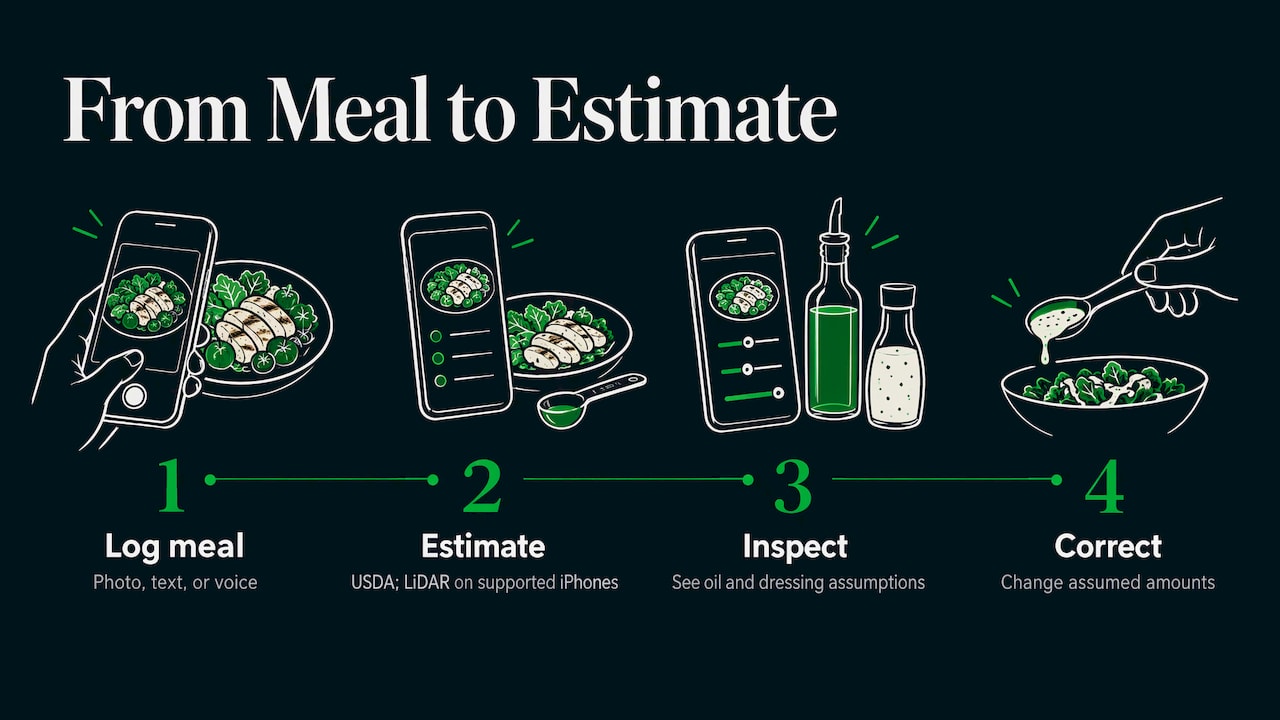
VeriTrack is an iPhone calorie and macro tracking app. You can photograph a meal, type a description or use your voice, and it estimates portions using USDA data. On supported iPhones it uses LiDAR depth measurement to improve portion sizing. The part that matters for this topic is that it shows the assumptions behind each estimate. If it assumed a tablespoon of oil or a certain amount of dressing, you see that, and you can correct it.
That is exactly how hidden calories get found: not by trusting a number, but by seeing what went into it. You also get a daily target based on your body and activity level, a daily meal diary, progress tracking, read-only Apple Health integration and gentle reminders.
Hidden calories are not a character flaw. They are a design problem in how we remember food.
We built VeriTrack around a simple belief: you should be able to see how a number was reached. When an app gives you a single figure and no reasoning, you cannot tell whether the oil was counted, whether the portion was a guess or what database it came from. So we label our assumptions and let you change them.
That matters most for the foods this article covers. Dressings, cooking fats, drinks and portion sizes are exactly where a hidden assumption can move the total. When the assumption is on screen, it stops being hidden.
We would rather you log an honest estimate every day than a perfect entry twice a week. Consistency is the habit that changes outcomes, and clarity is what makes consistency easy to keep.
Aliaksei
Try it on your next meal
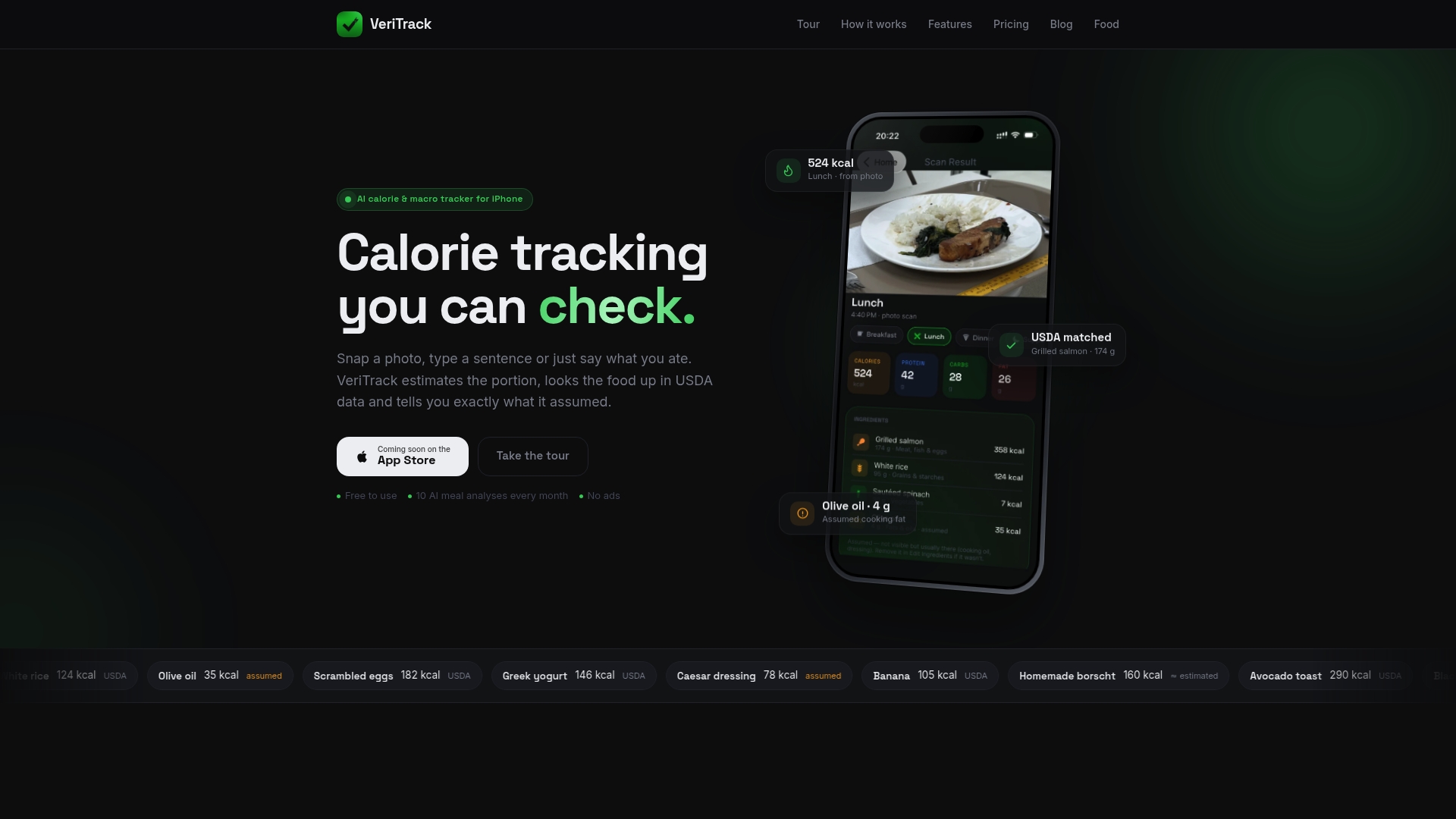
If you want to see where your own extras are hiding, VeriTrack makes the check quick: snap the plate, say what was in it or type it, and read the assumptions it shows. The free tier includes a limited number of AI meal analyses each month, and VeriTrack Premium offers unlimited analyses and the full feature set. Get VeriTrack for iPhone and log one ordinary day, extras included.
For a step-by-step setup, read our guide on how to track calories on iPhone. If you want to turn the logged totals into a target, see maintenance calories explained.
A short checklist for the next week
- Log your drinks first, including coffee add-ins and alcohol.
- Measure your cooking oil and dressing once, so you know what a tablespoon looks like.
- Read the servings per package, then log the number you actually ate.
- Plate your snacks instead of eating from the bag.
- At restaurants, log an honest estimate and include the bread, sides and sauce.
- After two weeks, look at your log and ask which extras show up most often.
That last question is the real payoff. Most people find two or three repeat offenders, and changing only those moves the total more than any dramatic rule would.
FAQ
How do I track calories without going crazy?
Log the easy-to-forget items first, weigh portions for a short learning period, then switch to estimates. The NHS describes weighing as a learning tool rather than a permanent chore. A log you keep up is more useful than a perfect one you drop after a week.
Does anything really have zero calories?
Water does, and some products are labeled that way. In the U.S., a food can claim zero calories when it has fewer than 5 calories per labeled serving, so repeated servings of a “zero” product can add up. Count heavy use, such as many sprays of oil or several packets of sweetener.
Are hidden calories only in unhealthy food?
No. Healthy foods such as nuts, avocado, granola, nut butter and olive oil are dense, so a small extra amount adds a lot of energy. Cleveland Clinic’s dietitian recommends moderation, not avoidance: make the serving visible and the food can fit a balanced diet.
Is the calorie number on a label my number?
Only if you eat exactly one labeled serving. The label describes the manufacturer’s serving, and you may eat two or two and a half. Multiply the calories by the number of servings you ate, as in the CDC’s soda example of 250 kcal for a 20-ounce bottle.
Sources
- Calories and weight loss, NHS Better Health
- Participant Guide: Burn More Calories Than You Take In, CDC
- Small ways calories add up in your diet, Cleveland Clinic
- Diet-Busting Foods, UF Health
- Concentrated Calories, Illinois Extension
- Restaurant Meals: Almost a Full Day’s Worth of Calories, JAMA Internal Medicine
- 12 Foods and Drinks That Can Add Extra Calories, Health.com
- Food Portions: Choosing Just Enough for You, NIDDK
- Counting calories: Get back to weight-loss basics, Mayo Clinic
- Food photography II, Cambridge University Press
- 21 CFR 101.60, Cornell Legal Information Institute
- Baby Milestone Tracker Benefits for First-Time Parents