
Protein Timing: When to Eat Protein for Muscle and Recovery
The best time to eat protein is less about a magic window and more about total intake and even meals. Here's what the research says and how to apply it.
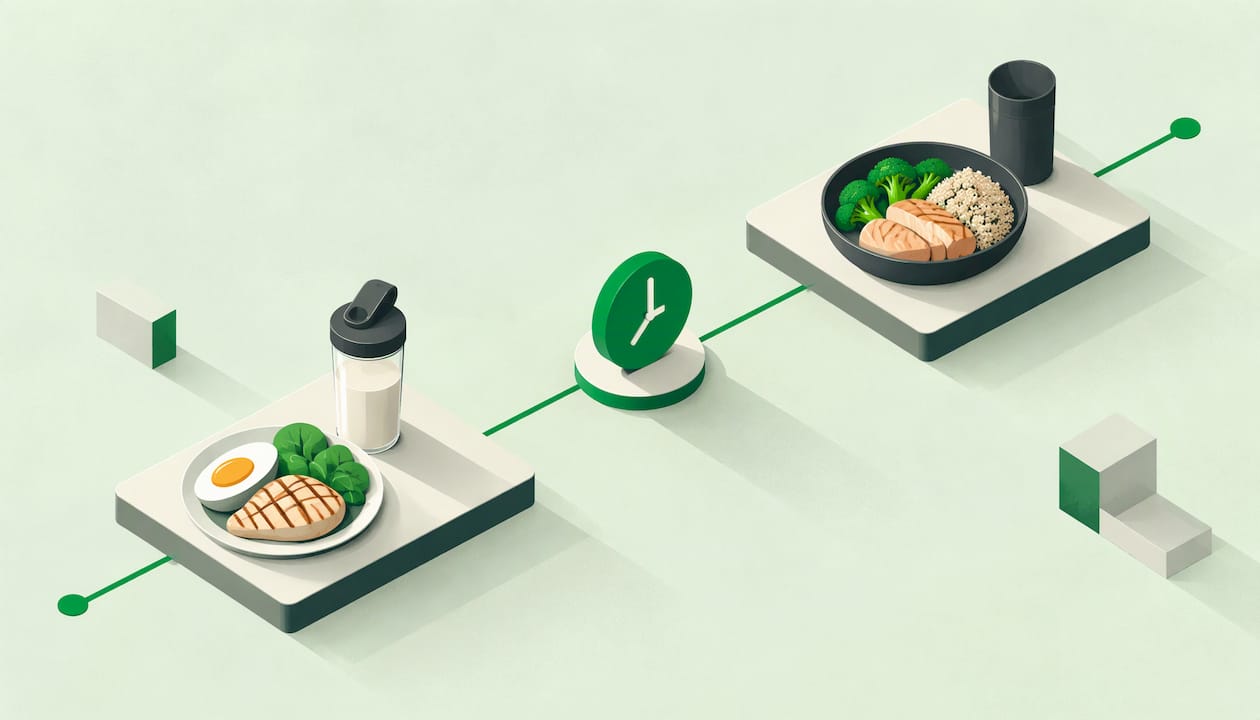
The best time to eat protein is spread across your day: roughly 20 to 40 g per meal, every 3 to 4 hours, after you’ve reached your daily total. The “30-minute window” after a workout is much wider than gym lore says. The hard part is not the clock. It’s knowing how much protein is on your plate at each meal, and that’s where logging with visible estimates pays off.
This guide covers what the research supports, what it doesn’t, and how to build a simple protein schedule you can keep on a busy day.
TL;DR
- Hit your daily protein total first. Timing is the second lever, not the first.
- Aim for about 0.25 to 0.40 g of protein per kg of body weight per meal (20 to 40 g for most people), spread across 3 to 5 meals.
- You don’t need to rush a shake after training: studies find the useful window around a workout is hours wide, not minutes.
- A slow-digesting protein before bed (20 to 40 g of casein) can add to your daily total and overnight recovery.
- Logging protein by meal shows you where your day is lopsided, so you can fix it with one change.
Table of Contents
- What protein timing actually means
- Total daily protein comes first
- How much protein per meal
- How far apart to space your meals
- Before or after your workout
- Protein before sleep
- Protein timing for fasting and irregular schedules
- A sample day for an 80 kg person
- Making timing measurable
- Common mistakes
- Try it in VeriTrack
- Our view on protein timing
- FAQ
- Sources
What protein timing actually means
Protein timing is when you eat protein relative to your workouts, your meals and your sleep. It covers three separate questions:
- Distribution: how you split protein across meals.
- Peri-workout timing: whether you eat it before or after training.
- Pre-sleep timing: whether a late dose helps overnight.
These have different answers, and most confusion online comes from blending them. Marketing around “anabolic windows” talks about question two. The stronger evidence is about question one.
Total daily protein comes first
Before you worry about the clock, check your daily number. The International Society of Sports Nutrition (ISSN) states that 1.4 to 2.0 g of protein per kg of body weight per day is enough for most exercising people to build and maintain muscle. During a calorie deficit, the same position stand notes that 2.3 to 3.1 g/kg/day may be needed to hold on to lean mass.
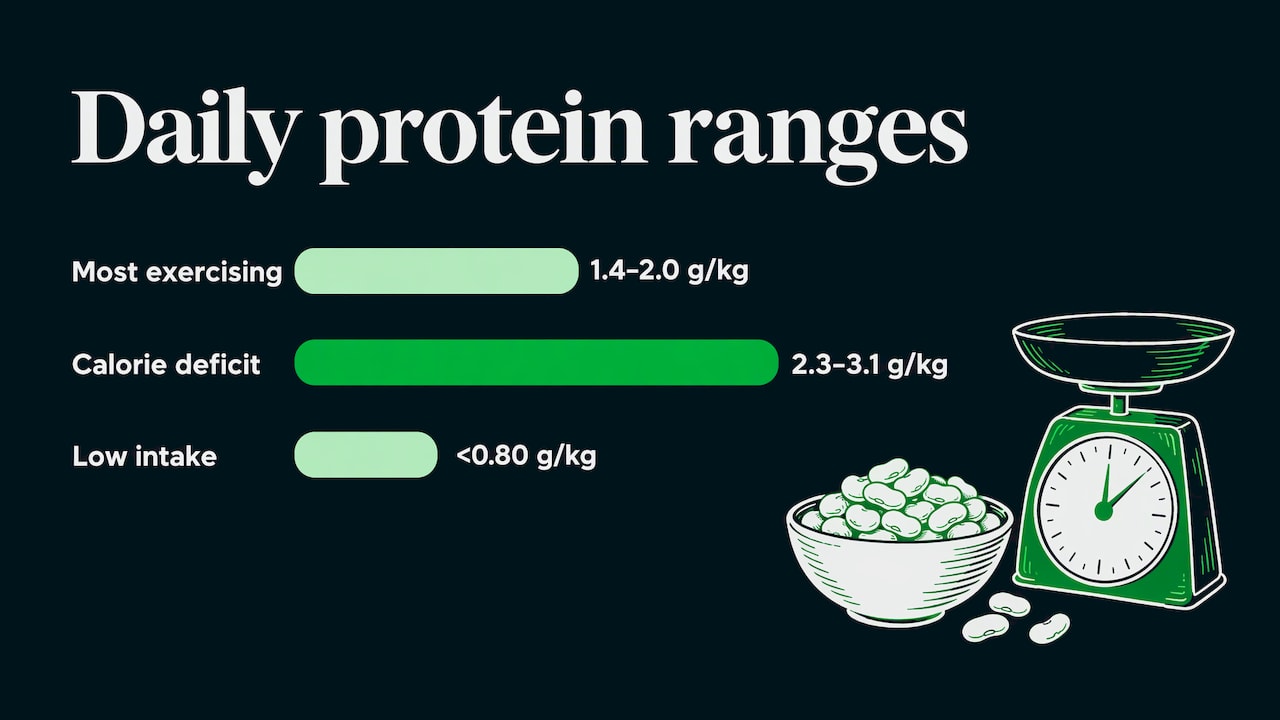
A review of protein distribution research makes the order of priorities clear. Its authors say the evidence for an optimal distribution is limited and inconsistent, and that the effect of distribution is hard to separate from the effect of simply eating more protein. For adults with low intakes, below 0.80 g/kg/day, they suggest that a more balanced spread may be a practical way to eat more protein overall.
The takeaway for you: if you’re short on total protein, a better schedule can help mostly because it gets you to a higher total. If you already hit your number, timing becomes a refinement.
A quick way to find your number
Divide your weight in pounds by 2.2 to get kilograms. Then multiply:
- General fitness and muscle maintenance: 1.4 to 2.0 g/kg per day.
- Cutting or dieting while training: the higher end of the range, up to 2.3 to 3.1 g/kg per day per the ISSN, and 1.6 to 2.4 g/kg per day in a review of weight loss in athletes.
For an 80 kg (about 176 lb) person, 1.6 g/kg is 128 g of protein a day. We’ll use that example below.
If you’re setting protein alongside calories, our guide to energy balance explains how the two fit together, and the body recomposition macros article shows how to set a protein target when you want to lose fat and keep muscle.
How much protein per meal
Muscle protein synthesis, the process your body uses to build and repair muscle, responds to each protein-containing meal. Research gives a consistent dose range for what triggers a strong response.
- The ISSN position stand recommends about 0.25 g/kg per meal, or an absolute 20 to 40 g, spread evenly every 3 to 4 hours.
- A review by Schoenfeld and Aragon suggests 0.4 g/kg per meal across at least four meals to reach 1.6 g/kg per day, with an upper figure of 0.55 g/kg per meal if you eat 2.2 g/kg per day.
- Hector and Phillips report that, in energy balance, adults need about 0.24 g/kg at each meal to maximally stimulate muscle protein synthesis.
Put those together and a practical target is 0.25 to 0.40 g/kg per meal. For our 80 kg example, that’s 20 to 32 g per meal.
The most common real-life pattern is a small breakfast (a coffee and toast, maybe 8 g of protein), a modest lunch and a big dinner holding half the day’s protein. It’s an easy pattern to fall into, and it’s easy to miss without a log.
How far apart to space your meals
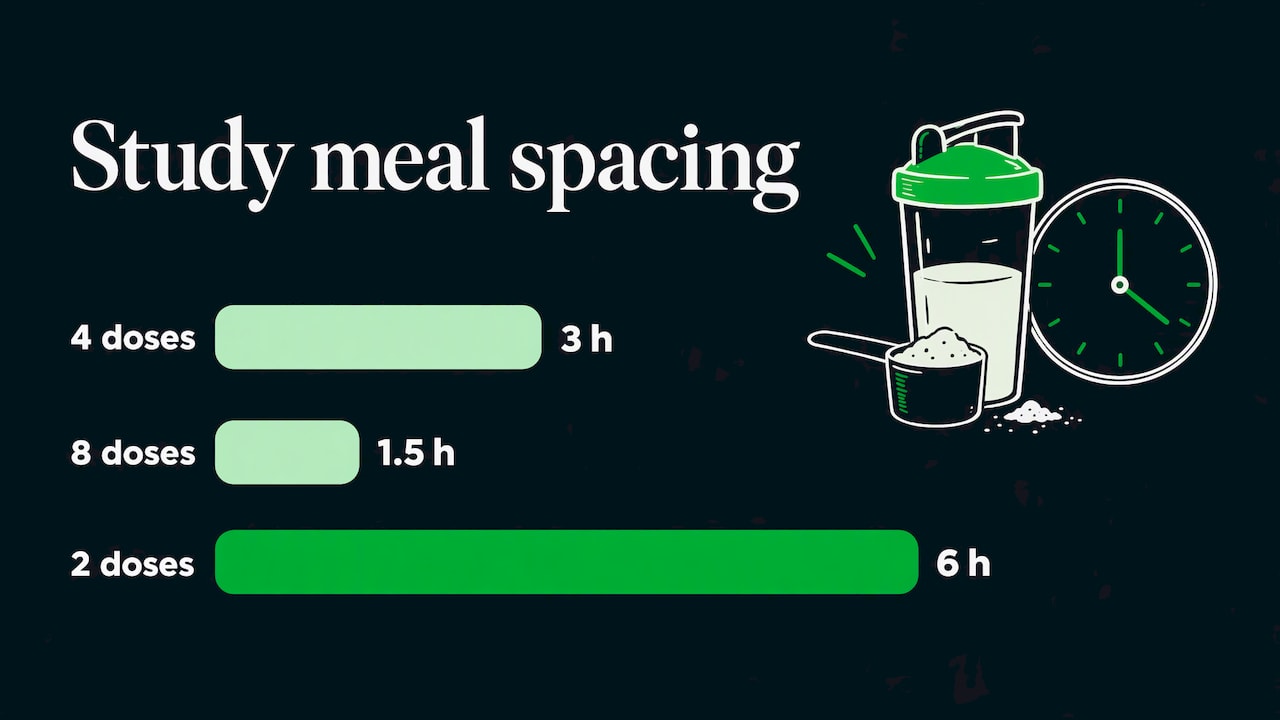
The ISSN recommends a 3 to 4 hour spacing. One of the studies behind that idea is a 2013 trial by Areta and colleagues. After resistance exercise, young men received the same total protein in three patterns over 12 hours. Four doses of 20 g of whey every 3 hours produced 31 to 48% greater muscle protein synthesis than eight 10 g doses every 1.5 hours or two 40 g doses every 6 hours.
This was a short lab study on a specific whey protein pattern, so treat it as a useful guide rather than a rule. It points to the same practical idea: a few reasonably sized servings beat one huge serving or constant grazing.
| Pattern | Example (80 kg person) | What the research suggests |
|---|---|---|
| Even spread | 4 meals of about 32 g | Matches the ISSN and Schoenfeld and Aragon ranges |
| Back-loaded | 10 g, 20 g, 98 g | Same total, but less even stimulation across the day |
| Constant snacking | 8 servings of 10 g | Below the per-meal dose that triggers a strong response |
Before or after your workout
This is the question most readers come with. The old advice was to drink a shake within 30 to 60 minutes of your last rep. Recent evidence is more relaxed.
A 2025 meta-analysis by Casuso and Goossens compared protein before versus after exercise. It found that protein taken anywhere from 15 minutes before to about 2 hours after training did not significantly change strength or body composition. A 2024 review by Antonio and colleagues agrees that eating protein within an hour of lifting is not an absolute requirement for an anabolic response.
What this means in practice:
- Eat a protein-containing meal in the few hours before you train and another in the few hours after.
- If you train fasted, such as before work, eating your first meal soon after is a sensible habit, and you don’t need to sprint to a shaker bottle.
- If you’ve just eaten a full meal, there’s no need for a second protein dose right after the workout.
The window is wide. That’s good news for anyone who trains at 6 a.m. and eats at 9.
Protein before sleep
Sleep is a long gap with no food, so a late dose of protein has been studied for overnight recovery.
In a 2012 study, men who ate 40 g of casein 30 minutes before sleep after evening resistance exercise showed higher overnight protein synthesis rates (311 vs 246 μmol/kg per 7.5 hours) and a better net protein balance. A 2021 systematic review found that 20 to 40 g of casein about 30 minutes before sleep stimulates overnight protein synthesis. It can also add to muscle gains after 10 to 12 weeks of resistance training in young men.
A 2020 review adds that pre-sleep protein is a viable way to reach your daily protein goal with no harmful effects on muscle, fat or bone in people who exercise.
For most people, this means a late-evening Greek yogurt, cottage cheese or a casein shake that fills out the last gap in your day. It’s most useful when dinner was early or light and you’re still short of your total.
Protein timing for fasting and irregular schedules
Not everyone eats three tidy meals. If you eat in a compressed window or have a packed work calendar, the research is encouraging.
In a 2019 randomized trial in active women, Tinsley and colleagues compared eating schedules over eight weeks of resistance training. Time-restricted feeding, about 7.5 hours a day, did not hold back muscle or strength gains when energy and protein were similar, at 1.6 g/kg per day.
A 2024 trial in middle-aged and older adults looked at a two-meal day. A protein intake of 1.5 g/kg/day produced a significantly better whole-body net protein balance than 0.8 or 1.1 g/kg/day.
So if you only get two or three meals, make each one count. Put a full serving of protein in each, and make the total big enough. Fewer meals just means each one needs to carry more.
A sample day for an 80 kg person
Here’s one way to reach 128 g (1.6 g/kg) with four evenly spaced meals. Swap foods to suit your taste.
| Time | Meal | Protein |
|---|---|---|
| 7:30 a.m. | Three-egg scramble, toast, Greek yogurt | about 32 g |
| 12:30 p.m. | Chicken, rice and vegetables | about 32 g |
| 4:00 p.m. | Cottage cheese with fruit, or a protein shake | about 30 g |
| 7:30 p.m. | Salmon, potatoes, salad | about 34 g |
If you train in the evening or still need a few more grams, add a small pre-sleep serving of casein or yogurt.
On a busy day, you don’t need all four meals perfect. The pattern is the goal: some protein early, some mid-day, some in the evening. Consistency beats perfection, which is a theme in why calorie tracking works even when you don’t do it perfectly.
Making timing measurable
The research gives you ranges: per meal, per day, spacing. Using them means knowing how many grams of protein each meal contains. That’s where most people guess, and guesses drift. A “palm of chicken” can be 20 g or 45 g.
Here’s how to apply the advice step by step.
- Set your daily target. Use the kg-based ranges above. VeriTrack calculates a daily nutrition target from your body and activity level, so you start with a number.
- Divide it by the meals you actually eat. For 128 g and four meals, that’s 32 g each. Three meals means about 43 g, which is above the usual per-meal range, so add a snack.
- Log each meal as you eat it. In VeriTrack you can photograph the plate, type a description or use your voice. That’s quick enough for a lunch break. It estimates the portion using USDA nutrition data, and on supported iPhones it uses LiDAR to measure depth for portion sizing.
- Read the assumptions and correct them. VeriTrack shows the assumptions behind each estimate, such as the portion size or how a food was prepared, so you can fix a wrong one. A protein number you can check is a number you can trust.
- Look at the day by meal. The daily meal diary shows where your protein sits across the day. If breakfast is at 8 g and dinner is at 70 g, you know what to change.
- Adjust one meal, not the whole day. Moving 15 g of protein to breakfast is easier than rebuilding your diet.
If you’re new to logging, these guides help: how to track calories on iPhone, how to estimate meal calories and keeping a food diary.
Common mistakes
- Chasing the window and missing the total. A shake in 20 minutes means little if you finish the day at 70 g.
- Eating most of your protein at dinner. It’s the most common pattern, and it leaves breakfast and lunch light.
- Grazing on small amounts. Many snacks of 5 to 10 g don’t reach the per-meal range.
- Ignoring body size. A 55 kg person and a 100 kg person need different servings. Use g/kg.
- Eyeballing portions. Protein foods are easy to under- or over-estimate, so measure or log.
People with kidney disease, and those on medicines that interact with dietary protein, should ask their doctor or a registered dietitian before raising protein intake.
Try it in VeriTrack
VeriTrack is an iPhone calorie and macro tracker built around logging that you can check. Photograph your meal, type it or say it, and see the protein for each meal against your daily target. Because the app labels the assumptions behind its estimates, you can correct them and keep your protein-by-meal picture accurate. It reads from Apple Health (read-only) and sends gentle reminders. The free tier includes a limited number of AI meal analyses each month, and the premium plan unlocks unlimited analyses and full features. Start with VeriTrack on your iPhone, or browse food and recipes for high-protein ideas.
Our view on protein timing
We think protein timing has been sold as a trick when it’s really a habit. The research says the same few things again and again: reach your daily total, give each meal a solid serving, and don’t stress over the exact minute.
The problem we see is not that people don’t know the ranges. It’s that they can’t tell how much protein they ate at lunch. Estimates are usually vague, and vague numbers make it hard to adjust.
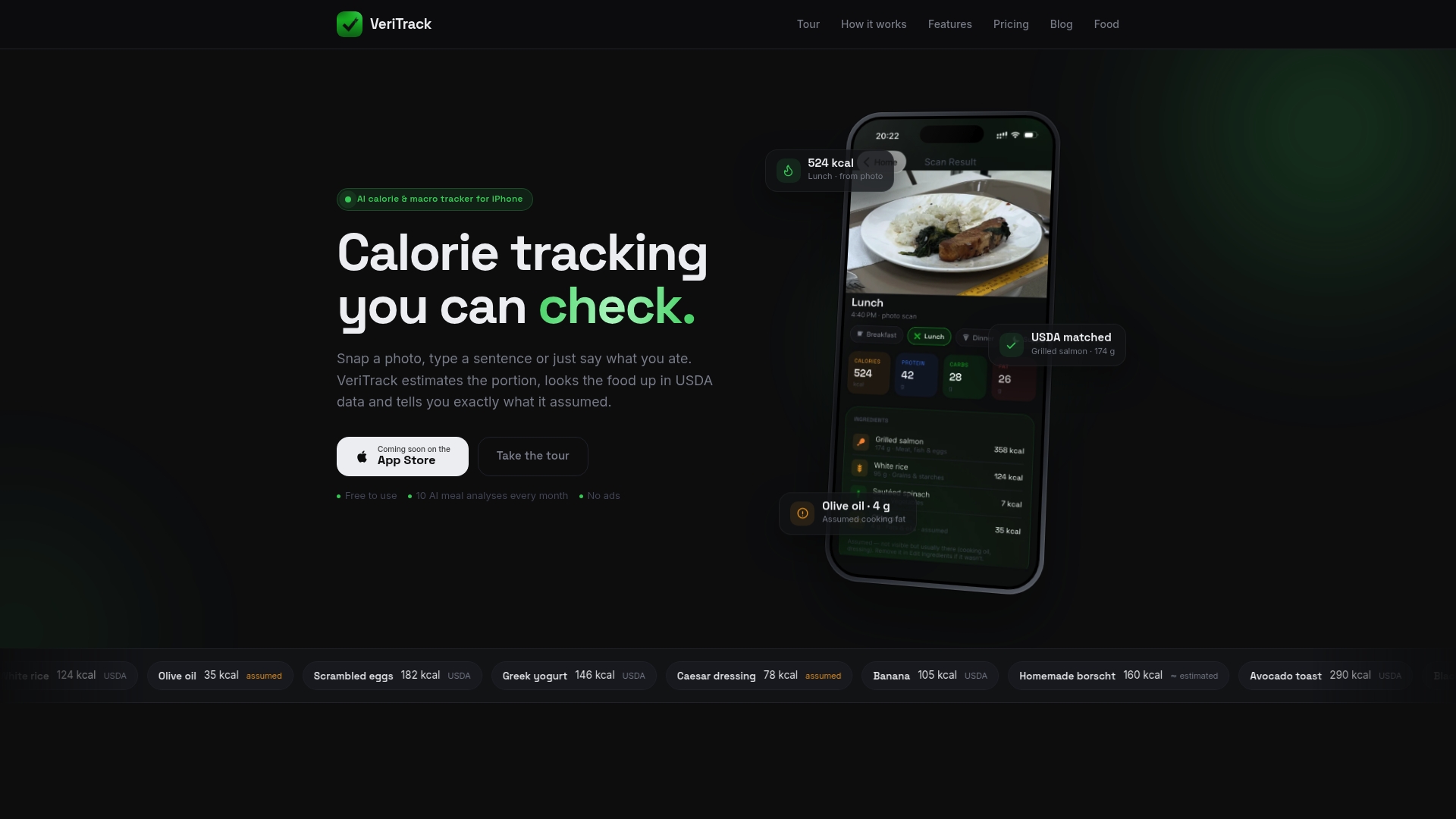
That’s why we built VeriTrack to show its work. When you log a meal, you see the assumptions behind the estimate, and you can correct them. LiDAR depth measurement on supported iPhones helps with portion size, which is where most protein errors begin.
Aim for steady, reasonable meals, and let the log tell you where to nudge. You don’t need a perfect day. You need a pattern you can repeat.
Aliaksei
FAQ
What is the best time to eat protein?
There isn’t one best time. The ISSN suggests about 20 to 40 g of high-quality protein every 3 to 4 hours, with the daily total mattering most. Pick times that fit your routine and repeat them.
Do I need protein right after a workout?
Not within a tight window. A 2025 meta-analysis found no significant difference in strength or body composition for protein taken from 15 minutes before to about 2 hours after training. Eating a protein-containing meal in that general period is enough.
How much protein should I eat per meal?
A practical range is 0.25 to 0.40 g per kg of body weight, or about 20 to 40 g for most adults. An 80 kg person would aim for roughly 20 to 32 g. Spread it over three to five meals.
Does eating protein before bed help?
It can. Studies using 20 to 40 g of casein about 30 minutes before sleep found higher overnight protein synthesis. It’s also an easy way to reach your daily total if dinner was light.
Can I time protein with intermittent fasting?
Yes. In a 2019 trial, eating within roughly a 7.5-hour window did not hold back muscle gains when protein and energy were matched. Put a full serving of protein in each meal and reach your daily total.
Sources
- International Society of Sports Nutrition Position Stand: protein and exercise (2017)
- Protein Distribution and Muscle-Related Outcomes (2020)
- Protein Recommendations for Weight Loss in Elite Athletes (2018)
- How much protein can the body use in a single meal (2018)
- Timing and distribution of protein ingestion during prolonged recovery (2013)
- Does Protein Ingestion Timing Affect Exercise-Induced Adaptations? (2025)
- Common questions and misconceptions about protein supplementation (2024)
- Protein ingestion before sleep improves postexercise overnight recovery (2012)
- Effects of pre-sleep protein consumption on muscle-related outcomes (2021)
- Effects of Dietary Protein on Body Composition in Exercising Individuals (2020)
- Time-restricted feeding plus resistance training in active females (2019)
- Effect of 3 Different Daily Protein Intakes in a 2-Meal Pattern (2024)