
Satiety and Calories: Why 200 kcal Can Fill You Up or Leave You Hungry
Calories don't equal fullness. Learn how energy density, protein, fiber and water change satiety per calorie, and how to log filling meals accurately.
Calories measure energy. They do not measure how full a food makes you. Two foods with the same kcal can differ in fullness by a wide margin, because water, fiber, protein and volume shape how satisfied you feel. The practical move is to pick foods that give you more fullness per calorie, then log them accurately so your daily target holds up. That is where tracking portions you can check, as we do in VeriTrack, earns its place.
TL;DR
- Fullness is not set by calories alone. Calorie-matched foods can differ about five-fold in expected satiety.
- Low energy density (few calories per gram, usually from water and fiber) lets you eat more food for the same kcal.
- Protein is the most satiating macronutrient, then carbohydrate, then fat, according to a 2023 review.
- Filling foods only help if you log the real portion, so measure or estimate size carefully.
Table of Contents
- Satiation and satiety: two different things
- Why the same calories don’t feel the same
- Energy density: the idea that explains most of it
- Protein, carbs and fat
- Foods that increase satiety
- Building a filling meal, step by step
- How VeriTrack helps you log satiating meals
- Our perspective
- FAQ
- Sources
Satiation and satiety: two different things
These words sound alike, but they describe different moments.
Satiation is what happens during a meal: the point where you feel you have had enough. Satiety is what happens after: how long it takes before hunger comes back. A physiology review frames satiation as what determines meal size and satiety as what prevents hunger from returning.
Researchers measure them differently. In a 2014 review, satiation is the maximum volume of a liquid meal a person tolerates, and satiety is how many kilocalories they eat at a buffet about four hours after a standard meal.
Why this matters to you: a food can help you stop eating sooner, keep you full longer, or both. A big salad may work mostly on satiation. A protein-rich breakfast may work mostly on satiety.
Why the same calories don’t feel the same
Your body does not count kcal at the table. It responds to volume, stomach stretch, nutrients, texture and what you have learned to expect from a food.
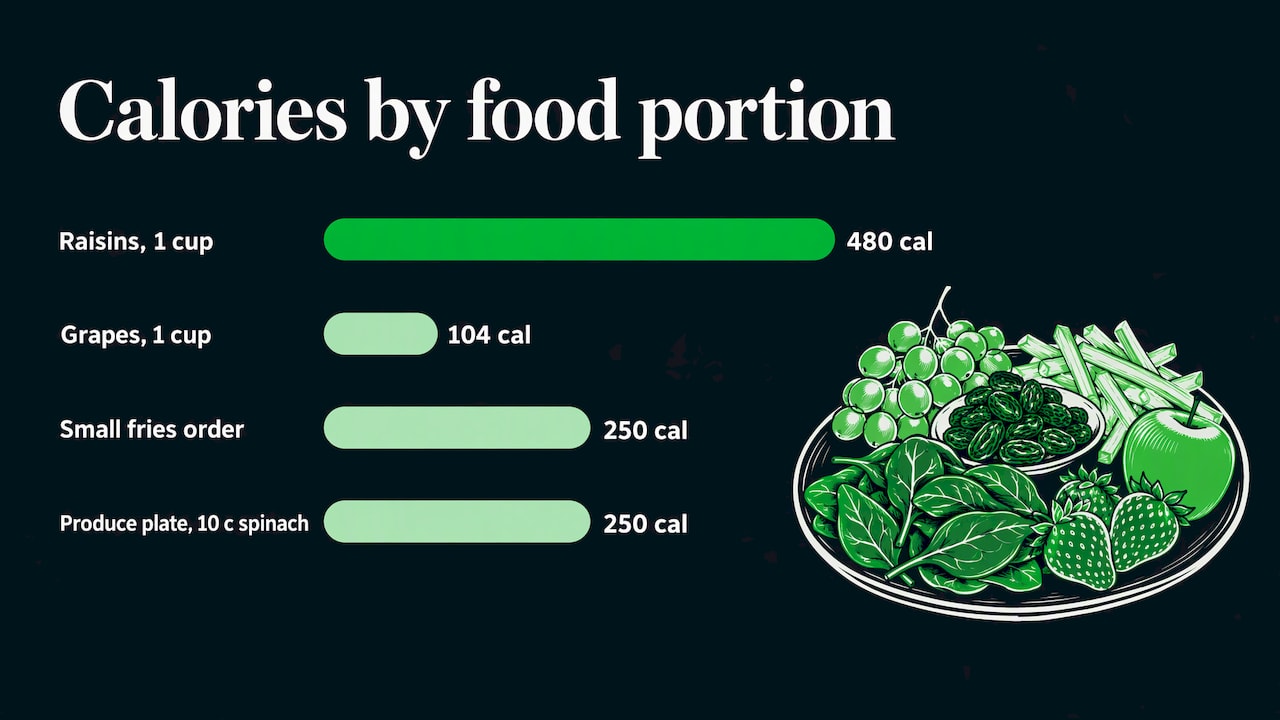
The review of expected satiety reports five-fold differences between calorie-matched foods. It also notes that energy-dense foods such as chocolate bars tend to have lower expected satiety. People lean on learned associations between a food and the fullness it brings, not on its calorie content. That can nudge us toward highly palatable, energy-dense foods and overeating.
The Mayo Clinic gives easy comparisons:
| Same calories, different plate | What you get |
|---|---|
| 1 cup of raisins | about 480 calories |
| 1 cup of grapes | about 104 calories |
| Small order of french fries | about 250 calories |
| The same 250 calories as produce | 10 cups of spinach, 1.5 cups of strawberries and a small apple |
None of this means you should fear dense foods. It means you can plan where your calories buy the most fullness.
Energy density: the idea that explains most of it
Energy density is the number of calories in a gram of food (kcal/g). The CDC’s guide points out that for the same calories, you can eat a bigger portion of a lower-energy-density food.
Barbara Rolls’ 2017 review explains the mechanics. Fat carries about 9 kcal/g, while carbohydrate and protein carry about 4 kcal/g each. Water carries 0, so water is the biggest influence on the energy density of everyday foods. The same review reports that when a diet’s energy density drops, adults and children spontaneously eat fewer calories.
What the studies show
- In a laboratory study cited by the CDC, people who began lunch with a low-energy-density salad ate fewer total calories than those with no salad, and said they felt just as full.
- A University of Leeds study of 78 women found that on high-energy-density days they took in an average of 1,057 extra calories. Three hours after breakfast, fullness scored 56.2 out of 100 on low-density days versus 31.4 on high-density days.
- Water built into food matters. Rolls’ review reports that water blended into a food had a greater effect on satiety than the same water drunk alongside it, partly because it slows stomach emptying.
Liquid calories are a special case. The physiology review notes that caloric drinks often trigger less post-intake satiety than comparable solid foods, which can lead to passive overconsumption. A smoothie and a bowl of the same fruit may not fill you equally.
Protein, carbs and fat
The 2023 review by Stubbs and colleagues ranks the macronutrients by their effect on satiety or energy intake: protein first, carbohydrate second, fat third. It also notes that energy density falls with water and rises with fat.
So if you ask whether carbs or fat fill you up more, carbs generally edge out fat per calorie, and protein beats both. In practice, a dish that pairs protein with water-rich vegetables or fiber-rich grains tends to work best.
Foods that increase satiety
Here is what the evidence supports, food by food.
Eggs and protein-rich breakfasts
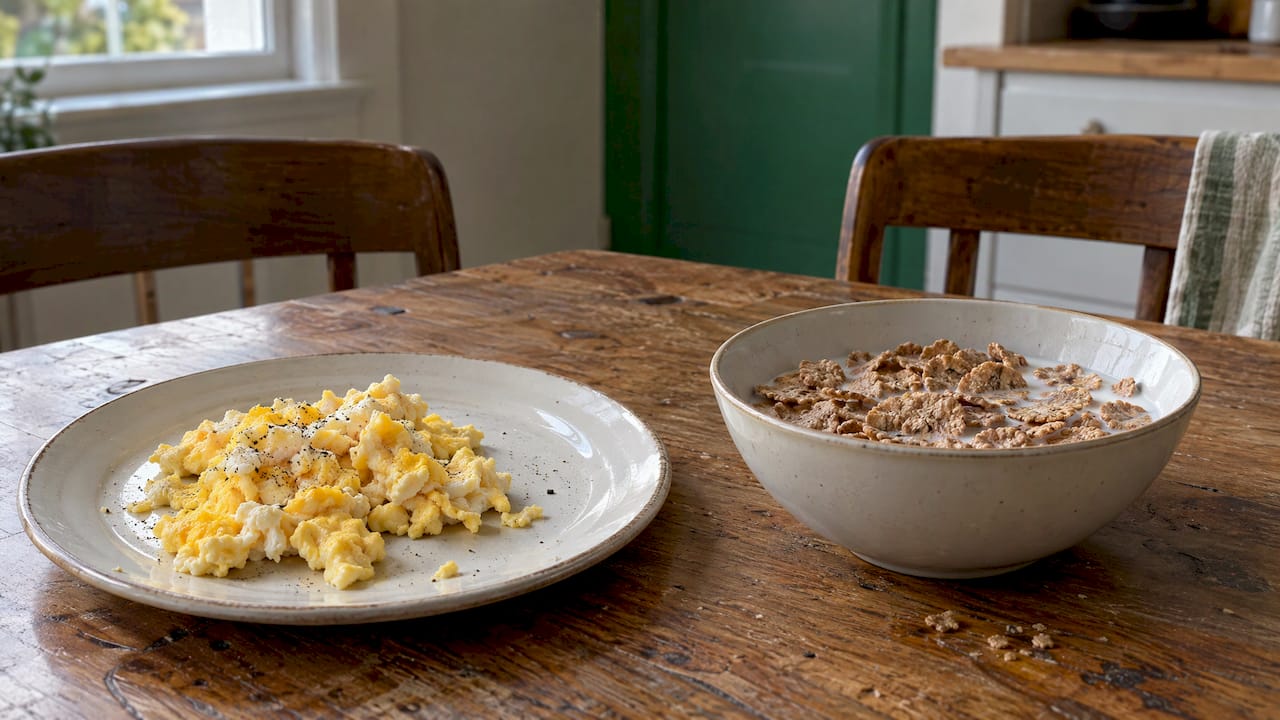
In a 2016 randomized crossover trial of 48 people, a 390 kcal egg breakfast with 30 g of protein led to greater overall satiety and 135 fewer kcal eaten at a later lunch than a cereal breakfast with 10 g of protein. An egg breakfast with 20 g of protein and 7 g of fiber cut lunch intake by 69 kcal.
Beans, peas, chickpeas and lentils
A review of pulses reports that short-term studies show pulses increase satiety over two to four hours. In one 38-food comparison, baked beans and eggs filled people more than white bread at equal 240 kcal portions. Weight-loss benefits showed up in trials when pulses were paired with an energy-restricted diet.
Oats, rye and other soluble-fiber grains
A 2025 systematic review of 48 crossover studies found cereal fiber linked to favorable satiety, with rye and oat fibers standing out and soluble-fiber cereals (rye, oats, barley) increasing acute satiety more than insoluble-fiber ones. The authors also note that portion size, food matrix and energy density all shape the result, so no single fiber dose can be recommended.
Water-rich fruits and vegetables
The Mayo Clinic notes grapefruit is about 90% water (half a grapefruit is 64 calories) and a medium raw carrot about 88% water (25 calories). One cup of air-popped popcorn is about 30 calories. Per the Leeds team, about 250 g of carrots and 20 g of chocolate each supply 100 calories.
Boiled potatoes, fish and oatmeal
Satiety rankings, such as the satiety index, put boiled potatoes at the top, followed by white fish, oatmeal and eggs. Treat rankings as a starting point: the foods in them were tested alone, and a 2019 review notes that the quantity and variety of foods on offer strongly influence how much people eat. Your mixed plate behaves differently from a single tested food.
Building a filling meal, step by step
Here is a routine that works at 1,200 kcal or 2,400 kcal alike. It needs consistency, not perfection.
- Start with protein. Aim for a clear protein source at each meal, such as eggs, fish, beans or lentils.
- Add volume from water-rich produce. Fill half the plate with vegetables or fruit. A starter salad or broth-based soup fits the pattern behind the CDC-cited lunch study.
- Choose a fiber-rich carbohydrate. Oats, beans or intact grains give you slow, lasting fullness.
- Measure the dense extras. Oils, nuts, cheese and dressings carry the most calories per gram, and they are the easiest to underestimate. See our guide to hidden calories.
- Eat most of your calories rather than drink them. Solid food tends to satisfy more than liquid calories.
- Log what you actually ate. A filling meal only fits your target if the portion you logged is the portion on the plate. Our guide to estimating meal calories walks through a method, and portion control for weight loss covers sizes.
Filling foods are often bulky, and bulky foods are hard to eyeball. A heap of lentils or a bowl of oatmeal can vary by hundreds of kcal depending on how it is scooped. Tools that capture a portion’s size help here, and a tracker that connects food choices to how you feel can sit alongside your routine for wellness.
How VeriTrack helps you log satiating meals
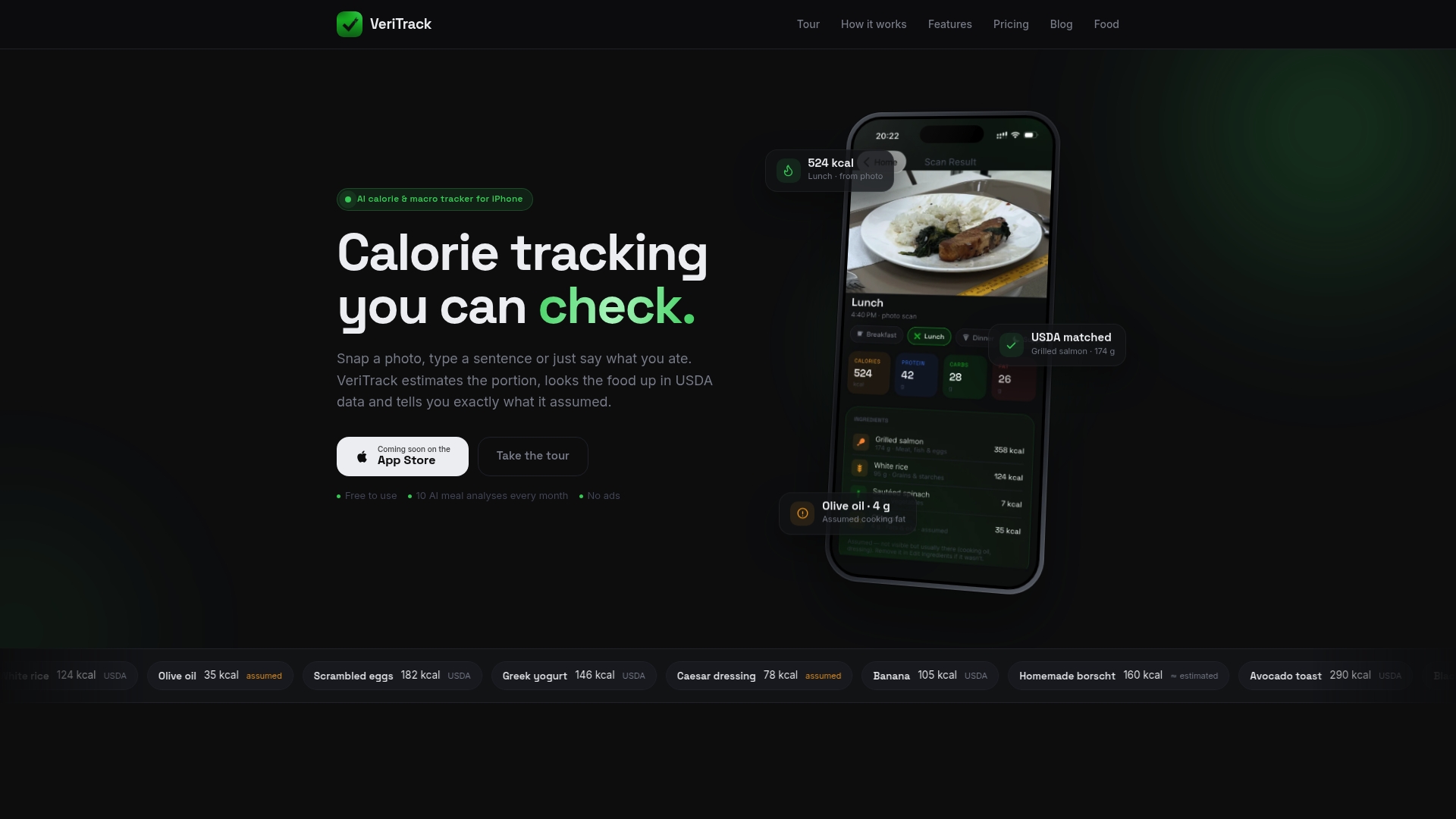
Our app is built for iPhone. You can photograph a meal, type it or say it out loud, and VeriTrack estimates the portion using USDA data. On supported iPhones it uses LiDAR depth measurement to size the portion, and it shows the assumptions behind each estimate so you can correct them. That matters most for the foods this article recommends: beans, oats, potatoes and big salads, where portion size makes the difference.
Your daily target is based on your body and activity level, and the diary and progress tracking show how your filling meals add up over time. The free tier includes a limited number of AI meal analyses each month, and Premium unlocks unlimited analyses and the full feature set. You can start with VeriTrack.
If you are new to logging, see how to track daily nutrition and why calorie tracking works even when you are not perfect.
Our perspective
Most people blame themselves when a diet leaves them hungry. We think the problem is often information. A calorie number tells you the energy in a food, and nothing about how it will feel an hour later.
Once you know that water, fiber and protein change fullness per calorie, you can build meals that fit your target without constant willpower. The catch is that those meals are the hardest to estimate by eye: a big bowl of vegetables, a scoop of beans, a drizzle of oil.
That is why we built VeriTrack to show its assumptions and let you correct them. When you can see how an estimate was made, you trust your log, and a log you trust is one you keep using.
Aliaksei
FAQ
Do calories make you feel full?
Not directly. Fullness responds to volume, water, protein, fiber and learned expectations as well as energy. Research shows that calorie-matched foods can differ five-fold in expected satiety, so the same kcal can feel very different.
Are carbs or fat more satiating?
Per the 2023 Stubbs review, the order is protein, then carbohydrate, then fat. Fat also packs about 9 kcal per gram, so it raises energy density quickly.
How can I feel full on 1,200 calories a day?
Lean on low-energy-density foods: vegetables, fruit, beans and broth-based soups, with a protein source at every meal. Measure oils, nuts and dressings, and log portions accurately so the day adds up to your target.
What is the difference between satiation and satiety?
Satiation is the feeling of having had enough during a meal. Satiety is how long you stay satisfied afterward before hunger returns.
Sources
- Peripheral mechanisms in appetite regulation (2014)
- Nutrients, satiety, and control of energy intake
- Expected Satiety: Application to Weight Management
- Weight loss: Feel full on fewer calories, Mayo Clinic
- Low-Energy-Dense Foods and Weight Management, CDC
- Dietary energy density: Applying behavioural science (2017)
- University of Leeds: a low energy diet leaves people feeling full
- Diet composition and energy intake in humans (2023)
- Effects of egg and fiber on satiety (2016)
- Pulse Consumption, Satiety, and Weight Management
- Cereal Fibers and Satiety: A Systematic Review (2025)
- Issues in Measuring and Interpreting Human Appetite (2019)