
Micronutrients Explained: Types, Functions and Food Sources
Micronutrients explained plainly: what vitamins and minerals are, what they do, common deficiencies, and how to track the foods that supply them without guessing.

Micronutrients are the vitamins and minerals your body needs in small amounts to work properly. They carry no calories, and your body makes almost none of them, so they have to come from food. This guide covers what they are, the main types, what they do, which foods supply them and how to keep an honest eye on your intake. That last part starts with logging your meals accurately, which is what we built VeriTrack for.
TL;DR
- Micronutrients are vitamins and minerals. They provide no energy, but your body can’t function without them.
- The WHO counts about 30 essential micronutrients: 13 vitamins and 16 minerals.
- Variety is the most reliable strategy: fruits, vegetables, whole grains, legumes, nuts, seeds and lean animal foods.
- Any intake estimate is only as good as the portions and food data behind it, so accurate logging comes first.
- Persistent symptoms, pregnancy or a medical condition call for a doctor or registered dietitian, not a guess from an app.
Table of Contents
- What micronutrients are, and how they differ from macros
- The main types of micronutrients
- How much you need
- Common deficiencies and what they can look like
- Getting a full range from food
- How to track micronutrients without fooling yourself
- Where VeriTrack fits
- Our perspective
- FAQ
- Sources
What micronutrients are, and how they differ from macros
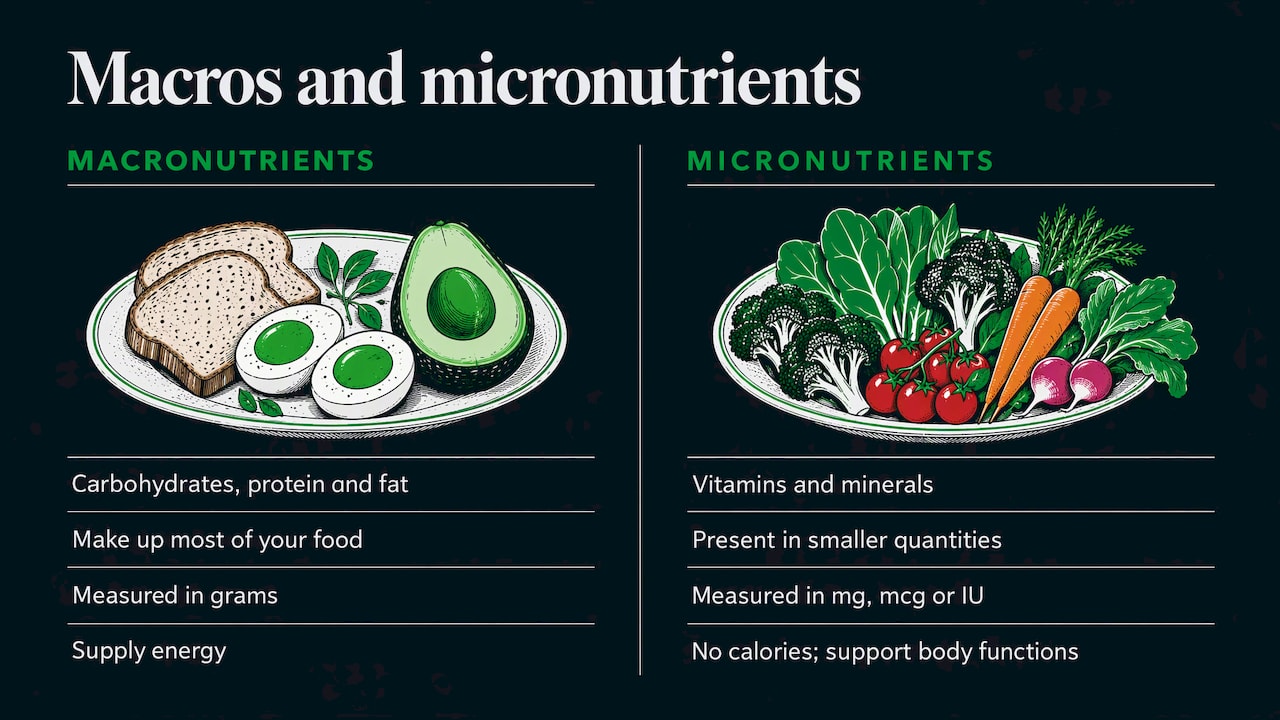
Food gives you two broad kinds of nutrients. Macronutrients (carbohydrates, protein and fat) make up the bulk of what you eat. Micronutrients (vitamins and minerals) are present in all foods and drinks, but in much smaller quantities. Tufts University’s nutrition letter notes that micronutrients provide no calories, yet their actions are essential to survival.
The difference shows up in how they are measured. Cleveland Clinic explains that macros are counted in grams and supply energy: 4 calories per gram for protein and carbohydrate, 9 for fat. Micronutrients are counted in milligrams, micrograms or International Units, and they support digestion, hormone production and brain function rather than fueling you.
The CDC adds one more point: apart from vitamin D, your body doesn’t produce them, so most must come from what you eat. Some people may need supplements to reach recommended amounts.
Think of macros as the lead actors and micronutrients as the supporting cast. The show doesn’t run without either.
The main types of micronutrients
The World Health Organization says there are about 30 essential micronutrients: 13 vitamins (A, the B-complex vitamins, C, D, E and K) and 16 minerals, including iron, iodine, zinc and calcium.
Vitamins: water-soluble and fat-soluble
The Merck Manual sorts vitamins into two groups:
- Water-soluble: vitamin C and the eight B-complex vitamins.
- Fat-soluble: vitamins A, D, E and K.
This matters in practice. Only A, D, E, K and B12 are stored in the body to any large extent. The others are needed more regularly through food.
Minerals: major and trace
Minerals such as calcium, potassium, sodium and phosphorus are needed in larger amounts. Trace minerals are needed in tiny amounts. The Merck Manual lists them as chromium, copper, fluoride, iodine, iron, manganese, molybdenum, selenium and zinc. It also notes that trace minerals are toxic at high levels, a good reason to treat “more” as not automatically “better.”
A quick reference
| Micronutrient | What it does | Example food sources |
|---|---|---|
| Iron | Helps produce muscle and red blood cells; supports brain development | Meat, seafood, fortified cereals, dark green vegetables, beans, lentils |
| Vitamin A | Protects eyesight; supports the immune system | Leafy greens, sweet potatoes, carrots, salmon, milk, eggs |
| Vitamin D | Supports bones, immunity, muscle and nerve function | Salmon, tuna, eggs, fortified milk, yogurt and cereals |
| Iodine | Helps make thyroid hormones | Iodized salt, cod, tuna, seaweed, shrimp, dairy |
| Folate | Helps make new cells | Dark green vegetables, nuts, beans, peas, lentils, citrus |
| Zinc | Supports cell metabolism, immunity, wound healing and taste | Oysters, meat, fish, beans, nuts, eggs, dairy |
The functions and food lists in this table come from the CDC’s micronutrient facts page, which lists sources for each nutrient.
How much you need
Requirements differ by age, sex and life stage. As examples, Healthline’s registered dietitian author cites adult recommendations of 700 to 900 mcg of vitamin A, 15 to 20 mcg of vitamin D and 1,000 to 1,200 mg of calcium per day, and 2,600 to 3,400 mg of potassium.
Notice the units. Micrograms and milligrams are thousands of times smaller than the grams you see for protein and fat. That is why micronutrients are “micro,” and why nobody eyeballs them.
Children have their own needs. For a look at how nutrition shifts at that age, see this overview of toddler nutrition needs and the micronutrient-rich foods that fit small appetites.
Common deficiencies and what they can look like
A deficiency means your intake or absorption is too low for too long. The MSD Manual lists typical effects:
- Iron and folate: fatigue and weakness from anemia.
- Vitamin A: night blindness.
- Vitamin C: weakness and bleeding gums.
- Vitamin D: thinning bones and bone pain.
- Vitamin B12: anemia, pins-and-needles sensations and confusion.
- Calcium: bone pain, fractures and muscle spasms.
These are slow-building and easy to mistake for ordinary tiredness. Beth Israel Deaconess Medical Center notes, for instance, that iron deficiency often has no obvious short-term symptoms because the body keeps iron in stores such as the liver and bone marrow.
Globally the problem is large. The WHO reports that over half of children under five and over two-thirds of non-pregnant women of reproductive age are deficient in at least one key micronutrient, typically iron, zinc, vitamin A or folate. Its micronutrients topic page names iron, vitamin A and iodine as the most common deficiencies, with low- and middle-income countries carrying the heaviest burden.
If you notice persistent fatigue, numbness, bruising or other symptoms like these, see your doctor. A blood test answers the question. A food log can’t, and neither can a symptom list.
Getting a full range from food
The WHO’s guidance is simple: eat a wide variety of nutrient-dense foods, including fruits, vegetables, whole grains, legumes, nuts, seeds and lean animal-source foods. Its examples are beans or lean meat for iron, dark green leafy vegetables for vitamin A and iodized salt to guard against iodine deficiency (WHO).

Cleveland Clinic’s dietitian advice points the same way: check that your diet includes foods from every food group rather than leaning on supplements, because your body works best when macros and micros are both met consistently (Cleveland Clinic).
A practical way to put that into a day:
- Add color. Dark leafy greens, orange vegetables and citrus cover different vitamins.
- Rotate proteins. Fish, eggs, beans and lentils bring different minerals than red meat does.
- Include nuts and seeds most days.
- Choose fortified foods where they fit, such as fortified cereals or milk.
- Don’t stack supplements on a guess. Trace minerals can be toxic at high levels, so ask your doctor before adding one.
How to track micronutrients without fooling yourself
Tracking can show you patterns: whether you almost never eat leafy greens, or whether fish shows up once a month. It works best as a pattern-finder, not a lab test. Here is how to get the most from it.
Start with what you actually ate
Every nutrient number is a multiplication: the amount of food times the nutrient content per gram. If the amount is wrong, the number is wrong, however good the database. A heaping cup of spinach and a loose handful are not the same, and a drizzle of oil is rarely what you remember. Our guide to how close a food scale really is and the walkthrough on estimating meal calories show how much portion error matters and how to keep it small.
Know that food data has natural spread
The USDA’s Agricultural Research Service explains that food composition values depend on how many samples were analyzed and the methods used. They also vary with genetics, environment, cooking and processing. So an entry for a carrot is a well-founded average, not the exact content of your carrot. Treat small gaps between foods as noise.
Be careful with supplements
Supplements are the hardest thing to log. In the SURE study of 444 participants, 714 different multivitamin and mineral combinations were reported, and missing brand or dose details reduced accuracy. If you take one, write down the exact product and dose rather than “a multi.”
Read results as ranges and trends
A useful routine:
- Look at a week or two of meals, not a single day. Intake naturally swings.
- Compare patterns against the recommended amounts for your age and sex.
- Look for food groups that are missing, then add foods rather than chasing a decimal.
- Take persistent gaps or symptoms to a doctor or registered dietitian, who can order tests.
Don’t treat a tracker as proof you are deficient or fine. It tells you what you logged, and that’s all.
Where VeriTrack fits
Good micronutrient habits depend on knowing what is on your plate. VeriTrack is an iPhone app built around that first step. You photograph a meal, type a description or speak it, and the app estimates portions using USDA data. On supported iPhones it uses LiDAR depth measurement to size portions, and it shows the assumptions behind each estimate so you can see and correct them.
That is useful when you log a salad, a stir-fry or a bowl of lentils quickly between meetings, because the portion guess is visible instead of buried. VeriTrack also sets a daily target based on your body and activity level, keeps a daily meal diary and sends gentle reminders. The free tier includes a limited number of AI meal analyses each month, and VeriTrack Premium unlocks unlimited analyses and the full feature set.
If you want to start with a clear picture of what you eat, try VeriTrack on your iPhone.

For related routines, our posts on protein intake tracking, hidden calories and how to track calories on iPhone cover the habits that make any log more reliable.
Our perspective
Most people think of tracking as a numbers game, and they stop when the numbers feel fussy. We think the better question is whether you can trust what’s in your log.
Micronutrients make that clear. The amounts are tiny, the foods that supply them vary, and a log built on guessed portions can look precise while being off. That’s why we built VeriTrack to show its assumptions. When you can see that the app assumed a cup of rice or a tablespoon of oil, you can fix it in seconds. A log you can check is one you can learn from.
We also believe consistency beats perfection. Photographing a meal, saying what you had or typing a quick line should take seconds, so you keep doing it. Over a few weeks, an honest log shows you what you actually eat, and that is where better choices start.
Aliaksei
FAQ
What are five micronutrients?
Iron, zinc, vitamin A, vitamin D and folate are five well-known ones. The CDC lists what each does and which foods supply it. Iron helps produce red blood cells, vitamin A supports eyesight and immunity, and folate helps make new cells.
What is the difference between micronutrients and macronutrients?
Macronutrients are carbohydrates, protein and fat. You eat them in large amounts, measure them in grams, and they provide calories. Micronutrients are vitamins and minerals. You need them in milligrams or micrograms, and they provide no calories.
How do I get all my micronutrients?
Eat a wide variety of whole foods: fruits, vegetables, whole grains, legumes, nuts, seeds and lean animal foods, as the WHO recommends. Rotating foods across the week covers more nutrients than repeating the same meals. If you think you may be low in something, ask your doctor about testing before taking a supplement.
Can a food tracker tell me if I’m deficient?
No. A food log shows approximately what you ate, and food data carries natural variation. Only a blood test ordered by a doctor can confirm a deficiency. Use your log to spot patterns, such as rarely eating leafy greens or fish, and bring them to your doctor or dietitian if you have symptoms.
Sources
- Understanding Micronutrients, Tufts Health & Nutrition Letter
- Micronutrient Facts, CDC
- What Are Macronutrients vs. Micronutrients?, Cleveland Clinic
- Healthy diet, World Health Organization
- Vitamins and Minerals, Merck Manual Consumer Version
- Micronutrients: Types, Functions, Benefits and More, Healthline
- Symptoms of Nutrient Deficiencies, MSD Manual
- Nutritional Deficiencies in Celiac Disease, Beth Israel Deaconess Medical Center
- Micronutrients, World Health Organization
- Food Composition Data: The Foundation of Dietary Guidance, USDA ARS
- Development of a supplement composition database, PMC