
Calorie Tracking for Muscle Gain: A Practical Guide
How to track calories and macros for muscle gain: set a modest surplus, hit your protein, read the scale and strength trends, and adjust without guessing.

To gain muscle, you eat a modest surplus, hit your protein every day and check the results against the scale and your lifts. Tracking is what makes that surplus real instead of a guess. It works only when the numbers you log are close to what you actually ate, and when you can see which numbers are estimates. That is why we built VeriTrack to show its assumptions and let you correct them.
This guide covers the numbers to aim for, a worked example, how to log accurately, and how to adjust every few weeks.
TL;DR
- Aim for a small surplus: roughly 200 to 400 kcal a day above maintenance for most lifters, and less as you get more advanced.
- Protein of 1.6 to 2.2 g per kg of body weight a day is the standard range for muscle gain.
- Judge progress on 3 to 4 week trends in weight and strength, never a single weigh-in.
- Big surpluses mostly add fat. Accurate portions matter more than a bigger number.
- If weight and lifts stall for 2 to 3 weeks, add a small amount of food and keep tracking.
Table of Contents
- Why a surplus needs tracking
- How big should your surplus be?
- Step 1: Find your maintenance calories
- Step 2: Set your calorie and macro targets
- Step 3: Log accurately
- Step 4: Read your progress
- Step 5: Adjust every 2 to 3 weeks
- Who this approach suits
- Our perspective
- Start tracking your bulk with VeriTrack
- FAQ
- Sources
Why a surplus needs tracking
Muscle growth needs two things at once: a training stimulus and enough energy to build new tissue. A 2022 review in PubMed notes that both are independent and necessary, and the surplus should be sufficient but not excessive. A bigger surplus does not automatically build more muscle.
That is where tracking helps. A surplus of 300 kcal is about one large handful of nuts plus a glass of milk and a banana. It is easy to miss by a skipped snack and just as easy to overshoot with a second helping. A splash of oil, a handful of nuts and a second helping all disappear from memory. A log keeps them visible.
If you want the science behind why logging helps even when you are not perfect, we explain it in why calorie tracking works.
How big should your surplus be?
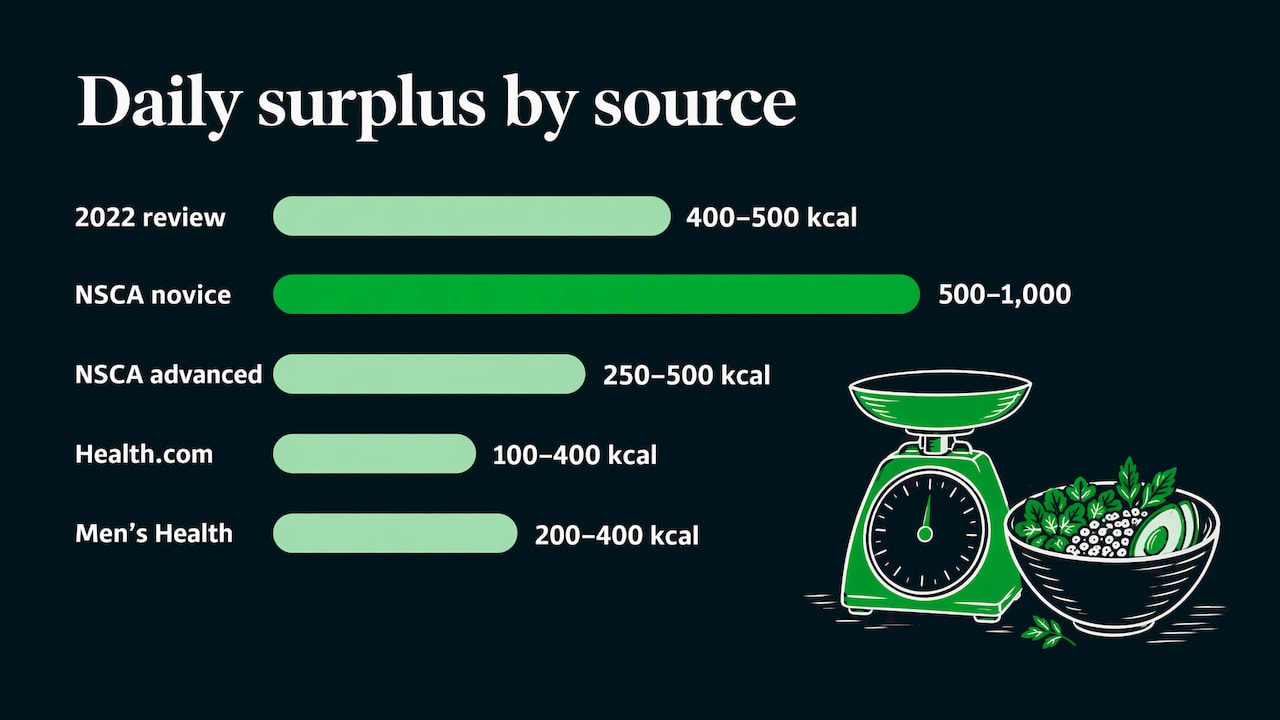
The research agrees on small and steady. Here is what the main sources say:
| Source | Suggested surplus | Notes |
|---|---|---|
| 2022 PubMed review | About 400 to 500 kcal a day | Targets 0.23 to 0.45 kg (½ to 1 lb) a week, mostly lean mass |
| 2019 bodybuilding review | About 10 to 20% above maintenance | Weekly gain of 0.25 to 0.5% of body weight for novice and intermediate lifters |
| NSCA journal, 2020 | 500 to 1,000 kcal for novices, 250 to 500 for advanced | Larger surpluses of 20 to 40% only for beginning trainees |
| Health.com, 2026 | 5 to 20% above maintenance | 100 to 400 kcal on a 2,000 kcal diet |
| Men’s Health, 2026 | 200 to 400 kcal a day | Aim for 0.5 to 1% of body weight per month |
A practical way to read this: if you are new to lifting, start near the upper end. If you have trained for years, stay near 200 to 300 kcal. The 2019 review cites a study of elite athletes where a surplus of about 600 kcal a day produced significantly more fat mass than a small surplus, with only a modest, non-significant lean mass advantage. The NSCA article adds that advanced athletes who gain too much fat then lose more muscle when they diet down.
The reasoning behind the numbers is simple. The 2022 review explains that 330 to 500 kcal a day comes from the energy cost of building a pound of lean tissue. Anything beyond that is mostly stored as fat.
Step 1: Find your maintenance calories
Maintenance, also called TDEE (total daily energy expenditure), is what you burn in a day including training. Healthline suggests estimating it with a calculator based on age, sex, lean body mass, activity and occupation, then adding your surplus on top.
A calculator is only a starting estimate. Your real maintenance shows up after two weeks of honest logging: if your weight is flat while you eat about 2,800 kcal a day, then 2,800 is your maintenance, whatever the formula said. VeriTrack sets a daily target from your body and activity level and can read your activity from Apple Health (read-only), so you begin with a sensible number and refine it from your own results.
Step 2: Set your calorie and macro targets
Macros are protein, carbohydrates and fat. Protein and carbs give 4 kcal per gram, fat gives 9, according to Optimum Nutrition’s macro guide. The 2019 off-season review gives these ranges for muscle gain:
- Protein: 1.6 to 2.2 g per kg of body weight a day, in 3 to 6 meals of about 0.40 to 0.55 g per kg each.
- Fat: 0.5 to 1.5 g per kg a day.
- Carbohydrates: the remaining calories, at least 3 to 5 g per kg a day.
All three come from the same 2019 review. Protein is the number to hit most reliably. We cover how to set it and reach it in protein intake tracking.
A worked example
Take a 180 lb (82 kg) lifter with a logged maintenance of 2,800 kcal. This is an illustration of the arithmetic, not a prescription.
- Surplus: 300 kcal, inside the 200 to 400 range, gives a target of 3,100 kcal.
- Protein: 2.0 g per kg is about 160 g, or 640 kcal.
- Fat: 0.8 g per kg is about 65 g, or roughly 585 kcal.
- Carbs: the remaining 1,875 kcal is about 470 g, or around 5.7 g per kg.
That puts carbs comfortably above the 3 to 5 g per kg floor, which fuels training. If you prefer more fat, trade carbs for it at 9 kcal per gram instead of 4.
At the start of a bulk, many people also wonder whether they need a surplus at all. Men’s Health notes that beginners can often build muscle at maintenance if training is progressive and protein is adequate. If you want to build and lean out together, see body recomposition macros.
Step 3: Log accurately
A 300 kcal surplus is a small margin. If your log is off by 300 kcal a day, you are not in a surplus at all, or you are in one twice the size you planned. Accuracy matters most in three places.
Portions
Portion size is the biggest source of error. Weighing food on a scale is the most precise method, and we explain how close is close enough in food scale accuracy. For the many meals you cannot weigh, such as restaurant plates, a packed lunch or a shared dish, VeriTrack lets you photograph the meal, type it or say it out loud. On supported iPhones it uses LiDAR depth measurement to estimate portion size, and it looks up nutrition from USDA data.

Assumptions
Every estimate rests on assumptions: how much oil was in the pan, how big the chicken breast was, how much rice is under the sauce. VeriTrack displays those assumptions next to the result. If you know the rice was 250 g cooked, you correct it, and the log updates. That visible reasoning is how we aim to keep calorie estimates something you can check rather than a number you must take on faith.
Consistency
Log raw or cooked weights the same way each time, and log drinks, snacks and cooking fats. The diary matters more than any single meal. Our guide to keeping a food diary covers habits that make it stick, and gentle reminders in the app help on busy days. Recipes you cook in batches are easier to handle once you calculate macros per serving.
The US military’s performance nutrition guidance also suggests eating every 2 to 4 hours, with three balanced meals and 2 to 4 snacks, and keeping the same fueling schedule on weekends. Weekends are where many logs quietly break, so keep logging on Saturday and Sunday.
Step 4: Read your progress
Your log tells you what you ate. Your body tells you whether it worked. Check three things:
- Weight trend. Weigh once or twice a week under the same conditions and compare weekly averages, not single days. Men’s Health also advises tracking trends rather than daily scale fluctuations.
- Strength. If your main lifts are rising over 4 to 8 weeks, you are building muscle. If you train heavy, it helps to find a gym spotter so you can push the final reps safely.
- Waist and photos. A waist that grows faster than your chest, shoulders and arms suggests too much of the gain is fat.
A useful rule of thumb for pace: the 2019 review targets 0.25 to 0.5% of body weight per week for novice and intermediate lifters. For a 180 lb lifter, that is roughly 0.45 to 0.9 lb a week. Gaining faster than that points to a surplus that is bigger than it needs to be.
Step 5: Adjust every 2 to 3 weeks
Change one thing at a time, and only after enough data.
| What you see | What to do |
|---|---|
| Weight flat for 2 to 3 weeks, lifts flat | Add about 100 to 250 kcal a day, mostly from carbs, then wait another 2 to 3 weeks |
| Weight rising quickly, strength flat | Hold calories steady and tighten your logging; trim the surplus if it continues |
| Weight steady, lifts rising | Keep going: you may be recomposing |
| Weight or activity changes a lot | Recalculate your maintenance and targets |
These thresholds come from coaching sources rather than controlled trials, so treat them as sensible starting rules. The principle behind them is backed by the research above: small surpluses, checked against trends.
One common finding is worth knowing if you struggle to gain at all. Hard gainers are often not under-eating at meals. They miss calories through skipped snacks, irregular timing and high daily activity. A complete log is how you find the gap. It is also why looking at weekly totals, not single days, tends to tell you more.
Who this approach suits
If you are a busy professional, quick logging by photo or voice makes it easier to keep a 3,000 kcal day on record without typing every ingredient. If you are a fitness enthusiast, the macro detail and the ability to correct assumptions matter. If you have dieted before and are now trying to gain, the same habit transfers: you are just aiming at a different number. For the iPhone basics, see how to track calories on iPhone.
Our perspective
Most people who struggle to gain muscle are not short on effort. They are short on accurate information. A bulk lives inside a narrow window: enough food to support growth, not so much that most of it becomes fat. A log that is off by a few hundred kcal can hide on either side of that window.
That is why we built VeriTrack around transparency. When you photograph a plate, we show the assumptions behind the estimate, such as portion size and ingredients, so you can see them and fix them. On supported iPhones, LiDAR depth measurement helps with portion sizing, and nutrition comes from USDA data. You decide what goes in your diary.
We would rather you log imperfectly and consistently than perfectly for a week and then stop. A clear daily target, gentle reminders and a diary you can trust make consistency easier. Progress tracking then shows you the trend, which is the number that actually guides your next adjustment.
Aliaksei
Start tracking your bulk with VeriTrack
VeriTrack is an iPhone app for calorie and macro tracking. You can log a meal with a photo, a typed description or your voice, see the assumptions behind every estimate, and correct them. It sets a daily target from your body and activity level, reads Apple Health data without writing to it, and keeps a daily diary with progress tracking. The free tier includes a limited number of AI meal analyses per month, and VeriTrack Premium unlocks unlimited analyses and the full feature set.
Set your surplus, log your first meal and watch the trend at veritrack.app.
FAQ
How many calories should I eat to gain muscle?
Most sources suggest about 200 to 500 kcal a day above your maintenance. Healthline recommends 300 to 500 kcal above baseline needs, and the US military guidance gives the same 300 to 500 range. Beginners can sit near the top, advanced lifters near the bottom.
Do I need to track macros or just calories?
Calories set whether you gain, and protein decides much of what you gain, so track both. Start with calories and protein. Add carbs and fat once that routine is easy. The ranges in step 2 give you a complete set of targets.
How much protein do I need for muscle gain?
The 2019 off-season review recommends 1.6 to 2.2 g per kg of body weight per day, spread across 3 to 6 meals. For an 82 kg lifter, that is roughly 131 to 180 g. Anyone with a kidney condition or a medical diet should check their protein target with their doctor first.
Is a bigger surplus faster?
Not in a useful way. A 2023 study reported by Health.com found that larger surpluses produced similar muscle and strength gains but more body fat. A smaller surplus with good training gives you the same muscle with less to lose later.
How long before I know if my calories are right?
Give it 2 to 3 weeks of consistent logging and training, then compare your weight trend and lifts. A single week can mislead because of water, salt and meal timing.
Sources
- Weight Gain Recommendations for Athletes and Military (PubMed, 2022)
- Nutrition Recommendations for Bodybuilders in the Off-Season (PMC, 2019)
- Magnitude and Composition of the Energy Surplus for Physique Athletes (NSCA, 2020)
- How Many Calories Do You Need To Eat Per Day To Gain Muscle? (Health.com)
- How to Bulk Without Packing on Unnecessary Fat (Men’s Health)
- How to Gain Muscle: Tips, Diet, and Workout Design (Healthline)
- Trying to Gain Muscle (374th Medical Group, Yokota Air Base)
- How to track your macronutrients and meet your goals (Optimum Nutrition)
- Find a Gym Spotter