
Carb Intake Tracking: A Practical Daily Method
Learn how to track carbohydrate intake: set a gram target, read labels, handle portions and net carbs, and keep a log you can check and correct.

Tracking your carbs comes down to three things: knowing the grams in each food, knowing how much of it you actually ate, and comparing the day’s total with a target. The portion is where most logs go wrong. VeriTrack is built around that problem. You photograph, type or say what you ate, it estimates the portion (using LiDAR depth measurement on supported iPhones), looks up carbohydrate values from USDA data, and shows the assumptions behind every number so you can correct them.
This guide walks through the routine step by step: what to count, how to read a label, how to handle homemade and restaurant food, and how to review your log.
TL;DR
- Count total carbohydrate in grams per meal, then add the meals up for a daily total. Your target should come from your body, activity and goal.
- The label’s carb figure is for one serving. Eat two servings and you double it.
- Portion size causes most of the error. Estimating it from a photo with depth data, with the assumptions visible, keeps the guess honest.
- Net carbs (total minus fiber) are a diet-specific choice. Pick one method and stay with it.
- If you take insulin or manage diabetes, your care team sets the carb amount that is right for you.
Table of Contents
- What carb intake tracking actually measures
- Step 1: Set a daily carb target
- Step 2: Read the label the right way
- Step 3: Handle food with no label
- Step 4: Decide how to count fiber: total or net carbs
- Step 5: Log as you eat, not at night
- Step 6: Review the log against your target
- How accurate does it need to be?
- Perspective
- Try it on your next meal
- FAQ
- Sources
What carb intake tracking actually measures
Carbohydrates are one of the three macronutrients, alongside protein and fat. Starches, sugars and fiber all count as carbohydrate. Carbs and protein each provide 4 calories per gram, and fat provides 9, according to Healthline’s macronutrient guide. So a 50 g serving of carbohydrate is about 200 kcal.
Tracking means writing down, for every meal and snack, how many grams of carbohydrate you ate. At the end of the day you add them up. That is the whole idea, and it is simple. The hard part is doing it quickly and accurately enough that you keep doing it.
There are two different reasons people track carbs, and they change how precise you need to be:
- General nutrition goals. Weight loss, maintenance, performance or a low-carb or keto plan. A good estimate each day is enough, and consistency matters more than perfection.
- Medical carb counting. For diabetes, the numbers feed into decisions about glucose and insulin. The American Diabetes Association describes basic carb counting as counting the grams of carbohydrate in a meal and matching that to mealtime insulin if you take it. If this is you, your care team sets your carb amount, and the log is the tool that gives them useful data.
The rest of this guide serves both, and flags where the medical case needs extra care.
Step 1: Set a daily carb target
Before you log anything, you need a number to compare against.
For a general reference, the Dietary Guidelines for Americans suggest that 45 to 65 percent of daily calories come from carbohydrate. The FDA’s label uses a Daily Value of 275 g of total carbohydrate per day, based on a 2,000-calorie diet. Your own number may be higher or lower depending on calorie needs.
Here is a worked example. Say your daily target is 2,000 kcal and you aim for 50 percent from carbs:
- 50% of 2,000 kcal = 1,000 kcal from carbs
- 1,000 kcal ÷ 4 kcal per gram = 250 g of carbohydrate per day
A low-carb or keto plan sets a much lower number, and a person with diabetes gets a figure from their care team. Our guide to calorie tracking for keto covers how to log fat, carbs and portions on those plans.
VeriTrack sets a daily nutritional target based on your body and activity level, so you start from a personalized figure instead of a generic one.
Step 2: Read the label the right way
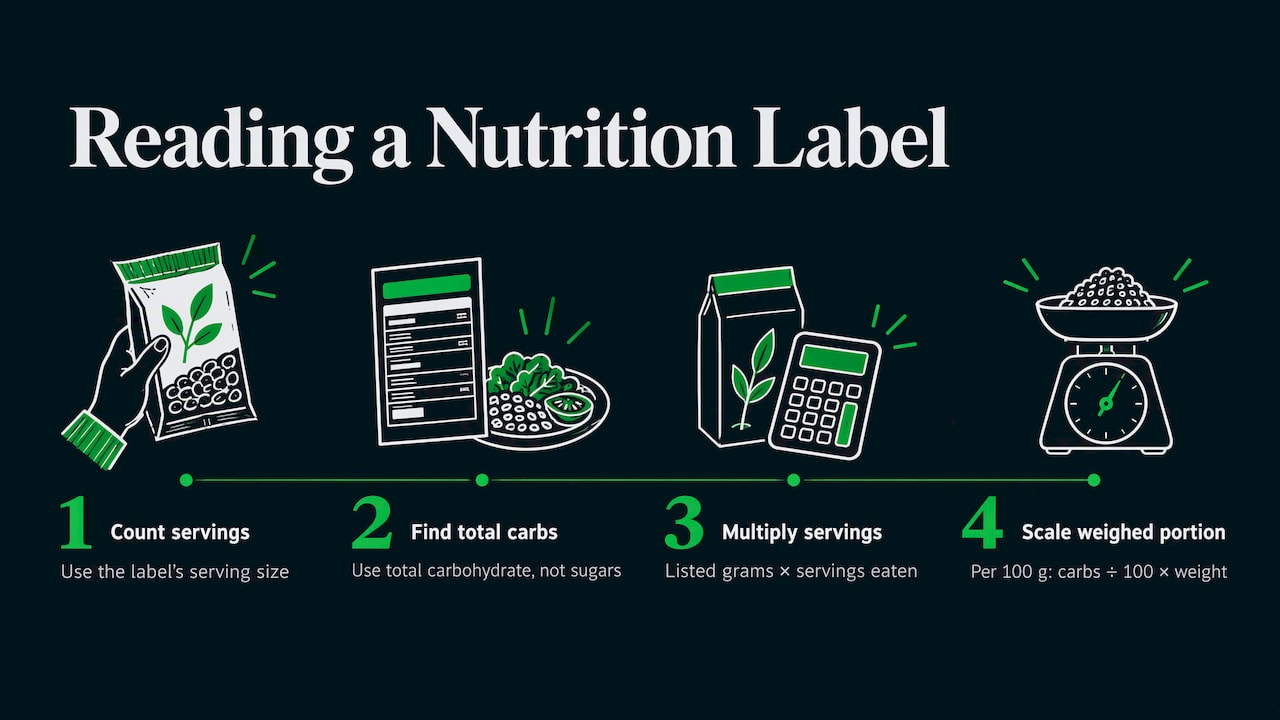
For packaged food, the label does most of the work. Three rules prevent most mistakes.
Use the serving size on the label. Every value on the panel refers to that serving. The ADA notes that eating two or three servings means doubling or tripling the listed grams. Healthline adds that a container can hold two or more servings, and that the labeled serving is often smaller than what people really eat.
Use the total carbohydrate line. It already includes sugar, starch and fiber, so you do not add the sugar line on top. The Dudley Group NHS Trust stresses using the total carbohydrate figure, not just the “of which sugars” line.
Scale to your portion. If the label gives carbs per 100 g and you weigh your portion, the formula is carbs per 100 g ÷ 100 × portion weight. Sheffield’s NHS guide gives an example: 77 g per 100 g of cereal and a 56 g portion comes to about 43 g of carbohydrate.
For foods labeled per piece, skip the weighing. The UHCW NHS guide shows that two slices of bread at 20.4 g each is 40.8 g, rounded to 41 g.
Johns Hopkins Medicine boils it down to three moves: work out how many servings you will eat, find the carbs per serving, and multiply.
Step 3: Handle food with no label
Most of the day’s trouble comes from food without a panel: a plate of pasta, a bowl of fruit, a restaurant dinner. This is where you need a portion estimate and a reliable nutrition database.
The CDC separates two ideas that people mix up. A portion is what you choose to eat. A serving is a defined amount, such as one slice of bread. The CDC also notes that one restaurant entrée can equal three to four servings. If you log “one serving of pasta” for a restaurant plate, you can be off by hundreds of calories and a large number of carb grams.
Hand-based estimates from the same CDC page can help when nothing else is available: a fist for a cup of fruit or grains, a cupped hand for 1 to 2 ounces of nuts, a palm for 3 ounces of meat.
This is the step VeriTrack was designed for. You take a photo of the plate, or type or say a description. On supported iPhones, LiDAR measures depth, which helps the app judge how much food is actually there. The nutrition values come from USDA data. The app then shows its assumptions, for example the portion it estimated and the food it matched, so you can see exactly how the carb figure was produced. If a guess is off, you correct it and the log updates.
For more on this routine, see our practical method for estimating meal calories.
Homemade recipes
For home cooking, calculate each ingredient’s carbs, add them up, then divide by the number of servings. Sheffield’s guide shows the pattern: 62 g of batter carbs divided by 6 servings, plus 12.7 g from honey, gives about 23 g per pancake. Write the per-serving figure next to the recipe so you only do the math once. Our guide to recipe macro tracking covers per-serving calculations in more detail.
Rice, pasta and other cooked foods
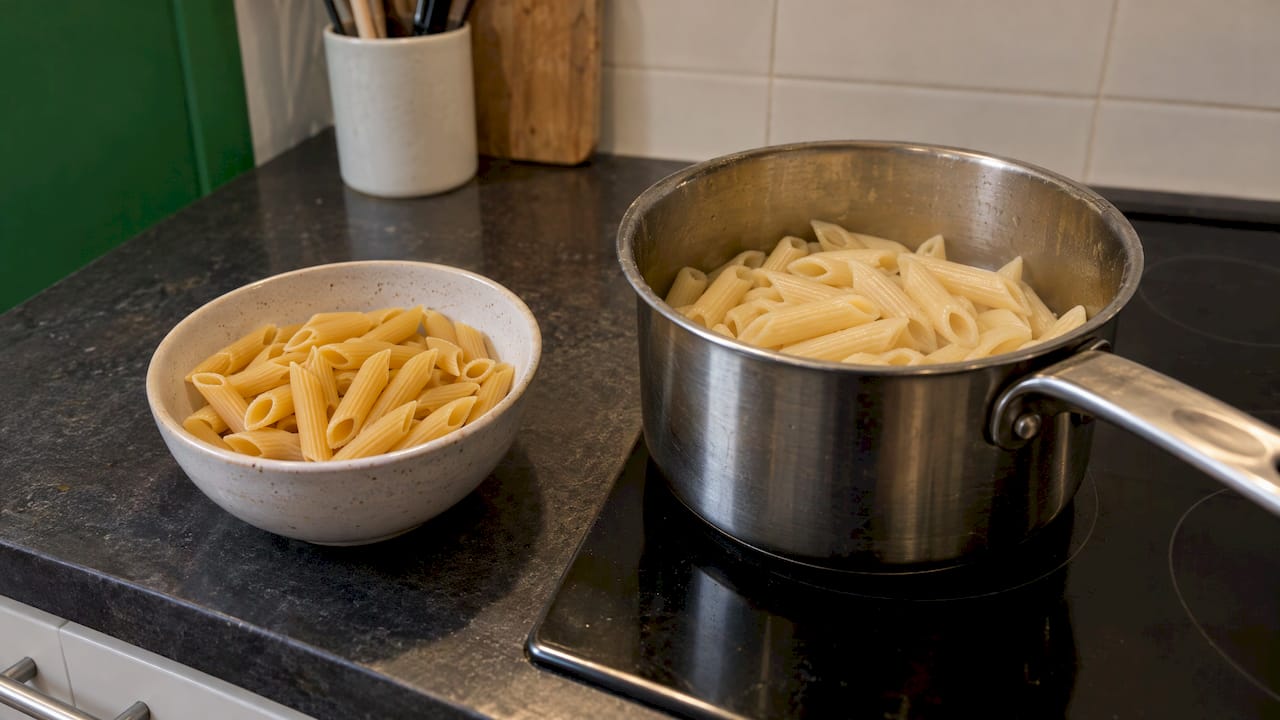
Check whether the label lists the dry or the cooked weight. The same Sheffield guide points out that for rice and pasta the label may give raw weight, and the carbs per gram differ a lot between raw and cooked. Logging a cooked portion with a dry-weight value is a common way to overshoot.
Step 4: Decide how to count fiber: total or net carbs
Total carbohydrate includes fiber. Some plans, especially low-carb and keto, count net carbs instead.
Alberta Health Services defines available carbohydrate as total carbohydrate minus fiber and sugar alcohols, because those do not cause a rapid rise in blood glucose. The ISPAD carb-counting book gives a label example: 37 g total minus 4 g fiber is 33 g net for a 55 g serving.
A practical rule: pick one method and use it every day. If your plan, or your care team, specifies net carbs, log net. If you do not have a specific instruction, total carbohydrate is the simplest number to read off a label and compare with the FDA’s Daily Value. Switching between the two from day to day makes your trend lines meaningless.
| Method | Formula | Good for |
|---|---|---|
| Total carbs | The “Total Carbohydrate” line | Everyday tracking, comparing with label %DV |
| Net carbs | Total carbohydrate minus fiber | Low-carb and keto plans |
| Available carbs | Total carbohydrate minus fiber and sugar alcohols | Diabetes guidance that uses this term |
Step 5: Log as you eat, not at night
Memory is the weak link in any food log. A splash of oil, a handful of nuts and a second helping all disappear from memory by evening. Logging right after the meal fixes this, and it takes seconds if the method is quick.
A routine that works for busy days:
- Snap or say it. Photograph the plate before you eat, or dictate a short description.
- Glance at the estimate. Check the food it identified and the portion it assumed.
- Correct what is off. Change the portion or swap the food. One tap beats guessing later.
- Move on. Do not chase perfect numbers. Aim for a log that is close enough to be useful and complete enough to trust.
VeriTrack also sends gentle reminders so that skipped meals do not become gaps in your diary, and it keeps a daily meal diary you can scroll back through. It reads from Apple Health on a read-only basis. Our broader guide on tracking daily nutrition shows how carbs fit alongside everything else you log.
Do not forget the small stuff
Sauces, dressings, cooking oil, sweetened drinks and snacks eaten standing up are the entries that quietly go missing. Our article on hidden calories lists where they hide.
Step 6: Review the log against your target
A log only helps if you read it. Once a week, look at three things.
- Daily average versus target. One high day does not matter. The average does.
- Which meals carry the carbs. Often one meal, such as a big lunch or an evening snack, makes up the difference.
- Which entries were estimates. Entries with large assumed portions are the ones to check first next time.
If your average sits well above your target, change one meal, not the whole day. A smaller portion of the carb-heavy item at your biggest meal is easier to keep up than a total overhaul. Our guide to portion control for weight loss goes deeper on this.
If you manage diabetes, add glucose to the picture. The ADA suggests tracking food and blood sugar before meals and about 2 to 3 hours after for a few days, so you and your care team can see how particular meals affect your glucose and set the right carb amount. Bring your food log to that appointment.
Protein often needs its own target alongside carbs. See protein intake tracking for how to set one.
How accurate does it need to be?
The NHS UHCW guide ranks carb-counting methods from least to most accurate: looking and guessing, then picture estimation, then weighing portions and using labels. Its point is that guessing by eye is the weakest because our perception of portion size is subjective.
That is why visible assumptions matter. A single number with no explanation is hard to trust or fix. A number that says “estimated 1.5 cups of cooked rice” is easy to correct, and each correction makes the day’s total more reliable. When you eat out and have no label, the same guide suggests logging your estimates so you can refine them over time. Keeping them in a diary does exactly that.
Perspective
Most people who give up on carb tracking do not give up because the math is hard. They give up because the number they log feels like a guess, and a guess that nobody can inspect is easy to stop believing.
That is the reason we built VeriTrack to show its work. When you photograph a meal, we estimate the portion, use LiDAR depth measurement on supported iPhones to make that estimate better, look up the nutrition in USDA data, and list the assumptions we made. You can see them and correct them.
We think a log you can check is a log you keep. You do not need to be perfect. You need entries you understand, a target that fits your body and activity, and a routine fast enough to survive a busy week.
Aliaksei
Try it on your next meal
If you want a faster way to log carbs on iPhone, VeriTrack lets you photograph, type or speak your meal and see the carb estimate with its assumptions. The free tier includes a limited number of AI meal analyses each month, and VeriTrack Premium adds unlimited analyses and the full feature set. For a walkthrough of the basics, read our guide to tracking calories on iPhone.
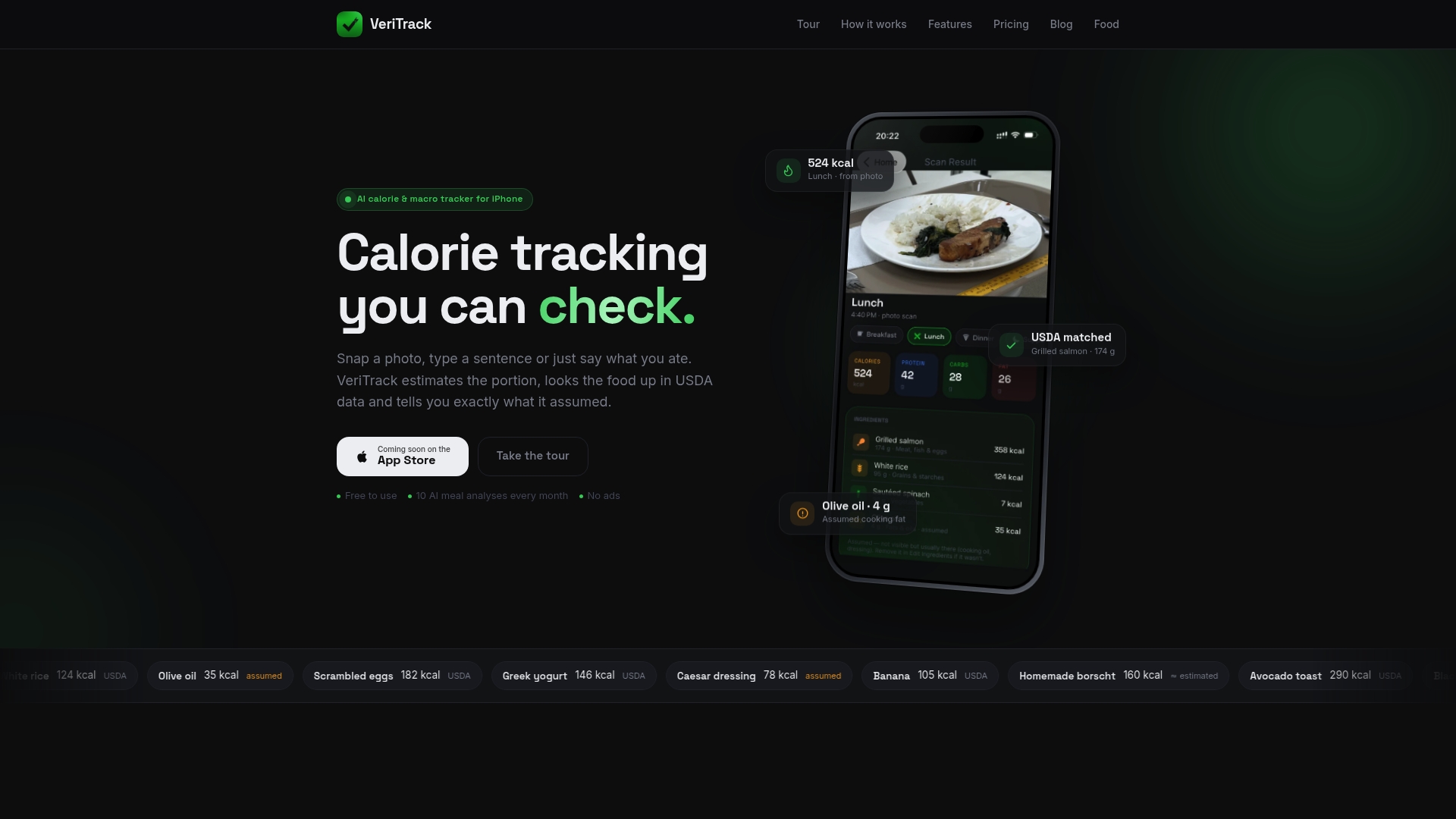
You can also browse foods and recipes on the VeriTrack food page.
FAQ
How do I track my carbs each day?
Set a daily gram target, then log every meal and snack with its total carbohydrate in grams. Use the label’s serving size for packaged food and a portion estimate for everything else. At the end of the day, add the meals up and compare the total with your target.
Should I track total carbs or net carbs?
Total carbohydrate is the number on the label and the easiest to compare with the FDA’s 275 g Daily Value. Net carbs subtract fiber, and some low-carb plans and diabetes guidelines use them. Choose the one your plan calls for and keep it the same every day.
How do I count carbs in restaurant meals?
Portions are usually larger than a single serving, and the CDC notes that one entrée can equal three to four servings. Estimate the portion size, then match the food to a nutrition database. With VeriTrack you photograph the plate, review the assumptions it shows, and correct anything that looks off.
Do I need to weigh my food?
Weighing gives the most precise figure for packaged and homemade food, and you can use the carbs per 100 g formula. For everyday tracking, a photo-based estimate with visible assumptions is faster and keeps you logging consistently. If you have diabetes, follow the method your care team gave you.
Sources
- How to Count Carbs for Diabetes, American Diabetes Association
- Diabetes Meal Planning, CDC
- Daily Value on the Nutrition and Supplement Facts Labels, FDA
- Carbs Count When Managing Diabetes, Johns Hopkins Medicine
- Paediatric Diabetes: step-by-step guide to carb-counting, UHCW NHS
- Type 1 Diabetes and Carbohydrate Counting, Dudley Group NHS Trust
- A guide to carbohydrate counting, Sheffield NHS
- Adult Diabetes Nutrition Guidelines, Alberta Health Services
- Healthy eating and carbohydrate counting, ISPAD
- The Best Macronutrient Ratio for Weight Loss, Healthline
- Counting Carbs, Healthline